PUBLISHER: Mordor Intelligence | PRODUCT CODE: 2122863

PUBLISHER: Mordor Intelligence | PRODUCT CODE: 2122863
Middle East And Africa Flavor And Fragrance - Market Share Analysis, Industry Trends & Statistics, Growth Forecasts (2026 - 2031)
According to Mordor Intelligence, the Middle East and Africa flavor and fragrance market size is expected to grow from USD 2.20 billion in 2025 to USD 2.34 billion in 2026 and is forecast to reach USD 3.15 billion by 2031 at 6.16% CAGR over 2026-2031.
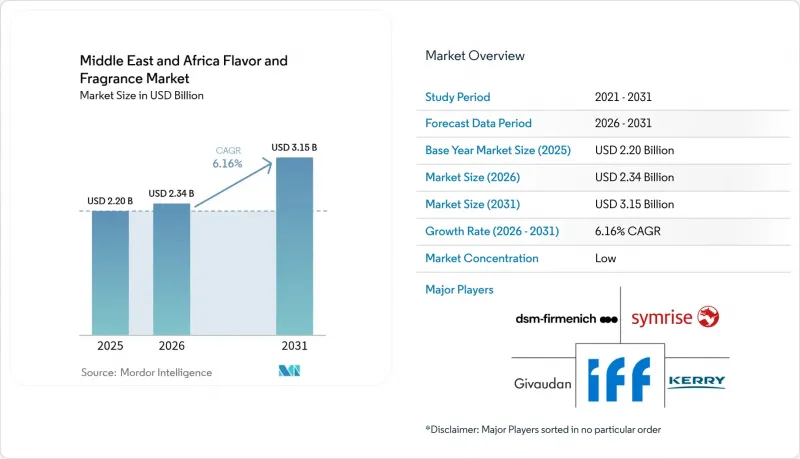
This report is Segmented by Type (Synthetic, Natural, and Nature-Identical), Form (Powder, Liquid, and Micro-Encapsulated), Application (Food and Beverages, Beauty and Personal Care, Pharmaceuticals, and Other Applications), and Geography (Saudi Arabia, South Africa, and Rest of Middle East and Africa). The Market Forecasts are Provided in Terms of Value (USD).
Middle East And Africa Flavor And Fragrance Market Trends and Insights
Rising demand for natural and clean-label ingredients
In the Middle East and Africa markets, growing consumer awareness about synthetic additives has intensified regulatory scrutiny. A study conducted in the UAE found that 61% of residents consider all food additives to be harmful, while only 26.7% possess a clear understanding of these additives. This knowledge gap presents an opportunity for natural ingredient suppliers to educate consumers and secure premium pricing. Companies are addressing this through biotechnology partnerships. For instance, DSM-Firmenich has collaborated with Interstellar Lab to improve botanical ingredient production. Their AI-powered biofarming platforms are designed to optimize resource utilization and stimulate the production of specific molecules. This movement is further supported by regulatory changes, such as South Africa's upcoming 2025 food additive regulations. These regulations prioritize Good Manufacturing Practices, limit the use of additives to essential levels, and prohibit certain substances in infant foods. Additionally, Symrise is leading a supply chain sustainability initiative focused on regenerative agriculture. This program aims to enhance biodiversity, increase carbon sequestration, and ensure a reliable supply of raw materials. At the same time, GSO standards and national authorities like the SFDA are enforcing the need for substantiated natural claims. While this creates entry barriers, it also rewards authentic innovation.
Growth of functional foods, beverages, and wellness products
The African energy drinks market is experiencing rapid growth, making it the fastest-growing segment in the soft drink industry. Innovation remains a key driver, with trends focusing on reformulated products featuring low-sugar content, reduced caffeine, and added nutrients such as B vitamins, amino acids, and minerals. Notably, 69% of consumers are willing to pay a premium for these functional benefits. Localization strategies are also critical, incorporating African botanicals like umhlonyane (African wormwood) and region-specific flavor adaptations, providing opportunities for flavor houses to create culturally relevant formulations. Regulatory frameworks for functional claims vary across MEA markets, with entities like Dubai Municipality and SFDA implementing specific guidelines for health supplement registration and nutritional labeling. The integration of traditional wellness practices with modern functional food science positions the Middle East and Africa region as a key growth area for flavor innovation, particularly in immunity, digestive health, and protein enhancement applications.
Stringent regulations on the use of additives
Food Compliance International reports that the Saudi Food and Drug Authority will implement comprehensive regulations between November 2024 and July 2025 . These regulations require food establishments to disclose calorie counts, allergen information, caffeine content, and identify high-sodium meals. These efforts align with Saudi Vision 2030's objectives to reduce sugar, salt, and unhealthy fats, driving reformulation strategies that impact flavor and fragrance applications. In South Africa, food additive regulations effective in 2025 will enforce strict purity standards, Good Manufacturing Practices, and limit additives to essential levels while banning certain substances in infant foods, as noted by GPC. These regulatory changes increase compliance costs and extend product development timelines. For example, in Ghana, 37% of processed foods were found unregistered with authorities, and 71% contained potentially hazardous additives. Companies must address varying national implementations of GSO standards, such as the UAE's requirement for Dubai Municipality registration, Saudi Arabia's SFDA compliance enforcement, and distinct approval processes in other GCC markets. Additionally, GSO standards regulate packaging materials to prevent harmful constituent migration or changes to organoleptic properties, significantly affecting flavor and fragrance delivery systems, as outlined by the Packaging Law.
Other drivers and restraints analyzed in the detailed report include:
- Increasing popularity of personalized and customized flavor/fragrance solutions
- Expansion of processed food and beverage industry
- Volatility in raw material prices
For complete list of drivers and restraints, kindly check the Table Of Contents.
Segment Analysis
Natural ingredients commanded 42.83% share of the Middle East and Africa flavor and fragrance market in 2025, and the segment is forecast to grow at 6.78% CAGR through 2031. This leadership reflects premium positioning and rapid biotech cost reductions that narrow price gaps versus synthetics. Synthetic molecules still anchor cost-sensitive products, especially those needing precise isoforms not yet feasible via bio-routes. Nature-identical inputs bridge the divide by replicating exotic notes without biodiversity strain. Lallemand's entry into yeast-based aroma production highlights fermentation's role in delivering volume at scale. Manus Bio and Givaudan's cell-factory deal further enhances sustainable production avenues. Halal certification frameworks across GCC markets reward natural sourcing, driving brand portfolios toward botanically verified claims.
Industry innovators apply precision fermentation to unlock minor terpenes once limited by low plant yields, improving cost efficiency without deforestation. Regulatory agencies acknowledge biotech-derived naturals as non-GMO under specific process definitions, smoothing import approvals. Price premiums are expected to persist, given consumer willingness to pay more for "real" botanical stories that carry social-impact assurances. For suppliers, transparency tools such as blockchain traceability become critical for substantiating origin, potency, and ethical handling, all of which reinforce the dominance of natural profiles in the Middle East and Africa flavor and fragrance market.
Complete Report Scope:
- Type
- Synthetic
- Natural
- Nature-Identical
- Form
- Powder
- Liquid
- Micro-Encapsulated
- Application
- Food and Beverages
- Dairy products
- Bakery and Confectionery
- Snacks and Savory Products
- Meat and Meat Alternatives
- Beverages
- Other Types
- Beauty and Personal Care
- Pharmaceuticals
- Other Applications
- Food and Beverages
- Geography
- Saudi Arabia
- South Africa
- Rest of Middle East and Africa
List of Companies Covered in this Report:
- DSM-Firmenich
- Givaudan SA
- International Flavors & Fragrances Inc.
- Symrise AG
- Kerry Group PLC
- Sensient Technologies Corp.
- MANE SA
- Takasago International Corp.
- Robertet Group
- Bell Flavors & Fragrances
- T. Hasegawa Co. Ltd.
- Archer Daniels Midland Co.
- Cargill Inc.
- Huabao International
- BASF SE (Aroma Ingredients)
- S H Kelkar & Co.
- Frutarom (IFF Savory Solutions)
- Alpha Aromatics
- Al-Rehab Perfumes
- Gulf Flavours & Food Ingredients
Additional Benefits:
- The market estimate (ME) sheet in Excel format
- 3 months of analyst support
TABLE OF CONTENTS
1 INTRODUCTION
- 1.1 Study Assumptions and Market Definition
- 1.2 Scope of the Study
2 RESEARCH METHODOLOGY
3 EXECUTIVE SUMMARY
4 MARKET LANDSCAPE
- 4.1 Market Overview
- 4.2 Market Drivers
- 4.2.1 Rising demand for natural and clean-label ingredients
- 4.2.2 Growth of functional foods, beverages, and wellness products
- 4.2.3 Increasing popularity of personalized and customized flavor/fragrance solutions
- 4.2.4 Expansion of processed food and beverage industry
- 4.2.5 Increasing use of fragrances in various cosmetics and personal care products
- 4.2.6 Growing interest in vegan and cruelty-free ingredients
- 4.3 Market Restraints
- 4.3.1 Stringent regulations on the use of additives
- 4.3.2 Volatility in raw material prices
- 4.3.3 Challenges in scaling up new sustainable or biotechnology-derived ingredients
- 4.3.4 Rising health concerns over the use of artificial flavoring
- 4.4 Supply Chain Analysis
- 4.5 Regulatory Outlook
- 4.6 Porter's Five Forces
- 4.6.1 Threat of New Entrants
- 4.6.2 Bargaining Power of Buyers/Consumers
- 4.6.3 Bargaining Power of Suppliers
- 4.6.4 Threat of Substitute Products
- 4.6.5 Intensity of Competitive Rivalry
5 MARKET SIZE AND GROWTH FORECAST (VALUE)
- 5.1 Type
- 5.1.1 Synthetic
- 5.1.2 Natural
- 5.1.3 Nature-Identical
- 5.2 Form
- 5.2.1 Powder
- 5.2.2 Liquid
- 5.2.3 Micro-Encapsulated
- 5.3 Application
- 5.3.1 Food and Beverages
- 5.3.1.1 Dairy products
- 5.3.1.2 Bakery and Confectionery
- 5.3.1.3 Snacks and Savory Products
- 5.3.1.4 Meat and Meat Alternatives
- 5.3.1.5 Beverages
- 5.3.1.6 Other Types
- 5.3.2 Beauty and Personal Care
- 5.3.3 Pharmaceuticals
- 5.3.4 Other Applications
- 5.3.1 Food and Beverages
- 5.4 Geography
- 5.4.1 Saudi Arabia
- 5.4.2 South Africa
- 5.4.3 Rest of Middle East and Africa
6 COMPETITIVE LANDSCAPE
- 6.1 Market Concentration
- 6.2 Strategic Moves
- 6.3 Market Ranking Analysis
- 6.4 Company Profiles (includes Global-level Overview, Market-level Overview, Core Segments, Financials (if available), Strategic Information, Market Rank/Share, Products and Services, Recent Developments)
- 6.4.1 DSM-Firmenich
- 6.4.2 Givaudan SA
- 6.4.3 International Flavors & Fragrances Inc.
- 6.4.4 Symrise AG
- 6.4.5 Kerry Group PLC
- 6.4.6 Sensient Technologies Corp.
- 6.4.7 MANE SA
- 6.4.8 Takasago International Corp.
- 6.4.9 Robertet Group
- 6.4.10 Bell Flavors & Fragrances
- 6.4.11 T. Hasegawa Co. Ltd.
- 6.4.12 Archer Daniels Midland Co.
- 6.4.13 Cargill Inc.
- 6.4.14 Huabao International
- 6.4.15 BASF SE (Aroma Ingredients)
- 6.4.16 S H Kelkar & Co.
- 6.4.17 Frutarom (IFF Savory Solutions)
- 6.4.18 Alpha Aromatics
- 6.4.19 Al-Rehab Perfumes
- 6.4.20 Gulf Flavours & Food Ingredients
7 MARKET OPPORTUNITIES AND FUTURE OUTLOOK

