PUBLISHER: Mordor Intelligence | PRODUCT CODE: 2114302

PUBLISHER: Mordor Intelligence | PRODUCT CODE: 2114302
Europe Flavors And Fragrances - Market Share Analysis, Industry Trends & Statistics, Growth Forecasts (2026 - 2031)
According to Mordor Intelligence, Europe flavors and fragrances market size in 2026 is estimated at USD 11.58 billion, growing from 2025 value of USD 11.09 billion with 2031 projections showing USD 14.4 billion, growing at 4.46% CAGR over 2026-2031.
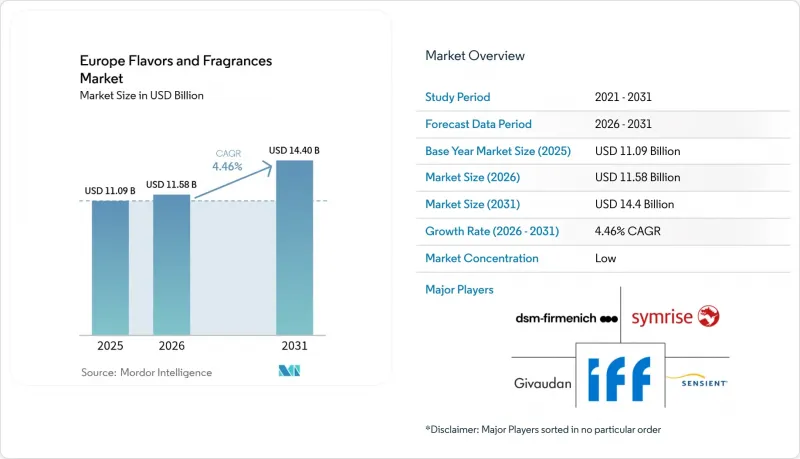
This report is Segmented by Type (Synthetic, Natural, Nature-Identical), Form (Powder, Liquid, Micro-Encapsulated), Application (Food and Beverages, Personal Care and Cosmetics, Other Applications), and Geography (United Kingdom, Germany, France, Spain, Italy, Netherlands, Belgium, Russia, Rest of Europe). The Market Forecasts are Provided in Terms of Value (USD).
Europe Flavors And Fragrances Market Trends and Insights
Rising demand for natural and clean-label ingredients
In Germany, 69% of organic food sales now occur through conventional retail outlets, highlighting a significant consumer shift toward transparency and naturalness and signaling the mainstream adoption of natural products. This trend extends beyond the food market. For example, Symrise AG launched the Mindera(R) platform, featuring 100% plant-based product protection technology designed for cosmetic formulations. Regulatory developments further support this transition. The EFSA recently approved naringenin as a food flavoring, citing no genotoxicity concerns, in stark contrast to its ban on artificial smoke flavorings. Companies investing in biotechnology-derived natural ingredients are aligning with evolving regulatory standards that increasingly favor naturally-sourced alternatives while positioning themselves to capture premium pricing.
Growth of functional foods, beverages, and wellness products
European beverage manufacturers are heeding the Union of European Beverage Associations' pledge to cut added sugars by 10% between 2019 and 2025. This commitment has spurred a demand for advanced flavor systems that not only preserve taste but also align with health-centric branding. A notable advancement in this realm is the rise of protein-based sweeteners. For instance, the X3 sweetener from the Fraunhofer Institute boasts a sweetness level 10,000 times that of table sugar, all while delivering flavor profiles reminiscent of honey. This blend of heightened health awareness and cutting-edge technology paves the way for flavor houses to craft multifunctional ingredients, ensuring both taste satisfaction and wellness advantages. Furthermore, the growing inclination towards botanicals and herbal extracts in functional applications underscores a consumer preference for naturally health-associated ingredients over synthetic ones.
Stringent European regulations on the use of additives
The European Union's ban on artificial smoke flavorings impacts approximately USD 34.91 billion in sales. Manufacturers have only two years to reformulate products containing these additives, while traditional smoking replacements are allowed a five-year phase-out period. EFSA's identification of genotoxicity in eight primary smoke flavoring products underscores the EU's increasingly stringent safety assessments, creating uncertainty for companies developing new synthetic ingredients, as highlighted by the European Commission. The new EU Regulation 2023/1545 expands fragrance allergen labeling requirements to 56 ingredients, with compliance deadlines set for July 2026 for existing products and July 2028 for new formulations. These regulatory pressures provide a competitive edge to companies with strong natural ingredient portfolios while imposing significant reformulation costs on those dependent on synthetic alternatives. The regulatory environment's shift toward precautionary principles indicates a continued tightening of approval processes, favoring established natural ingredients over novel synthetic compounds.
Other drivers and restraints analyzed in the detailed report include:
- Increasing popularity of personalized and customized flavor/fragrance solutions
- Expansion of processed food & beverage industry
- Volatility in raw material prices
For complete list of drivers and restraints, kindly check the Table Of Contents.
Segment Analysis
In 2025, natural ingredients hold a 42.78% market share and are expected to grow at a 5.88% CAGR through 2031. This growth reflects consumers' willingness to pay a premium for clean-label products, supported by regulatory encouragement for sustainable options. Advances in biotechnology further drive this segment. For example, Newcastle University has developed highly efficient biocatalysts for solvent-free flavor ester production, showcasing the potential for sustainable manufacturing. On the other hand, synthetic ingredients face stricter regulatory oversight. The European Food Safety Authority (EFSA), as noted by Food Compliance International, has removed several flavoring substances from the Union list, including 2-Phenylpent-2-enal and certain thiazoline compounds. Nature-identical ingredients offer a middle ground, delivering cost advantages over natural alternatives while avoiding the regulatory challenges linked to synthetic compounds.
Biotechnology-derived ingredients face uncertainty due to the EU's evolving definition of natural flavors. The Standing Committee on Plants, Animals, Food, and Feed is evaluating whether flavors produced by genetically modified microorganisms should qualify as 'natural.' This regulatory ambiguity influences investment decisions and market strategies, particularly for companies focusing on fermentation-based natural alternatives. The shift toward natural ingredients is accelerating, as demonstrated by major players like Symrise, which has achieved 95% sustainable sourcing of raw materials, proving the scalability and commercial viability of natural ingredient strategies.
Complete Report Scope:
- Type
- Synthetic
- Natural
- Nature-Identical
- Form
- Powder
- Liquid
- Micro-Encapsulated
- Application
- Food and Beverages
- Dairy products
- Bakery and Confectionery
- Snacks and Savory Products
- Meat Products
- Beverages
- Other Types
- Personal Care and Cosmetics
- Other Applications (Home Care, Fine Fragrances)
- Food and Beverages
- Geography
- United Kingdom
- Germany
- France
- Spain
- Italy
- Netherlands
- Belgium
- Russia
- Rest of Europe
List of Companies Covered in this Report:
- Givaudan SA
- DSM-Firmenich
- International Flavors & Fragrances Inc. (IFF)
- Symrise AG
- Sensient Technologies Corporation
- Takasago International Corporation
- Mane SA
- Robertet Group
- Bell Flavors & Fragrances
- Ungerer & Company
- European Flavours & Fragrances PLC
- Nactarome SPA
- Kerry Group PLC
- Corbion N.V.
- BASF SE
- Treatt PLC
- De Monchy Aromatics
- T Hasegawa Co., Ltd.
- Huabao International Holdings
- Biolandes SAS
Additional Benefits:
- The market estimate (ME) sheet in Excel format
- 3 months of analyst support
TABLE OF CONTENTS
1 INTRODUCTION
- 1.1 Study Assumptions & Market Definition
- 1.2 Scope of the Study
2 RESEARCH METHODOLOGY
3 EXECUTIVE SUMMARY
4 MARKET LANDSCAPE
- 4.1 Market Overview
- 4.2 Market Drivers
- 4.2.1 Rising demand for natural and clean-label ingredients
- 4.2.2 Growth of functional foods, beverages, and wellness products
- 4.2.3 Increasing popularity of personalized and customized flavor/fragrance solutions
- 4.2.4 Expansion of processed food & beverage industry
- 4.2.5 Increasing Use of Fragrances in various cosmetics and personal care products
- 4.2.6 Growing interest in vegan and cruelty-free ingredients
- 4.3 Market Restraints
- 4.3.1 Stringent European regulations on the use of additives
- 4.3.2 Volatility in raw material prices
- 4.3.3 Challenges in scaling up new sustainable or biotechnology-derived ingredients
- 4.3.4 Rising Health Concerns over the use of Artificial Flavoring
- 4.4 Supply Chain Analysis
- 4.5 Regulatory Outlook
- 4.6 Porter's Five Forces
- 4.6.1 Threat of New Entrants
- 4.6.2 Bargaining Power of Buyers/Consumers
- 4.6.3 Bargaining Power of Suppliers
- 4.6.4 Threat of Substitute Products
- 4.6.5 Intensity of Competitive Rivalry
5 MARKET SIZE AND GROWTH FORECAST
- 5.1 Type
- 5.1.1 Synthetic
- 5.1.2 Natural
- 5.1.3 Nature-Identical
- 5.2 Form
- 5.2.1 Powder
- 5.2.2 Liquid
- 5.2.3 Micro-Encapsulated
- 5.3 Application
- 5.3.1 Food and Beverages
- 5.3.1.1 Dairy products
- 5.3.1.2 Bakery and Confectionery
- 5.3.1.3 Snacks and Savory Products
- 5.3.1.4 Meat Products
- 5.3.1.5 Beverages
- 5.3.1.6 Other Types
- 5.3.2 Personal Care and Cosmetics
- 5.3.3 Other Applications (Home Care, Fine Fragrances)
- 5.3.1 Food and Beverages
- 5.4 Geography
- 5.4.1 United Kingdom
- 5.4.2 Germany
- 5.4.3 France
- 5.4.4 Spain
- 5.4.5 Italy
- 5.4.6 Netherlands
- 5.4.7 Belgium
- 5.4.8 Russia
- 5.4.9 Rest of Europe
6 COMPETITIVE LANDSCAPE
- 6.1 Market Concentration
- 6.2 Strategic Moves
- 6.3 Market Ranking Analysis
- 6.4 Company Profiles (includes Global-level Overview, Market-level Overview, Core Segments, Financials (if available), Strategic Information, Market Rank/Share, Products & Services, Recent Developments)
- 6.4.1 Givaudan SA
- 6.4.2 DSM-Firmenich
- 6.4.3 International Flavors & Fragrances Inc. (IFF)
- 6.4.4 Symrise AG
- 6.4.5 Sensient Technologies Corporation
- 6.4.6 Takasago International Corporation
- 6.4.7 Mane SA
- 6.4.8 Robertet Group
- 6.4.9 Bell Flavors & Fragrances
- 6.4.10 Ungerer & Company
- 6.4.11 European Flavours & Fragrances PLC
- 6.4.12 Nactarome SPA
- 6.4.13 Kerry Group PLC
- 6.4.14 Corbion N.V.
- 6.4.15 BASF SE
- 6.4.16 Treatt PLC
- 6.4.17 De Monchy Aromatics
- 6.4.18 T Hasegawa Co., Ltd.
- 6.4.19 Huabao International Holdings
- 6.4.20 Biolandes SAS
7 MARKET OPPORTUNITIES AND FUTURE OUTLOOK

