PUBLISHER: Mordor Intelligence | PRODUCT CODE: 2114303

PUBLISHER: Mordor Intelligence | PRODUCT CODE: 2114303
Asia-Pacific Flavor And Fragrance - Market Share Analysis, Industry Trends & Statistics, Growth Forecasts (2026 - 2031)
Flavors dominate the market with a substantial 57.35% share in 2025, demonstrating their fundamental role in shaping food and beverage applications. The segment's robust growth trajectory, marked by a CAGR of 6.74% through 2031, underscores the increasing demand for innovative flavor solutions across diverse consumer segments.
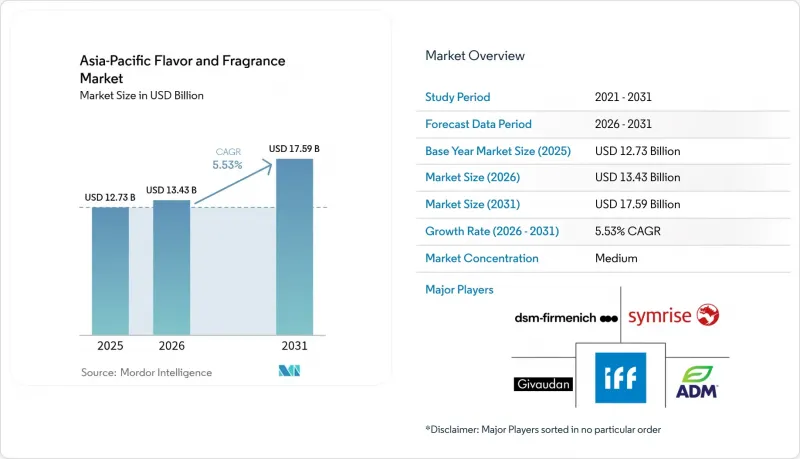
According to Mordor Intelligence, the Asia-Pacific flavors and fragrances market size demonstrated robust performance by reaching USD 12.73 billion in 2025. This report is Segmented by Product Type (Flavors, and Fragrance), Source (Natural, Synthetic, and Nature Identical), Form (Powder, Liquid, and Others), Application (Dairy, Bakery, Confectionary, and More), and Geography (China, India, Japan, Australia, and More). The Market Forecasts are Provided in Terms of Value and Volume (USD and Tonnes).
Asia-Pacific Flavor And Fragrance Market Trends and Insights
Expansion of Processed and Convenience Foods Industry
The demand for packaged meals with extended shelf life that replicate home-cooked flavors continues to grow among urban households, driven by their need for convenience and time-saving solutions. Southeast Asian consumers demonstrate strong daily consumption patterns for cookies, with a significant portion expressing willingness to pay premium prices for innovative flavor experiences. The expansion of digital grocery platforms and on-demand delivery services enhances product accessibility across markets, while the increasing participation of women in the workforce generates consistent market demand. Major food companies in China, Indonesia, and India are establishing strategic partnerships with specialized flavor houses to accelerate product reformulation processes that cater to local taste preferences. This substantial increase in order volume allows contract manufacturers to optimize their investments in spray-drying and liquid blending equipment, fostering economies of scale that promote broader flavor application across processed food categories.
Growing Preference for Functional Flavors with Health Benefits
Growing consumer awareness of the relationship between diet and wellness has driven significant demand for beverages containing botanicals, amino acids, and probiotic cultures that provide immunity and energy benefits. The global functional beverage market continues to experience substantial growth, with the Asia-Pacific region emerging as the primary growth driver. Japan's Foods with Health Claims regulatory framework serves as a comprehensive model for transparent efficacy labeling, influencing regulations across the region and establishing a standardized approval process. Manufacturers are incorporating umami compounds to improve satiety and mouthfeel while reducing sodium content, supporting weight management and low-sugar product lines. The premium positioning of these beverages enables higher pricing to offset the increased costs of bioactive ingredient extraction and stabilization, fostering a continuous cycle of margin growth and research investment.
Stringent Regulatory Frameworks and Approval Processes
The diverse and intricate regulatory framework across Asia-Pacific jurisdictions poses substantial compliance challenges for businesses aiming to enter these markets or innovate their products. China's implementation of GB 2760-2024, taking effect in February 2025, introduces more stringent regulations on food additive definitions and usage limitations, compelling manufacturers to undertake comprehensive product reformulations . Similarly, Japan's regulatory decision to prohibit the use of 3,6-dimethyl-5,6,7,7a-tetrahydro-2(4H)-benzofuranone from January 2025 illustrates the dynamic nature of safety assessment protocols, requiring businesses to maintain vigilant monitoring systems . The fragmented nature of regulations across these markets necessitates companies to develop and maintain distinct product development approaches for each jurisdiction. This regulatory complexity significantly increases development costs and extends time-to-market periods, creating particular challenges for smaller enterprises that often lack specialized regulatory expertise and financial resources.
Other drivers and restraints analyzed in the detailed report include:
- Innovations in Flavor and Fragrance Formulations Using Biotechnology
- Rising Interest in Traditional and Regional Flavors
- Limited Shelf Life and Storage Challenges for Natural Flavor and Fragrance Products
For complete list of drivers and restraints, kindly check the Table Of Contents.
Segment Analysis
The industry's evolution has led to a significant shift toward multi-sensory experiences, where taste and aroma elements merge to create unique product offerings that bridge traditional category boundaries.
This transformation is exemplified by strategic initiatives such as Givaudan's establishment of L'Appartement 125, a Fine Fragrance Creative Centre in Shanghai, in October 2024. The facility serves as a collaborative hub for partnerships with local brands, enabling the integration of cultural nuances into fragrance development. Through these strategic investments, flavor and fragrance companies are well-positioned to capitalize on opportunities across multiple segments while addressing the sophisticated consumer preferences for products that deliver comprehensive sensory experiences.
Synthetic sources dominate the market with a 69.45% share in 2025, primarily due to their significant cost advantages and highly reliable supply chains. These characteristics make synthetic sources particularly attractive for large-scale food and beverage manufacturers who require consistent, high-volume ingredient supplies for their production processes.
Natural sources are experiencing rapid growth at a 6.62% CAGR through 2031, as consumers increasingly seek clean-label products and regulatory bodies implement supportive frameworks for natural ingredients. This market evolution demonstrates a clear shift toward premium positioning, where natural ingredients command higher prices despite their increased production costs and supply chain complexities. Nature-identical compounds serve as an intermediate solution in this landscape, offering manufacturers a practical way to balance evolving consumer preferences with operational efficiency requirements.
Complete Report Scope:
- By Product Type
- Flavors
- Fragrance
- By Source
- Natural
- Synthetic
- Nature Identical
- By Form
- Powder
- Liquid
- Others
- By Application
- Dairy
- Bakery
- Confectionary
- Savory Snacks
- Meat
- Beverage
- Others
- By Geography
- China
- India
- Japan
- Australia
- Indonesia
- South Korea
- Thailand
- Singapore
- Rest of Asia-Pacific
List of Companies Covered in this Report:
- Givaudan S.A.
- DSM-Firmenich
- International Flavors & Fragrances Inc.
- Symrise AG
- Archer Daniels Midland Co.
- Sensient Technologies Corp.
- MANE Group
- Takasago International Corp.
- T. Hasegawa Co., Ltd.
- Robertet SA
- Huabao International Holdings
- Zhejiang NHU Co., Ltd.
- Shanghai Apple Flavor & Fragrance Co.
- Guangzhou Baihua Flavour & Fragrance Co.
- Kerry Group plc
- SH Kelkar & Company Ltd.
- Synergy Flavours APAC
- Kanbo International Group
- PT Indesso Aroma
- Atul Ltd.
Additional Benefits:
- The market estimate (ME) sheet in Excel format
- 3 months of analyst support
TABLE OF CONTENTS
1 INTRODUCTION
- 1.1 Study Assumptions and Market Definition
- 1.2 Scope of the Study
2 RESEARCH METHODOLOGY
3 EXECUTIVE SUMMARY
4 MARKET LANDSCAPE
- 4.1 Market Overview
- 4.2 Market Drivers
- 4.2.1 Expansion of processed and convenience foods industry
- 4.2.2 Growing preference for functional flavors with health benefits
- 4.2.3 Innovations in flavor and fragrance formulations using biotechnology
- 4.2.4 Rising interest in traditional and regional flavors
- 4.2.5 Demand for sustainable and eco-friendly flavors and fragrances
- 4.2.6 Development of multi-sensory flavors and fragrances combining taste and aroma
- 4.3 Market Restraints
- 4.3.1 Stringent regulatory frameworks and approval processes
- 4.3.2 Limited shelf life and storage challenges for natural flavor and fragrance products
- 4.3.3 Variability in quality and potency of natural raw ingredients
- 4.3.4 Fluctuations in global commodity prices impacting ingredient costs
- 4.4 Supply Chain Analysis
- 4.5 Regulatory Outlook
- 4.6 Porter's Five Forces
- 4.6.1 Threat of New Entrants
- 4.6.2 Bargaining Power of Buyers/Consumers
- 4.6.3 Bargaining Power of Suppliers
- 4.6.4 Threat of Substitute Products
- 4.6.5 Intensity of Competitive Rivalry
5 MARKET SIZE AND GROWTH FORECASTS (VALUE AND VOLUME)
- 5.1 By Product Type
- 5.1.1 Flavors
- 5.1.2 Fragrance
- 5.2 By Source
- 5.2.1 Natural
- 5.2.2 Synthetic
- 5.2.3 Nature Identical
- 5.3 By Form
- 5.3.1 Powder
- 5.3.2 Liquid
- 5.3.3 Others
- 5.4 By Application
- 5.4.1 Dairy
- 5.4.2 Bakery
- 5.4.3 Confectionary
- 5.4.4 Savory Snacks
- 5.4.5 Meat
- 5.4.6 Beverage
- 5.4.7 Others
- 5.5 By Geography
- 5.5.1 China
- 5.5.2 India
- 5.5.3 Japan
- 5.5.4 Australia
- 5.5.5 Indonesia
- 5.5.6 South Korea
- 5.5.7 Thailand
- 5.5.8 Singapore
- 5.5.9 Rest of Asia-Pacific
6 COMPETITIVE LANDSCAPE
- 6.1 Market Concentration
- 6.2 Strategic Moves
- 6.3 Market Share Analysis
- 6.4 Company Profiles (includes Global-level Overview, Market-level Overview, Core Segments, Financials (if available), Strategic Information, Market Rank/Share, Products and Services, Recent Developments)
- 6.4.1 Givaudan S.A.
- 6.4.2 DSM-Firmenich
- 6.4.3 International Flavors & Fragrances Inc.
- 6.4.4 Symrise AG
- 6.4.5 Archer Daniels Midland Co.
- 6.4.6 Sensient Technologies Corp.
- 6.4.7 MANE Group
- 6.4.8 Takasago International Corp.
- 6.4.9 T. Hasegawa Co., Ltd.
- 6.4.10 Robertet SA
- 6.4.11 Huabao International Holdings
- 6.4.12 Zhejiang NHU Co., Ltd.
- 6.4.13 Shanghai Apple Flavor & Fragrance Co.
- 6.4.14 Guangzhou Baihua Flavour & Fragrance Co.
- 6.4.15 Kerry Group plc
- 6.4.16 SH Kelkar & Company Ltd.
- 6.4.17 Synergy Flavours APAC
- 6.4.18 Kanbo International Group
- 6.4.19 PT Indesso Aroma
- 6.4.20 Atul Ltd.
7 MARKET OPPORTUNITIES AND FUTURE OUTLOOK

