PUBLISHER: Mordor Intelligence | PRODUCT CODE: 2114397

PUBLISHER: Mordor Intelligence | PRODUCT CODE: 2114397
Over The Top (OTT) - Market Share Analysis, Industry Trends & Statistics, Growth Forecasts (2026 - 2031)
According to Mordor Intelligence, the over the top (OTT) market size is projected to expand from USD 362.65 billion in 2025 and USD 400.51 billion in 2026 to USD 612.61 billion by 2031, registering a CAGR of 8.87% between 2026 to 2031.
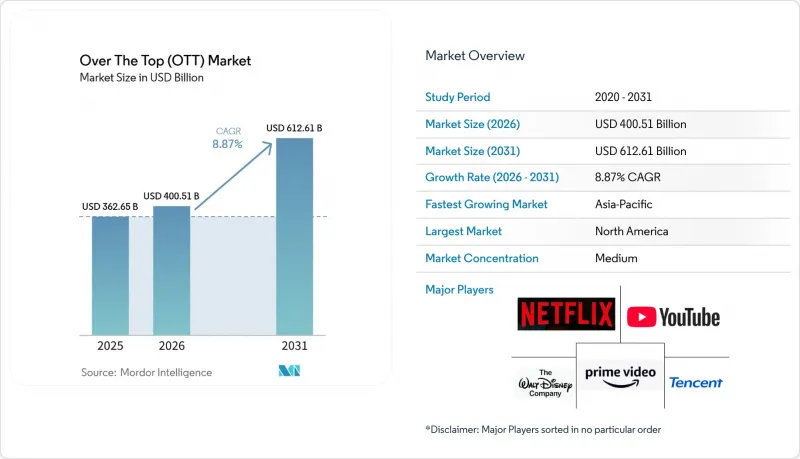
This report is Segmented by Monetization Model (SVOD, AVOD, TVOD, Hybrid, and More), Device Types (Smartphones and Tablets, Smart TVs, Laptops and Desktops, and More), Content Genre (Movies and Films, TV Shows and Episodic Content, Documentaries, and More), and Geography (North America, South America, Europe, Asia-Pacific, Middle East, and Africa). The Market Forecasts are Provided in Terms of Value (USD).
Global Over The Top (OTT) Market Trends and Insights
Bundled Telco and OTT Partnerships
Telecom bundles have become an important distribution route for the over the top (OTT) market, especially where customers are price sensitive. The arrangement can reduce cancellation rates for operators and lower subscriber acquisition costs for streaming platforms. Reliance Jio introduced an INR 200 (USD 2.10) OTT Pass in May 2026 that bundled 15 platforms, 1,000 live TV channels, and unlimited 5G access for 28 days. This package placed streaming services within a broader mobile offer rather than treating them as separate purchases. The model can broaden reach in high-volume markets, but it also places pressure on platforms to accept lower revenue per user. It has encouraged providers to use advertising and hybrid plans to recover revenue that a standalone subscription may not deliver.
Live Sports Rights Inflation
Streaming platforms are expected to spend USD 14.2 billion on sports rights in 2026, compared with USD 13.2 billion in 2025. Amazon Prime Video was expected to spend USD 3.8 billion, supported by the first full season of its NBA agreement. Live sports can attract viewers at a fixed time and create valuable advertising inventory for the over the top (OTT) market. The same rights can also support subscriber acquisition in mature markets where general entertainment subscriptions have slowed. However, rising rights fees create a difficult cost position for platforms that lack other large revenue streams. The OTT market is therefore likely to reward services that can use sports programming across subscriptions, advertising, and wider commercial ecosystems.
Escalating Content Acquisition and Production Costs
Content spending remains the largest cost pressure in the over the top (OTT) market. Netflix added USD 17.1 billion in content assets in fiscal 2025 and reported USD 24.0 billion in content obligations. Its 2025 revenue was USD 45.18 billion, which shows the scale of content investment needed to maintain a global service. Sports rights add a further cost burden because premium competitions require large multiyear commitments. In India, OTT content spending fell to INR 21.8 billion (USD 228 million) in 2025 from INR 26.7 billion (USD 279 million) in 2024 as platforms became more selective with mid-budget commissions. The over the top (OTT) market is consequently encouraging licensing, co-productions, and shared production arrangements where providers can limit risk without losing access to relevant content.
Other drivers and restraints analyzed in the detailed report include:
- Connected TV Advertising Shift
- Government Domestic Content Quotas
- High Churn and Subscription Stacking
For complete list of drivers and restraints, kindly check the Table Of Contents.
Segment Analysis
SVOD held 54.52% of the over the top (OTT) market by monetization model in 2025. Subscription revenue still anchors the largest platforms because it provides recurring income and a direct customer relationship. Hybrid services are projected to record the fastest growth at a 10.54% CAGR from 2026 to 2031. These plans combine a subscription charge with advertising revenue from the same viewer. AVOD is the second-largest monetization model and has particular relevance in price-sensitive markets across Asia-Pacific and South America.
TVOD and freemium services remain smaller parts of the OTT market, but they retain a clear role in selected use cases. TVOD is relevant for sports and live events where viewers may accept a transaction fee for time-sensitive access. Freemium services can introduce consumers to a platform before a paid conversion. The shift away from entirely ad-free subscriptions reflects the need to diversify revenue as mature services face slower subscriber additions. Netflix reported that advertising revenue exceeded USD 1.5 billion in 2025 and forecast that it would approach USD 3 billion in 2026. The OTT industry is therefore using hybrid plans as an enduring commercial model rather than a temporary promotional option.
Complete Report Scope:
- By Monetization Model
- SVOD
- AVOD
- TVOD
- Hybrid
- Freemium
- By Device Types
- Smartphones and Tablets
- Smart TVs
- Laptops and Desktops
- Other Device Types
- By Content Genre
- Movies and Films
- TV Shows and Episodic Content
- Documentaries
- Other Content Genres
- By Geography
- North America
- United States
- Canada
- Mexico
- South America
- Brazil
- Argentina
- Chile
- Rest of South America
- Europe
- Germany
- United Kingdom
- France
- Italy
- Spain
- Rest of Europe
- Asia-Pacific
- China
- Japan
- India
- South Korea
- Australia
- Rest of Asia-Pacific
- Middle East
- Saudi Arabia
- United Arab Emirates
- Qatar
- Rest of Middle East
- Africa
- South Africa
- Egypt
- Nigeria
- Rest of Africa
- North America
Geography Analysis
North America held 48.22% of the over the top market in 2025. High household broadband availability, established subscription video use, and mature advertising systems supported this position. Netflix, Disney, and Amazon collectively accounted for 65% of U.S. subscription VOD viewership in December 2025. The region faces a saturation challenge because new subscribers often come from competitors or from reactivated former subscribers. Canada's 15% domestic-programming contribution requirement, formalized in 2026, is changing the commissioning choices of global platforms.
Asia-Pacific is projected to be the fastest-growing OTT geography at an 11.17% CAGR from 2026 to 2031. China accounted for 46% of the region's online video revenue in 2025, followed by Japan at 17% and Australia at 10%. India is expected to become the world's largest SVOD subscription market by 2030 with 358 million individual subscriptions. Local platforms held 84% of SVOD subscriptions across Asia-Pacific, which limits the revenue share available to international services even as the over the top (OTT) expands.
Europe is the second-largest geographic segment in the over the top market and is centered on Germany, the United Kingdom, and France. European services operate under a 30% European content availability requirement. Germany is expected to apply an 8% local-revenue investment requirement from January 2027. South America is an emerging region where Brazil anchors adoption and telecom bundles are extending access beyond major cities. The Middle East has premium revenue centers in Saudi Arabia and the United Arab Emirates, while Africa remains centered on mobile access in South Africa, Egypt, and Nigeria.
- Netflix Inc.
- Google LLC
- Prime Video (Amazon.com, Inc.)
- The Walt Disney Company
- Tencent Holdings Limited
- Apple Inc.
- Warner Bros. Discovery, Inc.
- Comcast Corporation
- Paramount Global
- Roku, Inc.
- Baidu, Inc.
- Alibaba Group Holding Limited
- DAZN Group Limited
- JioStar Private Limited
- PCCW Media Limited
- Zee Entertainment Enterprises Limited
- MBC Group
- Canal+ Group
- Rakuten Group, Inc.
- Starz Entertainment, LLC
Additional Benefits:
- The market estimate (ME) sheet in Excel format
- 3 months of analyst support
TABLE OF CONTENTS
1 INTRODUCTION
- 1.1 Study Assumptions and Market Definition
- 1.2 Scope of the Study
2 RESEARCH METHODOLOGY
3 EXECUTIVE SUMMARY
4 MARKET LANDSCAPE
- 4.1 Market Overview
- 4.2 Market Drivers
- 4.2.1 Bundled Telco and OTT Partnerships
- 4.2.2 Live Sports Rights Inflation
- 4.2.3 Connected TV Advertising Shift
- 4.2.4 Government Domestic Content Quotas
- 4.2.5 Cloud-Based Content Delivery and AI Personalization
- 4.2.6 Hybrid Monetization and Ad Tier Expansion
- 4.3 Market Restraints
- 4.3.1 Escalating Content Acquisition and Production Costs
- 4.3.2 High Churn and Subscription Stacking
- 4.3.3 Bandwidth Constraints and Playback Quality Gaps
- 4.3.4 Regulatory, Privacy, and Content Compliance Complexity
- 4.4 Impact of Macroeconomic Factors on the Market
- 4.5 Industry Value Chain Analysis
- 4.6 Regulatory Landscape
- 4.7 Technological Outlook
- 4.8 Porter's Five Forces Analysis
- 4.8.1 Bargaining Power of Suppliers
- 4.8.2 Bargaining Power of Buyers
- 4.8.3 Threat of New Entrants
- 4.8.4 Threat of Substitutes
- 4.8.5 Competitive Rivalry
5 MARKET SIZE AND GROWTH FORECASTS (VALUE)
- 5.1 By Monetization Model
- 5.1.1 SVOD
- 5.1.2 AVOD
- 5.1.3 TVOD
- 5.1.4 Hybrid
- 5.1.5 Freemium
- 5.2 By Device Types
- 5.2.1 Smartphones and Tablets
- 5.2.2 Smart TVs
- 5.2.3 Laptops and Desktops
- 5.2.4 Other Device Types
- 5.3 By Content Genre
- 5.3.1 Movies and Films
- 5.3.2 TV Shows and Episodic Content
- 5.3.3 Documentaries
- 5.3.4 Other Content Genres
- 5.4 By Geography
- 5.4.1 North America
- 5.4.1.1 United States
- 5.4.1.2 Canada
- 5.4.1.3 Mexico
- 5.4.2 South America
- 5.4.2.1 Brazil
- 5.4.2.2 Argentina
- 5.4.2.3 Chile
- 5.4.2.4 Rest of South America
- 5.4.3 Europe
- 5.4.3.1 Germany
- 5.4.3.2 United Kingdom
- 5.4.3.3 France
- 5.4.3.4 Italy
- 5.4.3.5 Spain
- 5.4.3.6 Rest of Europe
- 5.4.4 Asia-Pacific
- 5.4.4.1 China
- 5.4.4.2 Japan
- 5.4.4.3 India
- 5.4.4.4 South Korea
- 5.4.4.5 Australia
- 5.4.4.6 Rest of Asia-Pacific
- 5.4.5 Middle East
- 5.4.5.1 Saudi Arabia
- 5.4.5.2 United Arab Emirates
- 5.4.5.3 Qatar
- 5.4.5.4 Rest of Middle East
- 5.4.6 Africa
- 5.4.6.1 South Africa
- 5.4.6.2 Egypt
- 5.4.6.3 Nigeria
- 5.4.6.4 Rest of Africa
- 5.4.1 North America
6 COMPETITIVE LANDSCAPE
- 6.1 Market Concentration
- 6.2 Strategic Moves
- 6.3 Market Share Analysis
- 6.4 Company Profiles (includes Global Level Overview, Market Level Overview, Core Segments, Financials as available, Strategic Information, Market Rank/Share, Products and Services, Recent Developments)
- 6.4.1 Netflix Inc.
- 6.4.2 Google LLC
- 6.4.3 Prime Video (Amazon.com, Inc.)
- 6.4.4 The Walt Disney Company
- 6.4.5 Tencent Holdings Limited
- 6.4.6 Apple Inc.
- 6.4.7 Warner Bros. Discovery, Inc.
- 6.4.8 Comcast Corporation
- 6.4.9 Paramount Global
- 6.4.10 Roku, Inc.
- 6.4.11 Baidu, Inc.
- 6.4.12 Alibaba Group Holding Limited
- 6.4.13 DAZN Group Limited
- 6.4.14 JioStar Private Limited
- 6.4.15 PCCW Media Limited
- 6.4.16 Zee Entertainment Enterprises Limited
- 6.4.17 MBC Group
- 6.4.18 Canal+ Group
- 6.4.19 Rakuten Group, Inc.
- 6.4.20 Starz Entertainment, LLC
7 MARKET OPPORTUNITIES AND FUTURE OUTLOOK
- 7.1 White-Space and Unmet-Need Assessment

