PUBLISHER: Mordor Intelligence | PRODUCT CODE: 2119112

PUBLISHER: Mordor Intelligence | PRODUCT CODE: 2119112
India OTT - Market Share Analysis, Industry Trends & Statistics, Growth Forecasts (2026 - 2031)
According to Mordor Intelligence, the India OTT market size was valued at USD 9.45 billion in 2025 and is estimated to grow from USD 11.05 billion in 2026 to reach USD 22.18 billion by 2031, at a CAGR of 14.95% during the forecast period (2026-2031).
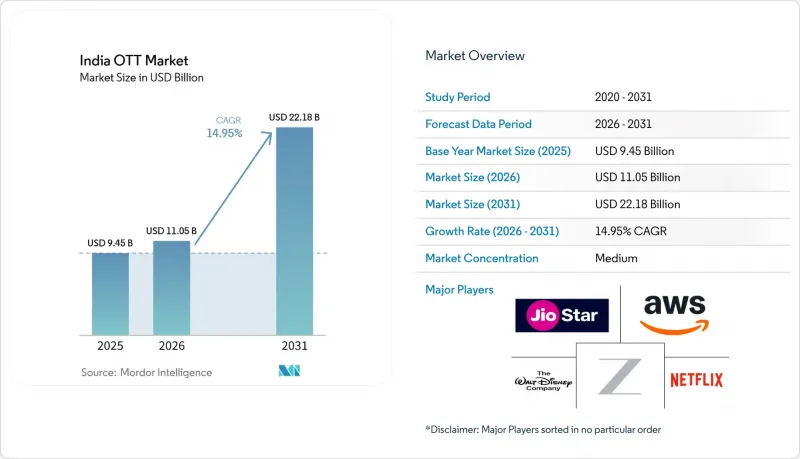
This report is Segmented by Revenue Model (SVOD, AVOD, TVOD, and Hybrid Subscription and Ads), by Device Type (Smartphones and Tablets, Smart TVs, Laptops and Desktops, and Other Device Types), by Content Genre (Movies and Films, TV Shows and Episodic Content, Documentaries, and Other Content Genres). The Market Forecasts are Provided in Terms of Value (USD).
India OTT Market Trends and Insights
Rising Connected TV Adoption in Urban Households
India's connected TV audience reached 166 million monthly viewers aged 15 and above in the first quarter of 2026, increasing 23% year over year. The same research found that 36% of connected TV viewers used only that screen for video, placing 59 million viewers beyond the reach of conventional linear television campaigns. The 2026 FICCI-EY report stated that India had 68 million connected TV households in 2025, including 40 million weekly active households, and projected more than 90 million households by 2028. The report also recorded a 42% increase in connected TV advertising revenue to INR 9,900 crore (USD 117.9 million) in 2025 and projected INR 16,400 crore (USD 195.2 million) by 2028. Connected TV, therefore, gives the India OTT market access to longer viewing sessions and a household setting that can support premium advertising formats. Kantar also found that 60% of connected TV viewers belonged to NCCS A households, which supports the case for premium subscriptions and higher-value advertising inventory.
Sports Rights and Live Event Monetization
Live sports remain a dependable way for platforms to attract viewers and keep them active through an event season. IPL 2025 reached 1.19 billion viewers across television and digital services, including 652 million digital viewers, while peak digital concurrency reached 55.2 million and total watch time reached 840 billion minutes. JioStar disclosed a USD 500 million commitment to sports production, marketing, and technology, underscoring that rights acquisition is tied to a broader effort to build long-term fan relationships. This approach can help the India OTT market turn occasional sports viewers into users of entertainment and ad-supported offerings between events. It also raises financial risk for platforms that pursue premium rights without enough advertising scale or paying users. JioStar India's provisions for expected losses on onerous sports contracts rose to INR 25,760 crore (USD 306.7 million) in FY25 from INR 12,319 crore (USD 146.7 million) in the prior year. The result is a market where large sports investments can deepen engagement but can also widen the advantage of platforms with stronger balance sheets.
Subscription Fatigue Among Price-Sensitive Users
Subscription fatigue limits services' ability to translate large audiences into recurring revenue. Ormax Media's 2025 OTT Audience Report indicated that audience growth slowed to below 10% in 2025 after exceeding 13% in earlier years, with service fragmentation and churn contributing to the slowdown. Monthly pricing may appear manageable for a single platform, but it becomes difficult when households maintain several subscriptions. The India OTT market must therefore carefully manage plan selection and payment renewals, particularly in price-sensitive households. Bundling can reduce consumers' immediate costs, but it may also weaken the direct relationship between a platform and its subscribers. Services with distinctive programming and clear plan differences are better placed to avoid being treated as easily replaceable.
Other drivers and restraints analyzed in the detailed report include:
- Hybrid Monetization Becomes the Default Revenue Stack
- Regional Language Content Expands Audience Reach Beyond Metro Cities
- Content Piracy and Account Sharing Pressure Monetization
For complete list of drivers and restraints, kindly check the Table Of Contents.
Segment Analysis
SVOD accounted for 46.31% of streaming revenue in 2025 and remained the largest revenue model. JioHotstar, Amazon Prime Video, and Netflix use multiple pricing tiers to offer paid access across a broad range of household budgets. These plans allow services to preserve premium options while keeping lower-price entry points available. TVOD addresses more event-driven viewing, especially when a title has a limited exclusive period before broader licensing. Zee Entertainment's digital business leadership described windowing periods of 2-3 weeks as a way to manage content costs before licensing to another platform. Hybrid subscription and advertising offerings recognize that many users do not fit neatly into fully paid or fully free categories. The India OTT industry is therefore using flexible access paths to support a more gradual move from casual viewing to paid services.
AVOD is projected to be the fastest-growing revenue model at a 15.38% CAGR from 2026 to 2031. The expansion follows growth in connected TV advertising and the broader use of programmatic buying. The 2026 FICCI-EY report noted the strong increase in connected TV advertising revenue during 2025. Advertisers in consumer goods, automotive, and financial services can use connected TV to reach households on a larger screen with measurable digital delivery. AVOD also provides a practical option for viewers who want video access but are reluctant to add another monthly subscription. Revenue results will depend on the quality of advertising inventory, household targeting, and a platform's ability to maintain a satisfactory viewing experience. This model provides the India over-the-top (OTT) market with a growth path less dependent on immediate subscription conversion.
Complete Report Scope:
- By Revenue Model
- SVOD
- AVOD
- TVOD
- Hybrid Subscription and Ads
- By Device Type
- Smartphones and Tablets
- Smart TVs
- Laptops and Desktops
- Other Device Types
- By Content Genre
- Movies and Films
- TV Shows and Episodic Content
- Documentaries
- Other Content Genres
List of Companies Covered in this Report:
- Netflix, Inc.
- Amazon.com, Inc.
- Alphabet Inc.
- JioStar India Private Limited
- Zee Entertainment Enterprises Limited
- Sony Pictures Networks India Private Limited
- Sun TV Network Limited
- Warner Bros. Discovery, Inc.
- Apple Inc.
- Arha Media & Broadcasting Private Limited
- Tata Play Limited
- Bharti Airtel Limited
- Pocket FM
- Shemaroo Entertainment Limited
- Eros Media World PLC
- Hoichoi Technologies Private Limited
- YuppTV, Inc.
- Balaji Telefilms Limited
- Hungama Digital Media Entertainment Private Limited
Additional Benefits:
- The market estimate (ME) sheet in Excel format
- 3 months of analyst support
TABLE OF CONTENTS
1 INTRODUCTION
- 1.1 Study Assumptions and Market Definition
- 1.2 Scope of the Study
2 RESEARCH METHODOLOGY
3 EXECUTIVE SUMMARY
4 MARKET LANDSCAPE
- 4.1 Market Overview
- 4.2 Market Drivers
- 4.2.1 Rising Connected TV Adoption in Urban Households
- 4.2.2 Sports Rights and Live Event Monetization
- 4.2.3 Hybrid Monetization Becomes the Default Revenue Stack
- 4.2.4 Regional Language Content Expands Audience Reach Beyond Metro Cities
- 4.2.5 Programmatic CTV Advertising Improves Ad Yield and Targeting
- 4.2.6 Bundling With Telco and Broadband Plans Lowers Acquisition Friction
- 4.3 Market Restraints
- 4.3.1 Subscription Fatigue Among Price-Sensitive Users
- 4.3.2 Content Piracy and Account Sharing Pressure Monetization
- 4.3.3 High Content Costs for Premium Sports and Originals
- 4.3.4 Fragmented Payments and Renewal Drop-Off in Mass-Market Segments
- 4.4 Industry Value Chain Analysis
- 4.5 Impact of Macroeconomic Factors on the Market
- 4.6 Regulatory Landscape
- 4.7 Technological Outlook
- 4.8 Porter's Five Forces Analysis
- 4.8.1 Threat of New Entrants
- 4.8.2 Bargaining Power of Suppliers
- 4.8.3 Bargaining Power of Buyers
- 4.8.4 Threat of Substitutes
- 4.8.5 Intensity of Competitive Rivalry
5 MARKET SIZE AND GROWTH FORECASTS (VALUE)
- 5.1 By Revenue Model
- 5.1.1 SVOD
- 5.1.2 AVOD
- 5.1.3 TVOD
- 5.1.4 Hybrid Subscription and Ads
- 5.2 By Device Type
- 5.2.1 Smartphones and Tablets
- 5.2.2 Smart TVs
- 5.2.3 Laptops and Desktops
- 5.2.4 Other Device Types
- 5.3 By Content Genre
- 5.3.1 Movies and Films
- 5.3.2 TV Shows and Episodic Content
- 5.3.3 Documentaries
- 5.3.4 Other Content Genres
6 COMPETITIVE LANDSCAPE
- 6.1 Market Concentration
- 6.2 Strategic Moves
- 6.3 Vendor Positioning Anaysis
- 6.4 Company Profiles (includes Global Level Overview, Market Level Overview, Core Segments, Financials as available, Strategic Information, Market Rank/Share, Products and Services, Recent Developments)
- 6.4.1 Netflix, Inc.
- 6.4.2 Amazon.com, Inc.
- 6.4.3 Alphabet Inc.
- 6.4.4 JioStar India Private Limited
- 6.4.5 Zee Entertainment Enterprises Limited
- 6.4.6 Sony Pictures Networks India Private Limited
- 6.4.7 Sun TV Network Limited
- 6.4.8 Warner Bros. Discovery, Inc.
- 6.4.9 Apple Inc.
- 6.4.10 Arha Media & Broadcasting Private Limited
- 6.4.11 Tata Play Limited
- 6.4.12 Bharti Airtel Limited
- 6.4.13 Pocket FM
- 6.4.14 Shemaroo Entertainment Limited
- 6.4.15 Eros Media World PLC
- 6.4.16 Hoichoi Technologies Private Limited
- 6.4.17 YuppTV, Inc.
- 6.4.18 Balaji Telefilms Limited
- 6.4.19 Hungama Digital Media Entertainment Private Limited
7 MARKET OPPORTUNITIES AND FUTURE OUTLOOK
- 7.1 White-Space and Unmet-Need Assessment

