PUBLISHER: Mordor Intelligence | PRODUCT CODE: 2119011

PUBLISHER: Mordor Intelligence | PRODUCT CODE: 2119011
Europe OTT - Market Share Analysis, Industry Trends & Statistics, Growth Forecasts (2026 - 2031)
According to Mordor Intelligence, the Europe OTT market size is projected to be USD 100.61 billion in 2025, USD 110.85 billion in 2026, and reach USD 167.50 billion by 2031, growing at a CAGR of 8.61% from 2026 to 2031.
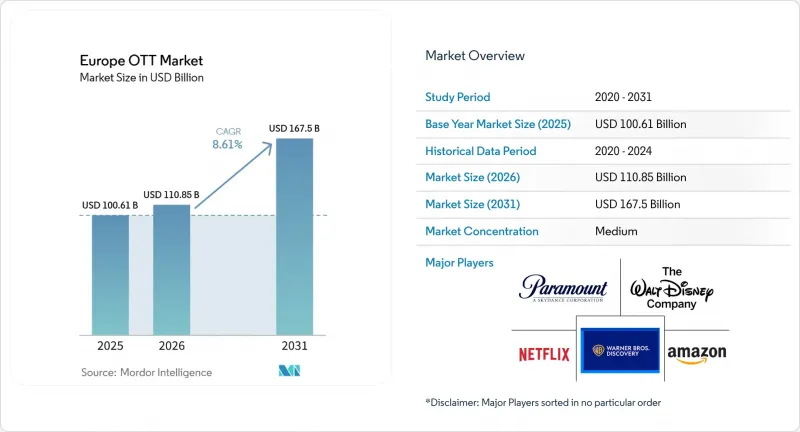
This report is Segmented by Revenue Model (Recurring Subscription Billing (SVOD), Transactional Billing (TVOD/PPV), Advertising-Supported Billing (AVOD/FAST), and Hybrid Monetization Billing), Device Types (Smartphones and Tablets, Smart TVs, and More), Content Genre (Movies and Films, TV Shows and Episodic Content, and Documentaries), and Country. The Market Forecasts are Provided in Terms of Value (USD).
Europe OTT Market Trends and Insights
Rising Adoption Of Ad-Supported Streaming Tiers
Ad-supported plans are bringing price-sensitive households into the Europe OTT market without requiring a full subscription payment. They also give established services a way to protect subscriptions when households review recurring expenses. A 2026 consumer study found that FAST channels reached 27% household adoption across the United Kingdom, Germany, France, Italy, Spain, and the Netherlands. This usage shows that advertising-funded viewing has become part of routine household viewing rather than a temporary response to prices. The Digital Services Act also sets transparency and accountability requirements for targeted advertising across member states. The Europe OTT market can therefore broaden its paid and free audiences, although platforms must build advertising systems that meet these requirements.
Broad Smart TV And Connected Device Penetration
Smart TVs serve as the primary channel through which the Europe OTT market reaches living-room viewers. In Germany, internet-based television is expected to cover a larger share of households in 2026 compared with 2025. OTT streaming is expected to become a more prominent television reception method for German households in 2026 than a year earlier. Older televisions also drive demand for external streaming devices when their software no longer supports current applications. Smart TV home screens now influence which services viewers discover first, making application placement an important commercial consideration. Therefore, the Europe OTT market must compete not only for programming rights but also for visibility on device interfaces.
Fragmented Language And Rights Licensing Complexity
The Europe OTT market operates across separate national rights environments, rather than as one fully unified content territory. Each agreement can require language versions, country-specific release windows, and compliance with domestic genre rules. This structure raises legal and administrative costs for services that want a broad regional offer. It also makes catalog depth depend partly on licensing capacity rather than on direct spending on programs. Large platforms can spread these compliance costs across many countries and subscribers. Smaller regional services and language-specific providers face a more difficult path to scale in the Europe OTT market.
Other drivers and restraints analyzed in the detailed report include:
- Expansion Of Local And Original Content Budgets
- Growing Multi-Service Subscription Stacking
- Premium Content Inflation And Sports Rights Escalation
For complete list of drivers and restraints, kindly check the Table Of Contents.
Segment Analysis
SVOD held 54.50% of regional streaming revenue in 2025, reflecting the established subscriber bases of Netflix, Amazon Prime Video, and Disney+. Hybrid subscription and advertising offers are projected to expand at a 9.58% CAGR through 2031, the fastest pace among revenue models. This arrangement combines recurring subscription revenue with advertising income from the same program inventory. It also allows platforms to offer lower-priced tiers without withdrawing paid access altogether. Germany showed the continuing importance of the subscription model, where SVoD spending exceeded EUR 3 billion, equivalent to USD 3.24 billion, in 2025. SVoD accounted for 81% of German home-video revenue that year. The pure subscription model remains the largest source of revenue because it is familiar to both platforms and households. Hybrid tiers do not replace that foundation. They extend it to viewers who want a lower entry price and to advertisers seeking connected television audiences.
AVOD is smaller than subscription video in revenue terms, but it serves viewers who may not accept a paid plan. This audience can increase advertising reach without requiring a subscription conversion. TVOD is declining because broad subscription catalogs reduce the need to rent or buy many titles separately. Digital electronic sell-through revenue in Germany fell 2% in 2025. Live-event subscriptions remain important because sports and concert programming can support higher-priced tiers. Movistar Plus+ showed this logic in Spain after expanding live sports. The Europe OTT industry is therefore using different price points to preserve recurring revenue while serving households with different spending limits.
Complete Report Scope:
- By Revenue Model
- SVOD
- AVOD
- TVOD
- Hybrid, Subscription and Ads
- By Device Types
- Smartphones and Tablets
- Smart TVs
- Laptops and Desktops
- Other Device Types
- By Content Genre
- Movies and Films
- TV Shows and Episodic Content
- Documentaries
- Other Content Genres
- By Country
- Germany
- United Kingdom
- France
- Italy
- Spain
- Rest of Europe
List of Companies Covered in this Report:
- Netflix, Inc.
- Amazon.com, Inc.
- The Walt Disney Company
- Warner Bros. Discovery, Inc.
- Paramount Skydance Corporation
- Apple Inc.
- Comcast Corporation
- Bertelsmann SE & Co. KGaA
- CANAL+ S.A.
- ITV plc
- Viaplay Group AB
- DAZN Group Limited
- Rakuten Group, Inc.
- Zattoo AG
- Television Francaise 1 S.A.
- MFE-MEDIAFOREUROPE N.V.
- Atresmedia Corporacion de Medios de Comunicacion, S.A.
- British Broadcasting Corporation
- Channel Four Television Corporation
Additional Benefits:
- The market estimate (ME) sheet in Excel format
- 3 months of analyst support
TABLE OF CONTENTS
1 INTRODUCTION
- 1.1 Study Assumptions and Market Definition
- 1.2 Scope of the Study
2 RESEARCH METHODOLOGY
3 EXECUTIVE SUMMARY
4 MARKET LANDSCAPE
- 4.1 Market Overview
- 4.2 Market Drivers
- 4.2.1 Rising Adoption of Ad-Supported Streaming Tiers
- 4.2.2 Broad Smart TV and Connected Device Penetration
- 4.2.3 Expansion of Local and Original Content Budgets
- 4.2.4 Growing Multi-Service Subscription Stacking
- 4.2.5 Telecom and Pay-TV Bundling Across Europe
- 4.2.6 Data-Driven Personalization and Recommendation Engine Monetization
- 4.3 Market Restraints
- 4.3.1 Fragmented Language and Rights Licensing Complexity
- 4.3.2 Premium Content Inflation and Sports Rights Escalation
- 4.3.3 Subscription Fatigue in Mature Western European Markets
- 4.3.4 Cross-Border Regulatory and Advertising Compliance Burden
- 4.4 Industry Value Chain Analysis
- 4.5 Impact of Macroeconomic Factors on the Market
- 4.6 Regulatory Landscape
- 4.7 Technological Outlook
- 4.8 Porter's Five Forces Analysis
- 4.8.1 Threat of New Entrants
- 4.8.2 Bargaining Power of Suppliers
- 4.8.3 Bargaining Power of Buyers
- 4.8.4 Threat of Substitutes
- 4.8.5 Competitive Rivalry
5 MARKET SIZE AND GROWTH FORECASTS (VALUE)
- 5.1 By Revenue Model
- 5.1.1 SVOD
- 5.1.2 AVOD
- 5.1.3 TVOD
- 5.1.4 Hybrid, Subscription and Ads
- 5.2 By Device Types
- 5.2.1 Smartphones and Tablets
- 5.2.2 Smart TVs
- 5.2.3 Laptops and Desktops
- 5.2.4 Other Device Types
- 5.3 By Content Genre
- 5.3.1 Movies and Films
- 5.3.2 TV Shows and Episodic Content
- 5.3.3 Documentaries
- 5.3.4 Other Content Genres
- 5.4 By Country
- 5.4.1 Germany
- 5.4.2 United Kingdom
- 5.4.3 France
- 5.4.4 Italy
- 5.4.5 Spain
- 5.4.6 Rest of Europe
6 COMPETITIVE LANDSCAPE
- 6.1 Market Concentration
- 6.2 Strategic Moves
- 6.3 Market Share Analysis
- 6.4 Company Profiles (includes Global Level Overview, Market Level Overview, Core Segments, Financials as available, Strategic Information, Market Rank/Share, Products and Services, Recent Developments)
- 6.4.1 Netflix, Inc.
- 6.4.2 Amazon.com, Inc.
- 6.4.3 The Walt Disney Company
- 6.4.4 Warner Bros. Discovery, Inc.
- 6.4.5 Paramount Skydance Corporation
- 6.4.6 Apple Inc.
- 6.4.7 Comcast Corporation
- 6.4.8 Bertelsmann SE & Co. KGaA
- 6.4.9 CANAL+ S.A.
- 6.4.10 ITV plc
- 6.4.11 Viaplay Group AB
- 6.4.12 DAZN Group Limited
- 6.4.13 Rakuten Group, Inc.
- 6.4.14 Zattoo AG
- 6.4.15 Television Francaise 1 S.A.
- 6.4.16 MFE-MEDIAFOREUROPE N.V.
- 6.4.17 Atresmedia Corporacion de Medios de Comunicacion, S.A.
- 6.4.18 British Broadcasting Corporation
- 6.4.19 Channel Four Television Corporation
7 MARKET OPPORTUNITIES AND FUTURE OUTLOOK
- 7.1 White-Space and Unmet-Need Assessment

