PUBLISHER: Mordor Intelligence | PRODUCT CODE: 2114399

PUBLISHER: Mordor Intelligence | PRODUCT CODE: 2114399
Vietnam Ceramic Tiles - Market Share Analysis, Industry Trends & Statistics, Growth Forecasts (2026 - 2031)
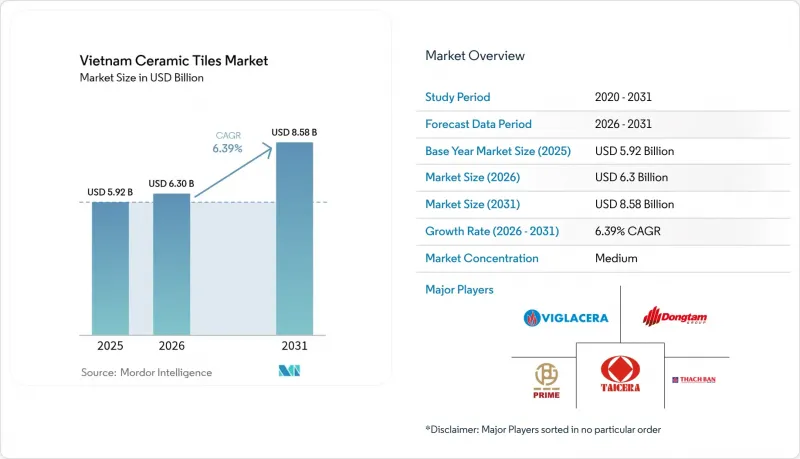
According to Mordor Intelligence, the Vietnam ceramic tiles market size is expected to grow from USD 5.92 billion in 2025 to USD 6.3 billion in 2026 and is forecast to reach USD 8.58 billion by 2031 at 6.39% CAGR over 2026-2031.
This report is Segmented by Product Type (Porcelain Tiles, Glazed Ceramic Tiles, and More), Application (Floor, Wall, Roofing), End-User (Residential, Commercial), Construction Type (New Construction, Renovation and Replacement), Distribution Channel (Specialty Tile & Stone Stores, and More), and Geography (Northern Vietnam, and More). The Market Forecasts are Provided in Terms of Value (USD).
Vietnam Ceramic Tiles Market Trends and Insights
Rising Urbanization & Residential Housing Demand
National urbanization is moving toward the official 60-65% target by 2030, with provincial master plans spurring high-rise neighborhoods and satellite townships . More than 30,000 new condominium units were delivered in northern cities during 2024, and average selling prices in Hanoi's primary market jumped 36%, signaling a decisive shift toward branded, higher-value finishes. Social-housing mega-schemes worth 16,000 billion VND in Dong Anh alone will add almost 6,900 units in two phases, anchoring volume for mid-priced tiles. Regulatory clarity from newly enacted Land and Housing Laws is shortening project lead times and bolstering developer confidence. As a result, the Vietnam ceramic tiles market continues to derive its core volume from flooring packages in mass-housing blocks where purchase decisions hinge on durability and ready availability.
Government Infrastructure Investment & Smart-City Programs
A record 230 public works broke ground simultaneously in August 2025, illustrating the government's commitment to transport, education, and urban resilience. Digital governance reforms have pushed 95% of construction permits online, slashing administrative delays and widening tender opportunities for local tile makers. Flagship mixed-use ventures such as the 2,870-hectare Vinhomes Green Paradise emphasize sustainability and premium building envelopes that heavily specify porcelain slabs. Provincial authorities now steward their smart-city plans, attracting Hong Kong and Shenzhen investors to develop sensor-enabled districts that require long-life, low-maintenance ceramic cladding. Such capital flows ripple across the Vietnam ceramic tiles market and create multi-year order visibility for domestic producers.
Volatile Energy Costs Impacting Production Margins
Kilns consume large volumes of natural gas or coal, so spot-price spikes directly erode profitability for Vietnam's 1,200 tile factories. Many smaller operators still run legacy tunnel kilns with thermal efficiency below 40%, magnifying cost swings. Pilot projects exploring hydrogen-ready burners or rooftop photovoltaics promise relief but demand capital outlays that micro-enterprises cannot shoulder quickly. Resolution 77's proposed tax relief on imported kiln parts may ease transition, yet short-term margin compression remains likely. Consequently, the Vietnamese ceramic tiles market could experience consolidation as only energy-savvy producers maintain cost competitiveness.
Other drivers and restraints analyzed in the detailed report include:
- Growing Middle-Class Preference for Premium Aesthetics
- Large-Format Porcelain Slabs for Energy-Efficient Cooling
- Intensifying Competition from Low-Cost Imports
For complete list of drivers and restraints, kindly check the Table Of Contents.
Segment Analysis
Porcelain already fuels the premium story within the Vietnam ceramic tiles market, growing at 8.01% CAGR through 2031 as builders pivot to large-format slabs for upscale villas and grade-A offices. Glazed tiles retained a dominant 51.62% Vietnam ceramic tiles market share in 2025 because of their design versatility and competitive price points. Production advances, such as full-body ink-penetration technology, enable porcelain panels to mimic marble veins with 400 DPI precision while delivering superior flexural strength. Domestic brands leverage this performance edge to access export niches in Japan and Australia, where frost resistance and water absorption limits are stringent. In parallel, cultural revival in craft clusters feeds demand for decorative mosaics that enrich boutique hotels and residential accent walls.
Unglazed heavy-duty formats maintain relevance for logistics parks, yet their share gradually declines as porcelain achieves cost parity. Mosaic and patterned subsegments benefit from bespoke orders tied to tourism complexes that narrate regional heritage in lobbies and facades. Research on humidity-responsive ceramics signals future cross-over products that combine aesthetics with passive cooling, potentially refreshing mature categories. As innovation cycles accelerate, producers that integrate design, durability and thermal performance secure pricing power. Overall, product-level diversification is reinforcing value capture inside the Vietnam ceramic tiles market.
Floor tiles contributed 60.35% of national volume in 2025 because every new apartment and retail outlet prioritizes resilient, easy-clean surfaces underfoot; this anchor segment keeps the Vietnam ceramic tiles market size substantial and predictable. Innovations such as nano-glaze antibacterial finishes help local brands upsell within flooring budgets. In contrast, roofing tiles headline growth at 6.54% CAGR thanks to cool-roof mandates in dense cities where energy codes now reward solar-reflective claddings. Demonstration projects record indoor temperature drops of 3-5 °C, driving municipal procurement for public schools and clinics.
Wall cladding remains a stable mid-volume category, but porcelain facade panels gain investor interest as glass-aluminum systems face cost inflation. Feature walls in cafes and coworking hubs increasingly use digitally printed motifs that replicate terrazzo or terrazul aesthetics without on-site terrazzo waste. Inside bathrooms, slip-rated surfaces and integrated groutless sheets simplify cleaning, supporting tile replacement cycles in hospitality revamps. As developers juggle cost, energy, and maintenance criteria, application choice becomes multidimensional, reinforcing balanced expansion within the Vietnam ceramic tiles market.
Complete Report Scope:
- By Product Type
- Porcelain Tiles
- Glazed Ceramic Tiles
- Unglazed Ceramic Tiles
- Mosaic Tiles
- Others (Decorative, Patterned, Handmade)
- By Application
- Floor
- Wall
- Roofing
- By End-User
- Residential
- Commercial
- Hospitality (Hotels, Resorts)
- Retail Spaces
- Offices & Institutions
- Healthcare
- Educational Facilities
- Transport Hubs (Airports, Metro, Bus Terminals)
- Other Commercial Users
- By Construction Type
- New Construction
- Renovation and Replacement
- By Distribution Channel
- Specialty Tile & Stone Stores
- Home Improvement & DIY Stores
- Online Retail
- Direct Sales to Contractors
- By Geography
- Northern Vietnam
- Central Vietnam
- Southern Vietnam
List of Companies Covered in this Report:
- Viglacera Corporation
- Prime Group
- Dong Tam Group
- Taicera Enterprise Company
- Thạch Ban Group
- Bạch Ma (White Horse Ceramics)
- CMC JSC (Catalan Tiles)
- Hoang Gia Royal Group
- Mikado Ceramic
- Vitto Group
- Trung Do Ceramic
- Thanh Thanh Ceramic
- Dong Nai Ceramic Tiles
- Cong Thanh Ceramic
- Hoa Binh Minh Ceramics
- Tasa Ceramic
- Kim Phong Tiles
- Hoan Mỹ Ceramics
- Toko Vietnam Co. Ltd.
Additional Benefits:
- The market estimate (ME) sheet in Excel format
- 3 months of analyst support
TABLE OF CONTENTS
1 Introduction
- 1.1 Study Assumptions & Market Definition
- 1.2 Scope of the Study
2 Research Methodology
3 Executive Summary
4 Market Landscape
- 4.1 Market Overview
- 4.2 Market Drivers
- 4.2.1 Rising urbanization & residential housing demand
- 4.2.2 Government infrastructure investment & smart-city programmes
- 4.2.3 Growing middle-class preference for premium aesthetics
- 4.2.4 Expansion of commercial real-estate & tourism facilities
- 4.2.5 Large-format porcelain slabs for energy-efficient cooling
- 4.2.6 Localised digital ink-jet printing cuts import dependence
- 4.3 Market Restraints
- 4.3.1 Volatile energy costs impacting production margins
- 4.3.2 Intensifying competition from low-cost imports
- 4.3.3 Production overcapacity driving price pressures
- 4.3.4 Tightening environmental & water-use regulations
- 4.4 Industry Value Chain Analysis
- 4.5 Porter's Five Forces Analysis
- 4.5.1 Threat of New Entrants
- 4.5.2 Bargaining Power of Suppliers
- 4.5.3 Bargaining Power of Buyers
- 4.5.4 Threat of Substitutes
- 4.5.5 Competitive Rivalry
- 4.6 Insights into the Latest Trends and Innovations in the Market
- 4.7 Insights on Recent Developments (New Product Launches, Strategic Initiatives, Investments, Partnerships, JVs, Expansion, M&As, etc.) in the Industry
5 Market Size & Growth Forecasts (Value in USD)
- 5.1 By Product Type
- 5.1.1 Porcelain Tiles
- 5.1.2 Glazed Ceramic Tiles
- 5.1.3 Unglazed Ceramic Tiles
- 5.1.4 Mosaic Tiles
- 5.1.5 Others (Decorative, Patterned, Handmade)
- 5.2 By Application
- 5.2.1 Floor
- 5.2.2 Wall
- 5.2.3 Roofing
- 5.3 By End-User
- 5.3.1 Residential
- 5.3.2 Commercial
- 5.3.2.1 Hospitality (Hotels, Resorts)
- 5.3.2.2 Retail Spaces
- 5.3.2.3 Offices & Institutions
- 5.3.2.4 Healthcare
- 5.3.2.5 Educational Facilities
- 5.3.2.6 Transport Hubs (Airports, Metro, Bus Terminals)
- 5.3.2.7 Other Commercial Users
- 5.4 By Construction Type
- 5.4.1 New Construction
- 5.4.2 Renovation and Replacement
- 5.5 By Distribution Channel
- 5.5.1 Specialty Tile & Stone Stores
- 5.5.2 Home Improvement & DIY Stores
- 5.5.3 Online Retail
- 5.5.4 Direct Sales to Contractors
- 5.6 By Geography
- 5.6.1 Northern Vietnam
- 5.6.2 Central Vietnam
- 5.6.3 Southern Vietnam
6 Competitive Landscape
- 6.1 Market Concentration
- 6.2 Strategic Moves
- 6.3 Market Share Analysis
- 6.4 Company Profiles (includes Global level Overview, Market level overview, Core Segments, Financials as available, Strategic Information, Market Rank/Share for key companies, Products & Services, and Recent Developments)
- 6.4.1 Viglacera Corporation
- 6.4.2 Prime Group
- 6.4.3 Dong Tam Group
- 6.4.4 Taicera Enterprise Company
- 6.4.5 Thạch Ban Group
- 6.4.6 Bạch Ma (White Horse Ceramics)
- 6.4.7 CMC JSC (Catalan Tiles)
- 6.4.8 Hoang Gia Royal Group
- 6.4.9 Mikado Ceramic
- 6.4.10 Vitto Group
- 6.4.11 Trung Do Ceramic
- 6.4.12 Thanh Thanh Ceramic
- 6.4.13 Dong Nai Ceramic Tiles
- 6.4.14 Cong Thanh Ceramic
- 6.4.15 Hoa Binh Minh Ceramics
- 6.4.16 Tasa Ceramic
- 6.4.17 Kim Phong Tiles
- 6.4.18 Hoan Mỹ Ceramics
- 6.4.19 Toko Vietnam Co. Ltd.
7 Market Opportunities & Future Outlook
- 7.1 Hydrogen-ready & solar-assisted kilns for decarbonisation
- 7.2 Circular-economy tile recycling & take-back programmes

