PUBLISHER: Mordor Intelligence | PRODUCT CODE: 2114702

PUBLISHER: Mordor Intelligence | PRODUCT CODE: 2114702
Cystic Fibrosis Therapeutics - Market Share Analysis, Industry Trends & Statistics, Growth Forecasts (2026 - 2031)
According to Mordor Intelligence, the cystic fibrosis therapeutics market size is expected to grow from USD 12.05 billion in 2025 to USD 13.45 billion in 2026 and is forecast to reach USD 23.31 billion by 2031 at 11.63% CAGR over 2026-2031.
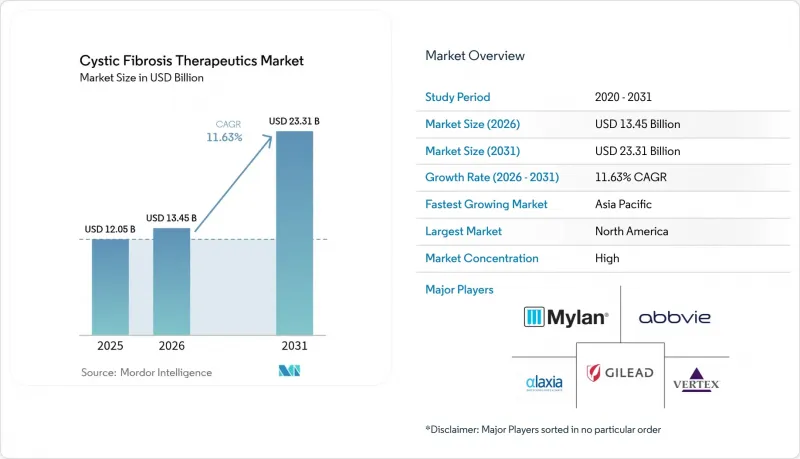
This report is Segmented by Drug Class (Pancreatic Enzyme Supplements, Mucolytics, Bronchodilators, Antibiotics, Anti-Inflammatory Agents, CFTR Modulators), Route of Administration (Inhaled Drugs, Oral Drugs, Intravenous Therapies, Gene Delivery), and Geography (North America, Europe, Asia-Pacific, Middle East & Africa, South America). The Market Forecasts are Provided in Terms of Value (USD).
Global Cystic Fibrosis Therapeutics Market Trends and Insights
Increasing Prevalence & Earlier Diagnosis
Uniform newborn screening protocols adopted in 2024 elevated detection across under-represented ethnic groups, reversing historic under-diagnosis in Black, Hispanic, Asian, and multiracial infants. California's statewide sequencing program confirmed the value of mutation-inclusive panels, prompting similar initiatives in Texas and New York. In India, academic registries now estimate 3,600 CF births per year, quadrupling prior counts and underscoring unmet therapeutic need. Earlier identification enables CFTR modulators to be prescribed before irreversible lung damage sets in, improving long-term outcomes and supporting premium pricing. These trends expand the cystic fibrosis therapeutics market by converting latent prevalence into active treatment demand.
Expanding Approvals of CFTR Modulators
Regulators moved decisively in 2024-2025. The US FDA cleared once-daily ALYFTREK for patients aged 6 and older with 31 additional mutations, while TRIKAFTA secured a label extension covering 94 non-F508del variants. Europe approved KALYDECO for infants from 1 month of age, setting a new precedent for early intervention. These actions extend therapeutic reach to previously untreated genotypes, fuelling double-digit adoption rates and reinforcing Vertex's first-mover advantage. Broader eligibility also improves payer economics by reducing hospitalizations and transplant rates, sustaining growth for the cystic fibrosis therapeutics market.
High Therapy Cost Burden
Annual list prices for triple-combination modulators range from USD 326,000 to USD 370,000, exceeding average household income in most middle-income nations. Only 12% of the estimated 162,400 global patients access these drugs, with coverage highly concentrated in wealthy jurisdictions. South African litigation seeks compulsory licensing, while EU investigations show poorer member states paying proportionally higher per-patient costs. These affordability gaps suppress uptake and slow volume growth for the cystic fibrosis therapeutics market.
Other drivers and restraints analyzed in the detailed report include:
- Government Orphan-Drug Incentives
- Capital Inflow into Rare-Disease R&D
- Patent Expiries & Generic Erosion
For complete list of drivers and restraints, kindly check the Table Of Contents.
Segment Analysis
CFTR modulators held 64.88% of overall sales in 2025 and outpacing every other treatment class. The cystic fibrosis therapeutics market size for CFTR modulators is projected to surge at 12.48% CAGR through 2031, buoyed by ALYFTREK's once-daily regimen and expanded mutation coverage. Oral bioavailability, favourable safety, and clear lung-function gains underpin clinician preference, although high costs continue to challenge payers outside Group A economies.
Pancreatic enzyme supplements remain indispensable to 80-90% of patients, but recurrent shortages and an impending generic wave temper revenue prospects. Mucolytics, anchored by dornase alfa, supply symptomatic relief across 65 countries yet face declining usage as modulators improve mucus clearance. Antibiotics such as inhaled tobramycin and aztreonam retain a role in managing chronic Pseudomonas infections, though altered airway microbiomes under modulator therapy may reduce dosing frequency. Anti-inflammatory agents and bronchodilators round out polypharmacy regimens but contribute modest share to the cystic fibrosis therapeutics market.
Complete Report Scope:
- By Drug Class
- Pancreatic Enzyme Supplements
- Mucolytics
- Bronchodilators
- Antibiotics
- Anti-inflammatory Agents
- CFTR Modulators
- By Route of Administration
- Inhaled Drugs
- Oral Drugs
- Intravenous Therapies
- Gene Delivery
- By Geography
- North America
- United States
- Canada
- Mexico
- Europe
- Germany
- United Kingdom
- France
- Italy
- Spain
- Rest of Europe
- Asia-Pacific
- China
- Japan
- India
- Australia
- South Korea
- Rest of Asia-Pacific
- Middle East & Africa
- GCC
- South Africa
- Rest of Middle East & Africa
- South America
- Brazil
- Argentina
- Rest of South America
- North America
Geography Analysis
North America commanded 43.21% of the cystic fibrosis therapeutics market revenue in 2025, supported by comprehensive insurance schemes, specialized care centres, and aggressive patient-advocacy funding. US adoption of triple combinations surpasses 85% of eligible patients, and Cystic Fibrosis Foundation grants continue to seed diagnostic and therapeutic innovations. Canada reported a 62% drop in hospital admissions and a 20% reduction in emergency visits after TRIKAFTA reimbursement, confirming real-world cost offsets. Mexico shows incremental uptake through private channels, though public reimbursement remains limited.
Europe represents a mature yet fragmented landscape. The United Kingdom secured a long-term pricing deal that unlocks broad access to TRIKAFTA, SYMKEVI, and ORKAMBI, ending years of negotiation stalemate. Germany, France, and the Nordics exhibit near-universal modulator coverage, whereas Lithuania and Poland contend with budget constraints that delay roll-out. The European Commission's approval of KALYDECO for infants as young as 1 month sets a new baseline for early treatment, though implementation varies by healthcare funding model.
Asia-Pacific is the fastest-growing territory with a 16.55% CAGR outlook, reflecting both rising diagnosis rates and policy reforms. China's national registry reveals genotype diversity that may require tailored drug development strategies. Japan's relaxed trial regulations expedite foreign entry, and South Korea added CF therapies to its rare-disease reimbursement list in 2025. Australia resolved cost-effectiveness debates and listed TRIKAFTA on PBS, while India expands neonatal screening as prevalence estimates climb. Cold-chain and fiscal obstacles persist across many ASEAN states, but targeted aid programs signal gradual improvement, enlarging the cystic fibrosis therapeutics market.
- Vertex Pharmaceuticals Inc.
- Abbvie
- Roche
- Gilead Sciences
- Teva Pharmaceutical Industries
- AstraZeneca
- Novartis
- Galapagos NV
- Insmed Inc.
- Chiesi Farmaceutici
- Zambon SpA
- Beyond Air
- Alaxia SAS
- Proteostasis Therapeutics
- Eloxx Pharmaceuticals
- Mylan NV (Viatris)
- Editas Medicine
- CRISPR Therapeutic
- GeneTx Biotherapeutics
- Arcturus Therapeutics
Additional Benefits:
- The market estimate (ME) sheet in Excel format
- 3 months of analyst support
TABLE OF CONTENTS
1 Introduction
- 1.1 Study Assumptions & Market Definition
- 1.2 Scope of the Study
2 Research Methodology
3 Executive Summary
4 Market Landscape
- 4.1 Market Overview
- 4.2 Market Drivers
- 4.2.1 Increasing Prevalence & Earlier Diagnosis
- 4.2.2 Expanding Approvals of CFTR Modulators
- 4.2.3 Government Orphan-Drug Incentives
- 4.2.4 Capital Inflow into Rare-Disease R&D
- 4.2.5 Expansion of Newborn Genomic Screening (EMS)
- 4.2.6 mRNA / Gene-Editing Platforms Enter CF Pipeline
- 4.3 Market Restraints
- 4.3.1 High Therapy Cost Burden
- 4.3.2 Patent Expiries & Generic Erosion
- 4.3.3 Adherence Burden of Multi-Drug Regimens
- 4.3.4 Cold-Chain Gaps for Inhaled Biologics (LMICs)
- 4.4 Regulatory Landscape
- 4.5 Porter's Five Forces Analysis
- 4.5.1 Threat of New Entrants
- 4.5.2 Bargaining Power of Buyers
- 4.5.3 Bargaining Power of Suppliers
- 4.5.4 Threat of Substitutes
- 4.5.5 Competitive Rivalry
5 Market Size & Growth Forecasts (Value in USD)
- 5.1 By Drug Class
- 5.1.1 Pancreatic Enzyme Supplements
- 5.1.2 Mucolytics
- 5.1.3 Bronchodilators
- 5.1.4 Antibiotics
- 5.1.5 Anti-inflammatory Agents
- 5.1.6 CFTR Modulators
- 5.2 By Route of Administration
- 5.2.1 Inhaled Drugs
- 5.2.2 Oral Drugs
- 5.2.3 Intravenous Therapies
- 5.2.4 Gene Delivery
- 5.3 By Geography
- 5.3.1 North America
- 5.3.1.1 United States
- 5.3.1.2 Canada
- 5.3.1.3 Mexico
- 5.3.2 Europe
- 5.3.2.1 Germany
- 5.3.2.2 United Kingdom
- 5.3.2.3 France
- 5.3.2.4 Italy
- 5.3.2.5 Spain
- 5.3.2.6 Rest of Europe
- 5.3.3 Asia-Pacific
- 5.3.3.1 China
- 5.3.3.2 Japan
- 5.3.3.3 India
- 5.3.3.4 Australia
- 5.3.3.5 South Korea
- 5.3.3.6 Rest of Asia-Pacific
- 5.3.4 Middle East & Africa
- 5.3.4.1 GCC
- 5.3.4.2 South Africa
- 5.3.4.3 Rest of Middle East & Africa
- 5.3.5 South America
- 5.3.5.1 Brazil
- 5.3.5.2 Argentina
- 5.3.5.3 Rest of South America
- 5.3.1 North America
6 Competitive Landscape
- 6.1 Market Concentration
- 6.2 Market Share Analysis
- 6.3 Company Profiles (includes Global level Overview, Market level overview, Core Segments, Financials as available, Strategic Information, Market Rank/Share for key companies, Products & Services, and Recent Developments)
- 6.3.1 Vertex Pharmaceuticals Inc.
- 6.3.2 AbbVie Inc.
- 6.3.3 F. Hoffmann-La Roche Ltd (Genentech)
- 6.3.4 Gilead Sciences Inc.
- 6.3.5 Teva Pharmaceutical Industries Ltd
- 6.3.6 AstraZeneca plc
- 6.3.7 Novartis AG
- 6.3.8 Galapagos NV
- 6.3.9 Insmed Inc.
- 6.3.10 Chiesi Farmaceutici SpA
- 6.3.11 Zambon SpA
- 6.3.12 Beyond Air Inc.
- 6.3.13 Alaxia SAS
- 6.3.14 Proteostasis Therapeutics
- 6.3.15 Eloxx Pharmaceuticals
- 6.3.16 Mylan NV (Viatris)
- 6.3.17 Editas Medicine
- 6.3.18 CRISPR Therapeutics
- 6.3.19 GeneTx Biotherapeutics
- 6.3.20 Arcturus Therapeutics
7 Market Opportunities & Future Outlook
- 7.1 White-space & Unmet-need Assessment

