PUBLISHER: Mordor Intelligence | PRODUCT CODE: 2115080

PUBLISHER: Mordor Intelligence | PRODUCT CODE: 2115080
India Office Furniture - Market Share Analysis, Industry Trends & Statistics, Growth Forecasts (2026 - 2031)
According to Mordor Intelligence, India office furniture market size in 2026 is estimated at USD 5.21 billion, growing from 2025 value of USD 4.81 billion with 2031 projections showing USD 7.73 billion, growing at 8.23% CAGR over 2026-2031.
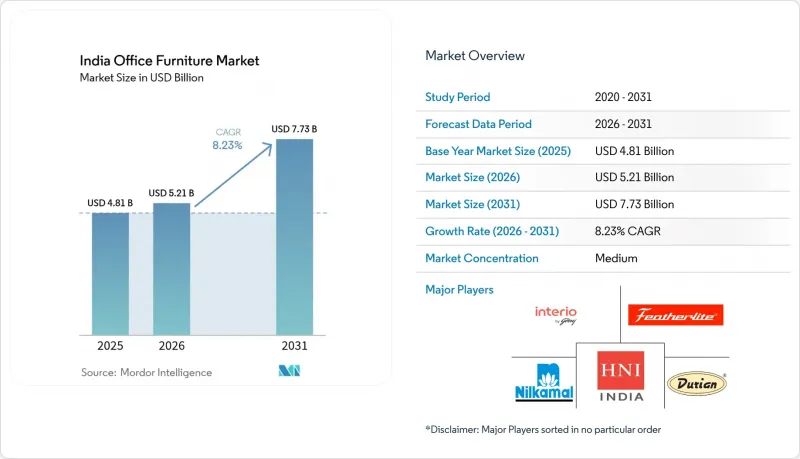
This report is Segmented by Product (Chairs, Tables, Storage Units, and More), Material (Wood, Metal, and More), Price Range (Economy, Mid-Range, Premium), End-User (Corporate Offices, Healthcare Offices, and More), Distribution Channel (B2C/Retail, B2B/Directly From Manufacturers), and Geography (North India, West India, South India, and More). The Market Forecasts are Provided in Terms of Value (USD).
India Office Furniture Market Trends and Insights
Hybrid Working Models Driving Demand for Flexible Furniture
Corporate occupancy now averages 60-70% on any given day, prompting companies to prioritize modular desks, height-adjustable workstations, and movable storage that can be reconfigured quickly when teams alternate between office and home. Demand for such adaptive solutions caused manufacturers to ship more than 100,000 home-office kits during the pandemic transition. Smart desks embedded with occupancy sensors mark the next wave, allowing facility managers to monitor space utilization in real time. As certification under BIS QCO 2025 tightens, vendors able to combine flexibility with compliance win larger multi-city rollout contracts. This preference for modularity feeds directly into the India office furniture market, reinforcing growth momentum across both premium and mid-range price bands.
Expansion of Corporate Real Estate Footprint
Rapid scaling of Global Capability Centres, which already employ 1.9 million people in 1,950 facilities, underpins sustained demand for quality furniture that meets global standards. Large occupiers increasingly engage single-vendor partners to furnish multiple sites, rewarding suppliers with nationwide installation and after-sales capacity. Premium finishes, collaborative tables, and acoustic booths dominate new fit-outs as technology and financial services firms elevate employee experience. Continuous growth in floor space across tier-1 cities and the rise of managed office operators in satellite towns keep the India office furniture market firmly on an upward trajectory.
Volatile Wood, Steel and Polymer Prices
Input cost swings force suppliers to shorten quotation validity and build price-escalation clauses into contracts. Steel frames used in modular cubicles have seen double-digit quarterly adjustments, while imported veneer prices fluctuate with shipping rates and currency moves. Manufacturers hedge inventories but margin compression persists, particularly on long-cycle government orders. Some vendors redesign products to reduce metal content and incorporate engineered panels that lower exposure to commodity volatility. Although raw-material turbulence dents immediate profitability, sustained demand keeps the India office furniture market expanding.
Other drivers and restraints analyzed in the detailed report include:
- Government "Make in India" Incentives for Furniture Manufacturing
- Rising Ergonomic and Employee-Well-Being Focus
- Price Pressure from Unorganised Manufacturers
For complete list of drivers and restraints, kindly check the Table Of Contents.
Segment Analysis
Chairs generated a 26.08% slice of 2025 revenues as enterprises refreshed seating stock to meet ergonomic guidelines. Within the segment, high-back task chairs and mesh models see consistent replacement cycles of three to four years, stabilizing base demand. Tables, however, exhibit the fastest 8.74% CAGR outlook, buoyed by breakout zones and hot-desk layouts that multiply worksurface requirements. The India office furniture market size for tables is projected to expand from USD 1.14 billion in 2026 to USD 1.74 billion by 2031.
Growth also stems from wider adoption of conference pods and sit-stand stations that blend table and divider functions. Mobile pedestal units bundle with benching systems, raising ticket size per workstation. Meanwhile, storage units confront digitalization headwinds, although lockable modular cubes gain favor in flexible offices. Soft seating and acoustic booths carve niches as employers add focus pods to open plans. Suppliers that offer coordinated chair-table packages with rapid lead times capture larger project awards, reinforcing their presence in the India office furniture market.
Wood preserved a 42.25% share in 2025 on the strength of executive cabins and boardroom suites, yet its position erodes as polymers replicate timber aesthetics at lighter weight. The India office furniture market share for polymers is slated to reach 27.65% by 2031 after rising at an 8.61% CAGR.
Polypropylene and glass-fiber blends allow complex geometries while meeting the 60 kg load standard for desks under BIS QCO 2025. Metal remains critical for healthcare and industrial settings that demand easy disinfection, though inflationary steel prices restrain its advance. Manufacturers investing in automated powder-coating lines and recycled PET felt panels gain an edge with sustainability-minded buyers. Wood suppliers, for their part, pivot to FSC-certified tropical hardwood substitutes and water-based lacquers to align with low-VOC mandates.
Complete Report Scope:
- By Product
- Chairs
- Employee Chairs
- Meeting Chairs
- Guest Chairs
- Tables
- Conference Tables
- Desks
- Other Tables
- Storage Units
- Filing Cabinets
- Bookcases & Shelving
- Sofas/Soft Seating
- Booths and Office Dividers
- Other Office Furniture (Stools, Reception Area Furniture, Accessories, Others)
- Chairs
- By Material
- Wood
- Metal
- Plastic & Polymer
- Other Materials
- By Price Range
- Economy
- Mid-range
- Premium
- By End-user
- Corporate Offices
- Healthcare Offices
- Educational Institutions
- Government & Public Offices
- Hospitality & Retail Back-office
- Others
- By Distribution Channel
- B2C / Retail
- Home Centers
- Specialty Furniture Stores
- Online
- Other Distribution Channels
- B2B / Directly from Manufacturers
- B2C / Retail
- By Geography
- North India
- West India
- South India
- East India
List of Companies Covered in this Report:
- Godrej Interio
- Featherlite
- Durian
- Nilkamal
- Wipro Furniture
- HNI India
- Steelcase India
- Herman Miller India
- Haworth India
- Ikea India
- Spacewood
- Urban Ladder
- Pepperfry
- Zuari Furniture
- Greenlam Office Solutions
- VJ Interior
- Tangent Furniture
- Opendesk India
- Orange Tree
- Modfurn
- ErgoSpace
- Ecopanel Partitions
Additional Benefits:
- The market estimate (ME) sheet in Excel format
- 3 months of analyst support
TABLE OF CONTENTS
1 Introduction
- 1.1 Study Assumptions & Market Definition
- 1.2 Scope of the Study
2 Research Methodology
3 Executive Summary
4 Market Landscape
- 4.1 Market Overview
- 4.2 Market Drivers
- 4.2.1 Hybrid working models driving demand for flexible furniture
- 4.2.2 Expansion of corporate real estate footprint
- 4.2.3 Government "Make in India" incentives for furniture manufacturing
- 4.2.4 Rising ergonomic and employee-well-being focus
- 4.2.5 Tier-II & III co-working boom
- 4.2.6 Modular demountable partitions shorten fit-out cycles
- 4.3 Market Restraints
- 4.3.1 Volatile wood, steel and polymer prices
- 4.3.2 Price pressure from unorganised manufacturers
- 4.3.3 Lengthy municipal fire-safety certification
- 4.3.4 Sustainability audits limiting VOC-heavy finishes
- 4.4 Industry Value Chain Analysis
- 4.5 Porter's Five Forces Analysis
- 4.5.1 Bargaining Power of Buyers
- 4.5.2 Bargaining Power of Suppliers
- 4.5.3 Threat of New Entrants
- 4.5.4 Threat of Substitutes
- 4.5.5 Competitive Rivalry
- 4.6 Insights into the Latest Trends and Innovations in the Market
- 4.7 Insights on Recent Developments (New Product Launches, Strategic Initiatives, Investments, Partnerships, JVs, Expansion, M&As, etc.) in the Market
- 4.8 Insights on Regulatory Framework and Industry Standards for Office Furniture
5 Market Size & Growth Forecasts (Value in USD)
- 5.1 By Product
- 5.1.1 Chairs
- 5.1.1.1 Employee Chairs
- 5.1.1.2 Meeting Chairs
- 5.1.1.3 Guest Chairs
- 5.1.2 Tables
- 5.1.2.1 Conference Tables
- 5.1.2.2 Desks
- 5.1.2.3 Other Tables
- 5.1.3 Storage Units
- 5.1.3.1 Filing Cabinets
- 5.1.3.2 Bookcases & Shelving
- 5.1.4 Sofas/Soft Seating
- 5.1.5 Booths and Office Dividers
- 5.1.6 Other Office Furniture (Stools, Reception Area Furniture, Accessories, Others)
- 5.1.1 Chairs
- 5.2 By Material
- 5.2.1 Wood
- 5.2.2 Metal
- 5.2.3 Plastic & Polymer
- 5.2.4 Other Materials
- 5.3 By Price Range
- 5.3.1 Economy
- 5.3.2 Mid-range
- 5.3.3 Premium
- 5.4 By End-user
- 5.4.1 Corporate Offices
- 5.4.2 Healthcare Offices
- 5.4.3 Educational Institutions
- 5.4.4 Government & Public Offices
- 5.4.5 Hospitality & Retail Back-office
- 5.4.6 Others
- 5.5 By Distribution Channel
- 5.5.1 B2C / Retail
- 5.5.1.1 Home Centers
- 5.5.1.2 Specialty Furniture Stores
- 5.5.1.3 Online
- 5.5.1.4 Other Distribution Channels
- 5.5.2 B2B / Directly from Manufacturers
- 5.5.1 B2C / Retail
- 5.6 By Geography
- 5.6.1 North India
- 5.6.2 West India
- 5.6.3 South India
- 5.6.4 East India
6 Competitive Landscape
- 6.1 Market Concentration
- 6.2 Strategic Moves
- 6.3 Market Share Analysis
- 6.4 Company Profiles {includes Global level Overview, Market level overview, Core Segments, Financials as available, Strategic Information, Market Rank/Share for key companies, Products & Services, and Recent Developments}
- 6.4.1 Godrej Interio
- 6.4.2 Featherlite
- 6.4.3 Durian
- 6.4.4 Nilkamal
- 6.4.5 Wipro Furniture
- 6.4.6 HNI India
- 6.4.7 Steelcase India
- 6.4.8 Herman Miller India
- 6.4.9 Haworth India
- 6.4.10 Ikea India
- 6.4.11 Spacewood
- 6.4.12 Urban Ladder
- 6.4.13 Pepperfry
- 6.4.14 Zuari Furniture
- 6.4.15 Greenlam Office Solutions
- 6.4.16 VJ Interior
- 6.4.17 Tangent Furniture
- 6.4.18 Opendesk India
- 6.4.19 Orange Tree
- 6.4.20 Modfurn
- 6.4.21 ErgoSpace
- 6.4.22 Ecopanel Partitions
7 Market Opportunities & Future Outlook
- 7.1 Smart Connected Desks Enhancing Office Productivity
- 7.2 Flexible Co-Working Spaces Demanding Versatile Furniture

