PUBLISHER: Mordor Intelligence | PRODUCT CODE: 2115135

PUBLISHER: Mordor Intelligence | PRODUCT CODE: 2115135
Asia-Pacific Aircraft MRO - Market Share Analysis, Industry Trends & Statistics, Growth Forecasts (2026 - 2031)
According to Mordor Intelligence, the Asia-Pacific aircraft MRO market was valued at USD 23.70 billion in 2026 and is expected to reach USD 30.29 billion by 2031, growing at a CAGR of 5.03%.
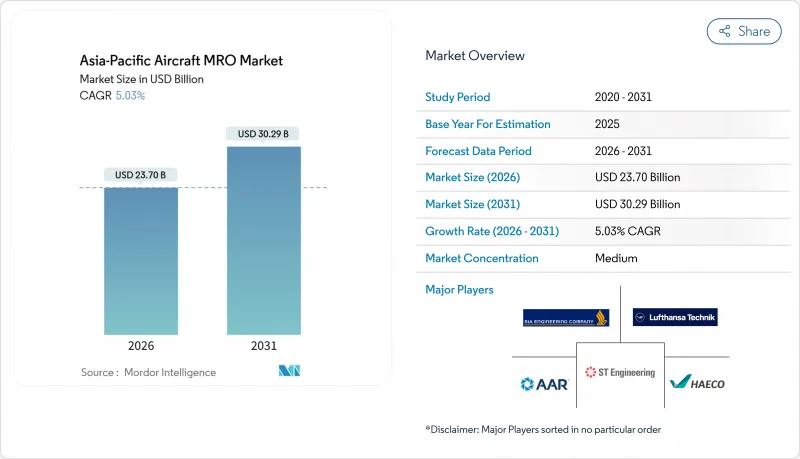
This report is Segmented by MRO Type (Engine, Airframe Heavy Maintenance, and More), Aircraft Type (Fixed Wing and Rotary Wing), Application (Commercial Aviation, Military Aviation, and General Aviation), Service Provider (Airline-Affiliated MRO, OEM Captive and More), and Geography (China, India, Malaysia, Indonesia, Singapore and More). The Market Forecasts are Provided in Terms of Value (USD).
Asia-Pacific Aircraft MRO Market Trends and Insights
Fleet Expansion of Narrow-Body and LCC Fleets Drives Baseline Demand
Airbus projects 19,500 aircraft deliveries to Asia-Pacific operators between 2024 and 2043, with 75% being single-aisle jets. These aircraft typically perform 10-12 flights daily, leading to compressed maintenance intervals. IndiGo's fleet, currently at 350 aircraft, is expected to exceed 500 aircraft by 2027. By 2027-28, IndiGo plans to add 12 bays at Bangalore Airport for MRO, aiming to triple its total available simultaneous aircraft MRO bays. Despite this expansion, the airline will remain dependent on MRO capacities outside India for another decade, until its new facility becomes fully operational.
Similar capacity constraints are observed with VietJet, AirAsia, and Cebu Pacific, which keep line-maintenance slots limited and favor providers with EASA Part-145 approvals. Meanwhile, China Eastern's new twelve-widebody mega-hangar in Shanghai highlights efforts to expand infrastructure and shift maintenance work to lower-cost domestic bases. These developments contribute to sustained baseline growth in the Asia-Pacific aircraft MRO market, further supported by delivery delays that extend the service life of older jets.
Aging Aircraft Creating Heavy-Check Backlog Elevates Demand
Delays in aircraft deliveries from Boeing and Airbus are expected to increase the average fleet age in the Asia-Pacific region to 11.4 years by 2026. This aging fleet will require more frequent D-checks, costing USD 3-5 million each and consuming up to 50,000 labor hours. Qantas has reported unscheduled corrosion repairs that sidelined 737-800s for six weeks, reflecting a broader backlog affecting maintenance facilities in Bangkok, Kuala Lumpur, and Jakarta. ST Engineering's airframe slots in Singapore are fully booked until mid-2027, with overflow routed to Jinan. Providers are prioritizing higher-margin engine work, leaving a gap in heavy-check capacity. Additionally, landing-gear overhauls face 18-month queues due to the limited number of authorized stations in the region, driving premium pricing for incumbents. Mandatory inspections under CAAC CCAR-145 and JCAB regulations ensure continued demand for structural maintenance in the Asia-Pacific aircraft MRO market.
Licensed-Technician Talent Crunch Constrains Capacity Expansion
IATA estimates that the Asia-Pacific region will require 189,000 licensed technicians by 2032, but is projected to produce only 127,000, resulting in a 33% shortfall. China alone will need 121,900 additional technicians, while India requires 45,000 by 2027. However, DGCA-approved schools in India graduate fewer than 2,000 engineers annually. Salaries in Manila and Bangkok have risen by 8-12% annually as Gulf carriers attract experienced staff with 30-40% higher tax-free pay, squeezing MRO margins tied to fixed-price contracts. Automation helps Air India reduce manual inspection hours by 25%, but the high capital investment required sidelines smaller providers. Certification timelines under EASA Part-66 and FAA Part 65 remain rigid, limiting the ability to address labor shortages despite physical hangar expansions, thereby constraining the growth of the Asia-Pacific aircraft MRO market.
Other drivers and restraints analyzed in the detailed report include:
- OEM-Airline Joint Ventures Redefine Aftermarket Capture
- AI-Driven Predictive Maintenance and Digital Twins
- GTF and LEAP Reliability Issues Stretch Turnaround Times
For complete list of drivers and restraints, kindly check the Table Of Contents.
Segment Analysis
Engine services accounted for 43.24% of the 2025 market value, driven by USD 3-5 million shop visits and the intensive OEM tooling requirements that few independent providers can meet. Prolonged GTF and LEAP engine events have increased parts consumption, pushing segment revenues higher despite reduced throughput. Consequently, the Asia-Pacific aircraft MRO engine market is growing faster than flight hours, underscoring the need for additional test cells in locations such as Singapore and Zhuhai.
Modifications and upgrades represent the fastest-growing segment, with a 7.59% CAGR, as airlines retrofit cabins, install winglets, and certify systems for 1-5% SAF blends under CAAS regulations. Airlines often combine these projects with heavy maintenance checks to optimize downtime, generating incremental revenue of approximately USD 1 million per aircraft. ST Engineering reported a 40% increase in retrofit inquiries in 2025, reflecting demand from operators seeking immediate fuel-efficiency improvements. This trend positions modifications as a strategic buffer for providers against fluctuations in airframe maintenance workloads within the Asia-Pacific aircraft MRO market.
Fixed-wing aircraft accounted for 96.87% of 2025 expenditures, led by A320 and 737 families, which log 3,500-4,500 flight hours annually and require A-checks every 500-750 hours. Widebody D-checks, which can cost up to USD 7 million and require 60,000 labor hours, have made Singapore, Hong Kong, and Shanghai critical hubs. The Asia-Pacific aircraft MRO market for fixed-wing services remains stable, driven by mandated inspections, despite fluctuations in traffic.
Helicopter maintenance, which accounts for only 3.13% of spending, is growing at an annual rate of 6.01%. This growth is driven by offshore energy, EMS, and tourism operators in Australia, Indonesia, and Thailand, who are refreshing AW139, H225, and Bell 412 fleets. Extended lead times of 12-18 months for dynamic components, combined with limited authorized repair shops, have created pricing power for providers. Expanding rotary-wing maintenance capabilities allows providers to diversify revenue streams and mitigate seasonal demand fluctuations in the Asia-Pacific aircraft MRO market.
Complete Report Scope:
- By MRO Type
- Engine
- Airframe Heavy Maintenance
- Component
- Line and Routine Checks
- Modifications and Upgrades
- By Aircraft Type
- Fixed Wing
- Rotary Wing
- By Application
- Commercial Aviation
- Passenger
- Cargo/Freighter
- Military Aviation
- General Aviation
- Commercial Aviation
- By Service Provider
- Airline-affiliated MRO
- Independent Third-party MRO
- OEM-Captive MRO
- Military Depots
- By Country
- China
- India
- South Korea
- Japan
- Singapore
- Malaysia
- Indonesia
- Rest of Asia-Pacific
List of Companies Covered in this Report:
- Hong Kong Aircraft Engineering Company Limited
- Singapore Technologies Engineering Ltd.
- Lufthansa Technik AG
- AAR CORP.
- SIA Engineering Company
- Air Works India (Engineering) Private Limited
- Guangzhou Aircraft Maintenance Engineering Company Limited (GAMECO)
- Lockheed Martin Corporation
- The Boeing Company
- ExecuJet MRO Services (Dassault Aviation)
- General Electric Company
- Safran SA
- GMF AeroAsia
- Rolls-Royce Holdings plc
- Avia Solutions Group PLC
- Sepang Aircraft Engineering Sdn Bhd (Airbus SE)
- AIRCRAFT MAINTENANCE AND ENGINEERING CORPORATION, BEIJING (AMECO)
- MTU Maintenance Zhuhai Co. Ltd.
- Thai Airways International Public Company Ltd. (THAI)
- KOREA AEROSPACE INDUSTRIES, LTD.
Additional Benefits:
- The market estimate (ME) sheet in Excel format
- 3 months of analyst support
TABLE OF CONTENTS
1 INTRODUCTION
- 1.1 Study Assumptions and Market Definition
- 1.2 Scope of the Study
2 RESEARCH METHODOLOGY
3 EXECUTIVE SUMMARY
4 MARKET LANDSCAPE
- 4.1 Market Overview
- 4.2 Market Drivers
- 4.2.1 Fleet expansion of narrow-body and LCC fleets
- 4.2.2 Aging aircraft creating heavy-check backlog
- 4.2.3 OEM-airline JVs accelerating aftermarket capture
- 4.2.4 Sustainability retrofits and SAF-ready conversions
- 4.2.5 AI-driven predictive maintenance and digital twins
- 4.2.6 On-shoring to hedge supply-chain/geopolitical risk
- 4.3 Market Restraints
- 4.3.1 Licensed-technician talent crunch
- 4.3.2 Global parts and materials shortages
- 4.3.3 GTF and LEAP reliability issues stretch TATs
- 4.3.4 Inflation and FX volatility pressuring costs
- 4.4 Value Chain Analysis
- 4.5 Regulatory Landscape
- 4.6 Technological Outlook
- 4.7 Porter's Five Forces Analysis
- 4.7.1 Bargaining Power of Buyers
- 4.7.2 Bargaining Power of Suppliers
- 4.7.3 Threat of New Entrants
- 4.7.4 Threat of Substitutes
- 4.7.5 Competitive Rivalry
5 MARKET SIZE AND GROWTH FORECASTS (VALUE)
- 5.1 By MRO Type
- 5.1.1 Engine
- 5.1.2 Airframe Heavy Maintenance
- 5.1.3 Component
- 5.1.4 Line and Routine Checks
- 5.1.5 Modifications and Upgrades
- 5.2 By Aircraft Type
- 5.2.1 Fixed Wing
- 5.2.2 Rotary Wing
- 5.3 By Application
- 5.3.1 Commercial Aviation
- 5.3.1.1 Passenger
- 5.3.1.2 Cargo/Freighter
- 5.3.2 Military Aviation
- 5.3.3 General Aviation
- 5.3.1 Commercial Aviation
- 5.4 By Service Provider
- 5.4.1 Airline-affiliated MRO
- 5.4.2 Independent Third-party MRO
- 5.4.3 OEM-Captive MRO
- 5.4.4 Military Depots
- 5.5 By Country
- 5.5.1 China
- 5.5.2 India
- 5.5.3 South Korea
- 5.5.4 Japan
- 5.5.5 Singapore
- 5.5.6 Malaysia
- 5.5.7 Indonesia
- 5.5.8 Rest of Asia-Pacific
6 COMPETITIVE LANDSCAPE
- 6.1 Market Concentration
- 6.2 Strategic Moves
- 6.3 Market Share Analysis
- 6.4 Company Profiles (includes Global level Overview, Market level overview, Core Segments, Financials as available, Strategic Information, Market Rank/Share for key companies, Products and Services, and Recent Developments)
- 6.4.1 Hong Kong Aircraft Engineering Company Limited
- 6.4.2 Singapore Technologies Engineering Ltd.
- 6.4.3 Lufthansa Technik AG
- 6.4.4 AAR CORP.
- 6.4.5 SIA Engineering Company
- 6.4.6 Air Works India (Engineering) Private Limited
- 6.4.7 Guangzhou Aircraft Maintenance Engineering Company Limited (GAMECO)
- 6.4.8 Lockheed Martin Corporation
- 6.4.9 The Boeing Company
- 6.4.10 ExecuJet MRO Services (Dassault Aviation)
- 6.4.11 General Electric Company
- 6.4.12 Safran SA
- 6.4.13 GMF AeroAsia
- 6.4.14 Rolls-Royce Holdings plc
- 6.4.15 Avia Solutions Group PLC
- 6.4.16 Sepang Aircraft Engineering Sdn Bhd (Airbus SE)
- 6.4.17 AIRCRAFT MAINTENANCE AND ENGINEERING
CORPORATION, BEIJING (AMECO)
- 6.4.18 MTU Maintenance Zhuhai Co. Ltd.
- 6.4.19 Thai Airways International Public Company Ltd. (THAI)
- 6.4.20 KOREA AEROSPACE INDUSTRIES, LTD.
7 MARKET OPPORTUNITIES AND FUTURE OUTLOOK
- 7.1 White-space and Unmet-Need Assessment

