PUBLISHER: Mordor Intelligence | PRODUCT CODE: 2115216

PUBLISHER: Mordor Intelligence | PRODUCT CODE: 2115216
North America Aircraft MRO - Market Share Analysis, Industry Trends & Statistics, Growth Forecasts (2026 - 2031)
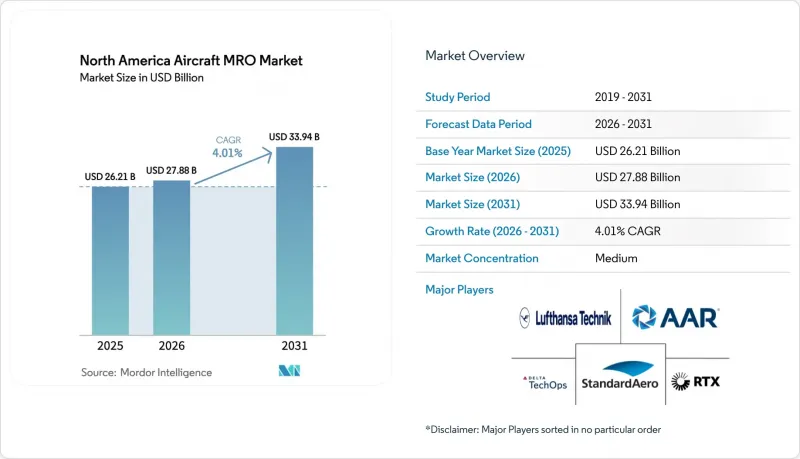
According to Mordor Intelligence, the North America aircraft MRO market size is expected to grow from USD 26.76 billion in 2025 to USD 27.88 billion in 2026 and is forecasted to reach USD 33.94 billion by 2031 at 4.01% CAGR over 2026-2031.
This report is Segmented by MRO Type (Engine, Airframe Heavy Maintenance, and More), Aircraft Type (Fixed Wing and Rotary Wing), Application (Commercial Aviation, Military Aviation, and General Aviation), Service Provider (Airline-Affiliated MRO, Independent Third-Party MRO, and More) and Geography (United States, Canada, and Mexico). The Market Forecasts are Provided in Terms of Value (USD).
North America Aircraft MRO Market Trends and Insights
Aging Commercial Fleet Requiring Life-Extension MRO
The average age of the commercial jet fleet in the region increased to 12.8 years in 2025, with narrowbody aircraft averaging 14.1 years and widebody aircraft averaging 11.3 years. Airlines are targeting 25- to 30-year life cycles for B737NG and A320ceo airframes, putting upward pressure on heavy D-check activity and corrosion remediation. Supplemental inspection mandates under FAA Part 26 are adding 15%-20% extra labor hours per event as cracks appear in wing root attachments and lap joints. OEMs increasingly bundle winglet retrofits and cabin reconfigurations with scheduled checks, locking customers into multi-year service packages that dampen price competition. These actions ensure the North America aircraft MRO market maintains a dependable structural backlog while intensifying the scramble for skilled technicians.
Rebound in Passenger and Cargo Traffic Boosting Flight Hours
Revenue departures increased 7.3% year-over-year in 2024 to 11.2 million, and total flight hours are expected to reach 28.5 million in 2026, surpassing pre-pandemic levels for the first time. A narrowbody flying 11 hours per day reaches its next engine shop visit roughly 18 months sooner than one flying 9 hours, bringing forward CFM56 and LEAP cycles. FedEx and UPS each reported double-digit block-hour growth in 2024, accelerating the overhaul of landing gear and APU. The engine overhaul turnaround has widened to 120-150 days by 2026, compared with 90 days two years earlier, forcing operators to lease spare engines and thereby inflating near-term spending. Consequently, the North America aircraft MRO market is experiencing demand peaks in line and engine services despite capacity headwinds.
Acute Skilled-Technician Shortage
Around 30% of certificated mechanics will reach retirement eligibility within five years, while US aviation schools graduated only 3,200 technicians in 2024, against an industry demand of roughly 5,000. Starting pay at Delta TechOps reached USD 72,000 in 2025, and sign-on bonuses of USD 10,000 to USD 15,000 became common at independent shops. Throughput fell 10% to 15% in 2025 compared to 2023, as facilities struggled to staff second shifts, forcing airlines to lease additional aircraft to protect their schedules. Automation, such as robotic paint stripping and automated non-destructive testing, offers relief but requires three to five years to scale. Until then, the labor gap will continue to weigh on the North America aircraft MRO market.
Other drivers and restraints analyzed in the detailed report include:
- OEM Long-Term Service Agreements Expanding Aftermarket Capture
- Engine-Shop Capacity Crunch Inflating US In-Region Demand
- Persistent Parts and Supply Chain Bottlenecks
For complete list of drivers and restraints, kindly check the Table Of Contents.
Segment Analysis
Engine activity generated 42.43% of 2025 revenue, as 18,000 active commercial turbofans produced a steady cadence of first-run removals. Each overhaul averaged USD 1.8 million for narrowbody units and USD 4.5 million for widebody engines. This sub-segment anchors relationships because high-value workscopes frequently cascade into accessory, fuel-nozzle, and gearbox repairs. Component shops, however, expand at a 4.25% CAGR through 2031 as avionics mandates, landing-gear fatigue, and APU renewals rise in tandem with fleet age. Because component visits require lower capital expenditure than engine test cells, they enable independents to enter the North America aircraft MRO market rapidly.
Line-maintenance providers continue to supply a base-load of walk-around checks, minor defect rectification, and A-checks at outstations, sustaining employment across regional airports. Heavy airframe work grows more slowly due to extended structural intervals on next-generation jets. Yet, schedules remain full as operators retrofit cabin Wi-Fi, winglets, and weight-saving composite panels. Modifications and upgrades offer margin upside because engineering services add billable design hours alongside hands-on labor. Combined, these diverse service lines keep the North America aircraft MRO market resilient to cyclical swings.
Fixed-wing fleets delivered 64.22% of 2025 MRO revenue, reflecting 7,800 active narrowbodies, 1,200 widebodies, and more than 15,000 business jets and turboprops registered in North America. Their high utilization and established maintenance planning documents provide predictable shop scheduling. Rotary-wing demand, although smaller in absolute value, grows at a 4.87% CAGR as military UH-60 and AH-64 upgrades and offshore oil-and-gas fleet renewals drive transmission overhaul and composite rotor-blade replacement work.
Rotary-wing MRO requires specialized tooling for dynamic components and hot-section inspections of turboshaft engines, creating entry barriers that favor niche providers. Firms such as StandardAero and ST Engineering have established rotary-wing centers of excellence, positioning them to capitalize on depot overflow and to supply composite repair know-how. Consequently, rotary-wing programs add a differentiated growth vector to the North America aircraft MRO market.
Complete Report Scope:
- By MRO Type
- Engine
- Airframe Heavy Maintenance
- Component
- Line and Routine Checks
- Modifications and Upgrades
- By Aircraft Type
- Fixed Wing
- Rotary Wing
- By Application
- Commercial Aviation
- Passenger
- Cargo/Freighter
- Military Aviation
- General Aviation
- Commercial Aviation
- By Service Provider
- Airline-affiliated MRO
- Independent Third-party MRO
- OEM-Captive MRO
- Military Depots
- By Geography
- United States
- Canada
- Mexico
List of Companies Covered in this Report:
- Delta TechOps (Delta Air Lines Inc.)
- AAR CORP.
- StandardAero Aviation Holdings, Inc.
- Lufthansa Technik AG
- RTX Corporation
- General Electric Company
- Safran SA
- Singapore Technologies Engineering Ltd.
- Hong Kong Aircraft Engineering Company Limited
- Rolls-Royce Holdings plc
- Honeywell International Inc.
- The Boeing Company
- Lockheed Martin Corporation
- Textron Aviation Inc.
- IAG Aero Group
- Spirit AeroSystems Inc.
- Air Canada Group
- Aeroman (MROH Group)
- WestJet Technics
Additional Benefits:
- The market estimate (ME) sheet in Excel format
- 3 months of analyst support
TABLE OF CONTENTS
1 INTRODUCTION
- 1.1 Study Assumptions and Market Definition
- 1.2 Scope of the Study
2 RESEARCH METHODOLOGY
3 EXECUTIVE SUMMARY
4 MARKET LANDSCAPE
- 4.1 Market Overview
- 4.2 Market Drivers
- 4.2.1 Aging commercial fleet requiring life-extension MRO
- 4.2.2 Rebound in passenger and cargo traffic boosting flight hours
- 4.2.3 OEM long-term service agreements expanding aftermarket capture
- 4.2.4 Engine-shop capacity crunch inflating US in-region demand
- 4.2.5 Surge in Used Serviceable Material (USM) adoption to cut TAT
- 4.2.6 Military life-extension programs for legacy fleets
- 4.3 Market Restraints
- 4.3.1 Acute skilled-technician shortage
- 4.3.2 Persistent parts and supply-chain bottlenecks
- 4.3.3 Tightening hazardous-chemicals and waste-disposal regulations
- 4.3.4 Longer maintenance intervals on new-gen aircraft
- 4.4 Value Chain Analysis
- 4.5 Regulatory Landscape
- 4.6 Technological Outlook
- 4.7 Porter's Five Forces Analysis
- 4.7.1 Bargaining Power of Buyers
- 4.7.2 Bargaining Power of Suppliers
- 4.7.3 Threat of New Entrants
- 4.7.4 Threat of Substitutes
- 4.7.5 Intensity of Rivalry
5 MARKET SIZE AND GROWTH FORECASTS (VALUE)
- 5.1 By MRO Type
- 5.1.1 Engine
- 5.1.2 Airframe Heavy Maintenance
- 5.1.3 Component
- 5.1.4 Line and Routine Checks
- 5.1.5 Modifications and Upgrades
- 5.2 By Aircraft Type
- 5.2.1 Fixed Wing
- 5.2.2 Rotary Wing
- 5.3 By Application
- 5.3.1 Commercial Aviation
- 5.3.1.1 Passenger
- 5.3.1.2 Cargo/Freighter
- 5.3.2 Military Aviation
- 5.3.3 General Aviation
- 5.3.1 Commercial Aviation
- 5.4 By Service Provider
- 5.4.1 Airline-affiliated MRO
- 5.4.2 Independent Third-party MRO
- 5.4.3 OEM-Captive MRO
- 5.4.4 Military Depots
- 5.5 By Geography
- 5.5.1 United States
- 5.5.2 Canada
- 5.5.3 Mexico
6 COMPETITIVE LANDSCAPE
- 6.1 Market Concentration
- 6.2 Strategic Moves
- 6.3 Market Share Analysis
- 6.4 Company Profiles (includes Global level Overview, Market level overview, Core Segments, Financials as available, Strategic Information, Market Rank/Share for key companies, Products and Services, and Recent Developments)
- 6.4.1 Delta TechOps (Delta Air Lines Inc.)
- 6.4.2 AAR CORP.
- 6.4.3 StandardAero Aviation Holdings, Inc.
- 6.4.4 Lufthansa Technik AG
- 6.4.5 RTX Corporation
- 6.4.6 General Electric Company
- 6.4.7 Safran SA
- 6.4.8 Singapore Technologies Engineering Ltd.
- 6.4.9 Hong Kong Aircraft Engineering Company Limited
- 6.4.10 Rolls-Royce Holdings plc
- 6.4.11 Honeywell International Inc.
- 6.4.12 The Boeing Company
- 6.4.13 Lockheed Martin Corporation
- 6.4.14 Textron Aviation Inc.
- 6.4.15 IAG Aero Group
- 6.4.16 Spirit AeroSystems Inc.
- 6.4.17 Air Canada Group
- 6.4.18 Aeroman (MROH Group)
- 6.4.19 WestJet Technics
7 MARKET OPPORTUNITIES AND FUTURE OUTLOOK
- 7.1 White-space and Unmet-need Assessment

