PUBLISHER: Mordor Intelligence | PRODUCT CODE: 2116640

PUBLISHER: Mordor Intelligence | PRODUCT CODE: 2116640
Middle East And Africa Aircraft MRO - Market Share Analysis, Industry Trends & Statistics, Growth Forecasts (2026 - 2031)
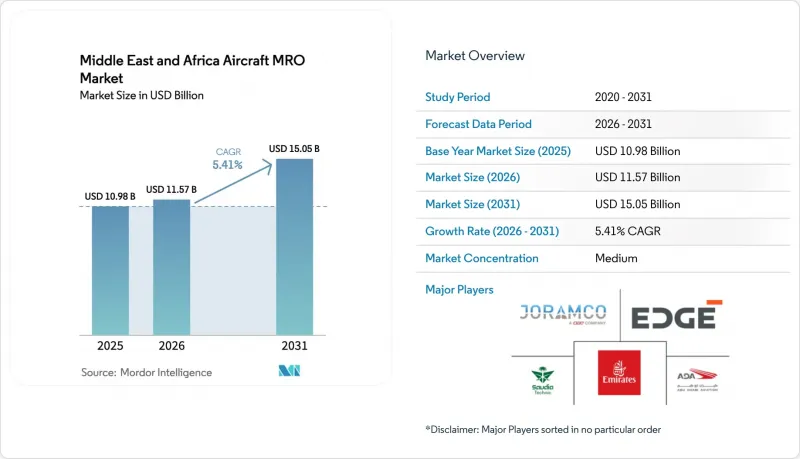
According to Mordor Intelligence, the Middle East and Africa aircraft MRO market size was valued at USD 10.98 billion in 2025 and estimated to grow from USD 11.57 billion in 2026 to reach USD 15.05 billion by 2031, at a CAGR of 5.41% during the forecast period (2026-2031).
This report is Segmented by MRO Type (Airframe MRO, Engine MRO, Component and Modifications MRO, and Line Maintenance), Aviation (Commercial Aviation, Military Aviation, General Aviation, and Unmanned Aerial Vehicles), Maintenance Provider Type (Airline In-House MRO and More), and Geography (Middle East and Africa). The Market Forecasts are Provided in Terms of Value (USD).
Middle East And Africa Aircraft MRO Market Trends and Insights
Fleet Renewal Programs by Gulf and African Flag Carriers
Gulf and African airlines are re-equipping with A320neo, 737 MAX, 777X, and A350 aircraft, driving a surge in early-life engine shop visits for LEAP-1A, GEnx, and Trent XWB powerplants. GE Aerospace invested USD 10 million in test-cell upgrades in Dubai and Doha to meet the next-generation workload. Younger fleets deliver fuel savings but demand tighter adherence to OEM restoration intervals to safeguard operating-cost guarantees. Carriers that secure overhaul slots early gain dispatch reliability advantages, prompting competitors to book capacity years in advance. The resulting front-loaded demand accelerates engine-service revenue growth faster than global fleet expansion.
Expansion of Low-Cost Carriers Across the GCC and North Africa
Flydubai, Air Arabia, and Jazeera Airways operate high-utilization narrow-body fleets exceeding 11 flight hours daily, compressing A-check cycles and amplifying demand for line maintenance. Flydubai's USD 190 million facility at Dubai World Central opened extra narrow-body bays that turn aircraft in 6 to 8 hours, keeping schedule disruptions low. Safran's Casablanca LEAP shop mirrors this model for North-African LCCs, allowing operators to avoid ferry flights to Europe. Variable-cost maintenance plans, component pooling, and pay-by-the-hour contracts align with the LCC's cash-flow profile and redirect heavy-check revenue to regional hubs. The short booking horizons characteristic of LCCs benefit providers able to guarantee overnight returns, raising line-service volume across the GCC and North Africa.
Shortage of Skilled Maintenance Technicians and Retention Challenges
Boeing projects that Africa will require 22,000 new licensed technicians by 2042, yet current regional training pipelines graduate fewer than 500 engineers annually. Gulf shops compete directly with their host airlines for EASA Part-66 and FAA-licensed talent, driving up base salaries by double digits and compressing MRO operating margins. Visa requirements and housing costs further constrain expatriate hiring, while poaching between carriers raises staff turnover rates above 15% in UAE free zones, and delays in workforce scale-up risk underutilizing new hangars, such as Joramco's five-line expansion in Amman. The talent gap lowers adequate capacity, subtracting 0.9 percentage points from forecast CAGR across the aircraft MRO market.
Other drivers and restraints analyzed in the detailed report include:
- Increasing Adoption of OEM Power-by-the-Hour Service Agreements
- Defense Localization Initiatives Supporting Domestic Engine MRO Capabilities
- Geopolitical Instability Disrupting Engine-Parts and Material Supply Chains
For complete list of drivers and restraints, kindly check the Table Of Contents.
Segment Analysis
Engine work represented the single-largest pool, capturing 37.02% of the aircraft MRO market share in 2025. Yet line maintenance, buoyed by on-wing borescope inspections and mobile repairs, is projected to outpace every other segment at a 6.05% CAGR to 2031. The aircraft MRO market size attributable to line services reached USD 2.94 billion in 2025 and is forecast to reach USD 4.19 billion by 2031, aided by GCC LCC fleets that prioritize rapid turnarounds. Providers invest in portable test cells, engine wash rigs, and mobile borescope suites to shrink downtime windows, with GE Aerospace and Lufthansa Technik leading deployment across Dubai and Doha hubs. High-cycle narrowbody fleets amplify demand for A-checks and corrective tasks, incentivizing MROs to base technicians across airport ramps rather than in hangar bays.
Line maintenance growth cascades through component provisioning; mobile engine teams often flag accessory gearbox leaks, bleed-valve failures, and minor hot-section distress that need immediate spares. Safran Landing Systems' forthcoming East Africa office aims to provide predictive parts supply for landing gear interventions. Continuous line activity compresses shop-visit intervals, prompting providers to balance throughput against resource strain. Engine MRO remains capital-intensive; CFM56 and LEAP complete overhauls range from USD 2 to 4 million per shop visit. Therefore, operators will continue to assign deep maintenance to facilities with certified test cells and OEM licenses. These structural differences ensure both segments coexist, each anchoring distinct value pools within the aircraft MRO market.
Complete Report Scope:
- By MRO Type
- Airframe MRO
- Engine MRO
- Component and Modifications MRO
- Line Maintenance
- By Aviation
- Commercial Aviation
- Narrowbody
- Widebody
- Regional Jets
- Military Aviation
- Combat
- Transport
- Special Mission
- Helicopters
- General Aviation
- Business Jets
- Commercial Helicopters
- Unmanned Aerial Vehicles
- Commercial Aviation
- By Maintenance Provider Type
- Airline In-house MRO
- Independent Third-Party MRO
- OEM-Affiliated MRO
- By Geography
- Middle East
- Saudi Arabia
- United Arab Emirates
- Qatar
- Turkey
- Rest of Middle East
- Africa
- Sourth Africa
- Egypt
- Rest of Africa
- Middle East
List of Companies Covered in this Report:
- Emirates Engineering
- Abu Dhabi Aviation
- Saudia Technic (SAEI)
- EDGE Group PJSC
- Joramco
- Lufthansa Technik AG
- General Aerospace (General Electric Company)
- Safran SA
- RTX Corporation
- Rolls-Royce Plc
- Sanad
- Turkish Technic Inc.
- Ethiopian Airlines
- South African Airways
- Qatar Airways
- AJW Group
Additional Benefits:
- The market estimate (ME) sheet in Excel format
- 3 months of analyst support
TABLE OF CONTENTS
1 INTRODUCTION
- 1.1 Study Assumptions and Market Definition
- 1.2 Scope of the Study
2 RESEARCH METHODOLOGY
3 EXECUTIVE SUMMARY
4 MARKET LANDSCAPE
- 4.1 Market Overview
- 4.2 Market Drivers
- 4.2.1 Fleet renewal programs by Gulf and African flag carriers
- 4.2.2 Expansion of low-cost carriers across the GCC and North Africa
- 4.2.3 Increasing adoption of OEM power-by-the-hour service agreements
- 4.2.4 Defense localization initiatives supporting domestic engine MRO capabilities
- 4.2.5 Growth of on-wing and mobile engine MRO service offerings
- 4.2.6 Adoption of predictive maintenance analytics by regional MRO hubs
- 4.3 Market Restraints
- 4.3.1 Shortage of skilled maintenance technicians and retention challenges
- 4.3.2 Geopolitical instability affecting engine parts and material supply chains
- 4.3.3 Limited harmonisation of Part-145 maintenance standards across Africa
- 4.3.4 Extended customs clearance timelines for engine components in non-GCC markets
- 4.4 Value Chain Analysis
- 4.5 Regulatory Landscape
- 4.6 Technological Outlook
- 4.7 Porter's Five Forces Analysis
- 4.7.1 Threat of New Entrants
- 4.7.2 Bargaining Power of Buyers
- 4.7.3 Bargaining Power of Suppliers
- 4.7.4 Threat of Substitutes
- 4.7.5 Intensity of Competitive Rivalry
5 MARKET SIZE AND GROWTH FORECASTS (VALUE)
- 5.1 By MRO Type
- 5.1.1 Airframe MRO
- 5.1.2 Engine MRO
- 5.1.3 Component and Modifications MRO
- 5.1.4 Line Maintenance
- 5.2 By Aviation
- 5.2.1 Commercial Aviation
- 5.2.1.1 Narrowbody
- 5.2.1.2 Widebody
- 5.2.1.3 Regional Jets
- 5.2.2 Military Aviation
- 5.2.2.1 Combat
- 5.2.2.2 Transport
- 5.2.2.3 Special Mission
- 5.2.2.4 Helicopters
- 5.2.3 General Aviation
- 5.2.3.1 Business Jets
- 5.2.3.2 Commercial Helicopters
- 5.2.4 Unmanned Aerial Vehicles
- 5.2.1 Commercial Aviation
- 5.3 By Maintenance Provider Type
- 5.3.1 Airline In-house MRO
- 5.3.2 Independent Third-Party MRO
- 5.3.3 OEM-Affiliated MRO
- 5.4 By Geography
- 5.4.1 Middle East
- 5.4.1.1 Saudi Arabia
- 5.4.1.2 United Arab Emirates
- 5.4.1.3 Qatar
- 5.4.1.4 Turkey
- 5.4.1.5 Rest of Middle East
- 5.4.2 Africa
- 5.4.2.1 Sourth Africa
- 5.4.2.2 Egypt
- 5.4.2.3 Rest of Africa
- 5.4.1 Middle East
6 COMPETITIVE LANDSCAPE
- 6.1 Market Concentration
- 6.2 Strategic Moves
- 6.3 Market Share Analysis
- 6.4 Company Profiles (includes Global level Overview, Market level overview, Core Segments, Financials as available, Strategic Information, Market Rank/Share for key companies, Products and Services, and Recent Developments)
- 6.4.1 Emirates Engineering
- 6.4.2 Abu Dhabi Aviation
- 6.4.3 Saudia Technic (SAEI)
- 6.4.4 EDGE Group PJSC
- 6.4.5 Joramco
- 6.4.6 Lufthansa Technik AG
- 6.4.7 General Aerospace (General Electric Company)
- 6.4.8 Safran SA
- 6.4.9 RTX Corporation
- 6.4.10 Rolls-Royce Plc
- 6.4.11 Sanad
- 6.4.12 Turkish Technic Inc.
- 6.4.13 Ethiopian Airlines
- 6.4.14 South African Airways
- 6.4.15 Qatar Airways
- 6.4.16 AJW Group
7 MARKET OPPORTUNITIES AND FUTURE OUTLOOK
- 7.1 White-space and Unmet-Need Assessment

