PUBLISHER: Mordor Intelligence | PRODUCT CODE: 2124678

PUBLISHER: Mordor Intelligence | PRODUCT CODE: 2124678
Middle East Aircraft MRO - Market Share Analysis, Industry Trends & Statistics, Growth Forecasts (2026 - 2031)
According to Mordor Intelligence, the Middle East aircraft MRO market size stands at USD 10.55 billion in 2026 and is projected to reach USD 13.35 billion by 2031, reflecting a 4.82% CAGR over the forecast period.
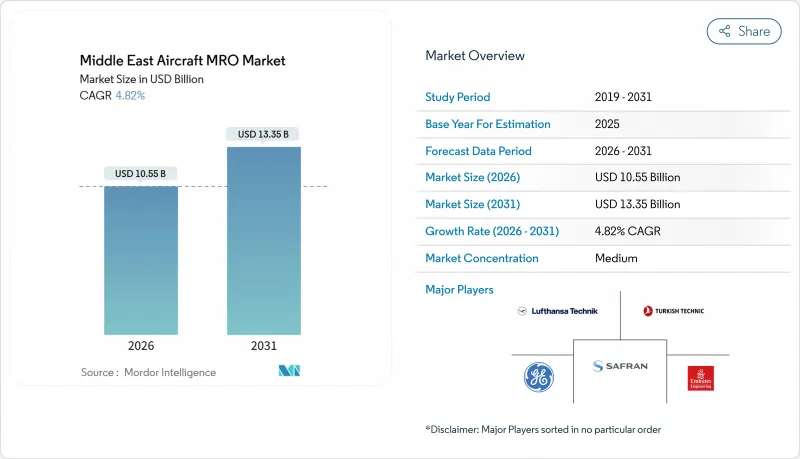
This report is Segmented by MRO Type (Airframe Heavy Maintenance, Engine, Components, and More), Aircraft Class (Fixed Wing and Rotary Wing), Application (Commercial Passenger, Commercial Cargo/Freighter, and More), Service Provider (Airline-Affiliated MRO, and More), and Geography (Saudi Arabia, United Arab Emirates, Qatar, Kuwait, and More). The Market Forecasts are Provided in Terms of Value (USD).
Middle East Aircraft MRO Market Trends and Insights
National-Carrier Fleet Expansion Programs in GCC Boosting Heavy-Check Demand
Saudia ordered 105 A320-family aircraft in 2024 and 39 B787-9s in 2025, aiming for a 200-unit fleet by 2030; these deliveries compress heavy-check intervals and inject an estimated 120 additional airframe checks per year into the Middle East aircraft MRO market. Emirates' record order for 90 B777-8 freighters in 2024 will require two dedicated widebody bays at a USD 950 million complex coming online at Dubai World Central in 2027. Qatar Airways adjusted the C-check frequency for its A350-1000s and B777-9s from 18 months to 14 months in 2025 and awarded overflow contracts to Turkish Technic and Joramco, thereby expanding regional third-party opportunities. Etihad Engineering's Al Massar program aims to double revenue by integrating newly acquired Abu Dhabi Aviation line stations, which collectively increase widebody throughput by 25%.
Privatization of Saudi and UAE Airports Creating Third-Party MRO Opportunities
Saudi Arabia's General Authority of Civil Aviation framework now permits long-term land leases for independent hangars, ending the historic monopoly of Saudia Technic and reallocating roughly 15% of heavy-check volume toward non-airline shops by 2030. The Public Investment Fund's USD 1.5 billion infusion into Jeddah's MRO Village extends 10 new bays to third-party operators scheduled for completion in 2027. In the UAE, Mubadala's Sanad logged AED 2.3 billion (USD 626.28 million) revenue in H1 2024 after onboarding Asiana Airlines and European lessors under an expanded engine-maintenance contract. Dubai Airports Authority has allocated 1.2 million square feet at Dubai South to IER MRO Industries, whose USD 1.3 billion facility is expected to feature twin LEAP-capable test cells by 2027.
Skilled-Technician Shortage Elevating Labor Costs in Dubai and Riyadh
Vacancy rates for EASA B1/B2 mechanics reached 22% in Dubai in 2025, pushing monthly wages above USD 7,000 and squeezing independent shop margins by 200 basis points.[3] Etihad Engineering's tri-party academy with GE and Lufthansa Technik will graduate its first 200 Emirati technicians in 2027, leaving a near-term supply gap. Saudi training programs enroll 150 students annually, yet fewer than 40% secure GCAA licenses within two years, compounding wage inflation. Military rotary-wing specialists in the UAE command a monthly salary of USD 7,400, reflecting the scarcity of their expertise.
Other drivers and restraints analyzed in the detailed report include:
- Ramp-Up of LEAP and GTF Engine Fleets Necessitating New Engine Shops
- Digital Twin Adoption Reducing Turnaround Time and Increasing Shop-Visit Volume
- Prolonged Redelivery Delays at OEM Shops Limiting Aftermarket Share
For complete list of drivers and restraints, kindly check the Table Of Contents.
Segment Analysis
Component maintenance will grow at a 5.38% CAGR through 2031, the fastest among MRO types, as operators adopt modular repair strategies to cut aircraft-on-ground durations. Engine work held 46.73% of 2025 revenue within the Middle East aircraft MRO market, a share tied to LEAP and GTF overhauls that can exceed USD 8 million per shop visit. Prolonged OEM redelivery cycles shift incremental spend toward landing gear, avionics, and APU overhaul, where Etihad Engineering's five-year component-support deal with Lufthansa Technik generates USD 120 million in annual revenue. Emirates' Aviation Supply Centre stocks 12,000 line-replaceable units (LRUs) and offers 24-hour turnaround, attracting contracts from Qatar Airways and Turkish Airlines.
Airframe heavy checks and line maintenance together account for 35% of the 2025 spend, with widebody work concentrated in Istanbul, Jeddah, and Dubai hangars that handle 30,000 to 50,000 labor-hour events. Passenger-to-freighter (P2F) conversions and cabin retrofits form a fast-growing niche; Israel Aerospace Industries completed 18 P2F projects in 2024 for Middle East carriers, each adding USD 8 million to USD 12 million in revenue. Line-maintenance outsourcing by LCCs redistributes USD 200 million annually toward independent stations, accelerating the shift in the Middle East aircraft MRO market.
Fixed-wing platforms controlled 91.14% of 2025 revenue, while rotary-wing work is projected to grow at a 6.65% CAGR through 2031, as Saudi Arabia and the UAE expand their military and offshore-energy helicopter fleets. Saudi contracts for 60 UH-60M Black Hawks include 10 years of sustainment worth USD 400 million to local shops, while Abu Dhabi Aviation operates a dedicated rotary-wing center servicing AW139, S-92, and H225 fleets. Narrowbody jets continue to dominate fixed-wing spending, driven by LCC growth, whereas widebody heavy checks cluster at Turkish Technic's Istanbul base, which inducted 22 units in Q1 2025.
Regional jets and turboprops account for less than 5% of the spend, reflecting retirements in favor of larger narrowbody aircraft on intra-GCC routes. Rotary-wing demand relies on specialized tooling and OEM partnerships, limiting provider participation and concentrating share among a handful of shops, which positions the Middle East aircraft MRO market for higher margins in this niche.
Complete Report Scope:
- By MRO Type
- Airframe Heavy Maintenance
- Engine
- Components
- Line and Routine Checks
- Modifications and Upgrades
- By Aircraft Class
- Fixed Wing
- Rotary Wing
- By Application
- Commercial Passenger
- Commercial Cargo/Freighter
- Military Aviation
- General Aviation
- By Service Provider
- Airline-affiliated MRO
- Independent Third-party MRO
- OEM-Captive MRO
- Military Depots
- By Geography
- Saudi Arabia
- United Arab Emirates
- Qatar
- Kuwait
- Bahrain
- Oman
- Jordan
- Turkey
- Egypt
List of Companies Covered in this Report:
- Safran S.A.
- General Electric Company
- Rolls-Royce plc
- RTX Corporation
- Lufthansa Technik AG
- Turkish Technic Inc.
- Saudia Technic
- Etihad Airways Engineering L.L.C
- Emirates Engineering (Emirates Group)
- FL Technics (Avia Solutions Group)
- ExecuJet MRO Services (Pty) Ltd.
- Joramco
- Sanad (Mubadala Company)
- Honeywell International Inc.
- Textron Inc.
- Jordan Aeronautical-systems Company (JAC)
- Wallan Aviation
- KH Aviation
- Mukamalah Aviation Company limited (Aloula Aviation)
- AeroGulf Services
Additional Benefits:
- The market estimate (ME) sheet in Excel format
- 3 months of analyst support
TABLE OF CONTENTS
1 INTRODUCTION
- 1.1 Study Assumptions and Market Definition
- 1.2 Scope of the Study
2 RESEARCH METHODOLOGY
3 EXECUTIVE SUMMARY
4 MARKET LANDSCAPE
- 4.1 Market Overview
- 4.2 Market Drivers
- 4.2.1 National-carrier fleet expansion programs in GCC boosting heavy-check demand
- 4.2.2 Privatization of Saudi and UAE airports creating third-party MRO opportunities
- 4.2.3 Ramp-up of LEAP and GTF engine fleets necessitating new engine shops
- 4.2.4 Digital twin adoption reducing turnaround time and increasing shop-visit volume
- 4.2.5 Emergence of LCCs driving line-maintenance outsourcing
- 4.2.6 Military offset policies pushing OEMs to localize component repair
- 4.3 Market Restraints
- 4.3.1 Skilled-technician shortage elevating labor costs in Dubai and Riyadh
- 4.3.2 Prolonged redelivery delays at OEM shops limiting aftermarket share
- 4.3.3 Political instability in levant impacting widebody utilization rates
- 4.3.4 High capex for engine test cells deterring independent entrants
- 4.4 Value Chain Analysis
- 4.5 Regulatory Outlook
- 4.6 Technological Outlook
- 4.7 Porter's Five Forces Analysis
- 4.7.1 Bargaining Power of Suppliers
- 4.7.2 Bargaining Power of Buyers/Consumers
- 4.7.3 Threat of New Entrants
- 4.7.4 Threat of Substitute Products
- 4.7.5 Competitive Rivalry
5 MARKET SIZE AND GROWTH FORECASTS (VALUE)
- 5.1 By MRO Type
- 5.1.1 Airframe Heavy Maintenance
- 5.1.2 Engine
- 5.1.3 Components
- 5.1.4 Line and Routine Checks
- 5.1.5 Modifications and Upgrades
- 5.2 By Aircraft Class
- 5.2.1 Fixed Wing
- 5.2.2 Rotary Wing
- 5.3 By Application
- 5.3.1 Commercial Passenger
- 5.3.2 Commercial Cargo/Freighter
- 5.3.3 Military Aviation
- 5.3.4 General Aviation
- 5.4 By Service Provider
- 5.4.1 Airline-affiliated MRO
- 5.4.2 Independent Third-party MRO
- 5.4.3 OEM-Captive MRO
- 5.4.4 Military Depots
- 5.5 By Geography
- 5.5.1 Saudi Arabia
- 5.5.2 United Arab Emirates
- 5.5.3 Qatar
- 5.5.4 Kuwait
- 5.5.5 Bahrain
- 5.5.6 Oman
- 5.5.7 Jordan
- 5.5.8 Turkey
- 5.5.9 Egypt
6 COMPETITIVE LANDSCAPE
- 6.1 Market Concentration
- 6.2 Strategic Moves
- 6.3 Market Share Analysis
- 6.4 Company Profiles (includes Global level Overview, Market level overview, Core Segments, Financials as available, Strategic Information, Market Rank/Share for key companies, Products and Services, and Recent Developments)
- 6.4.1 Safran S.A.
- 6.4.2 General Electric Company
- 6.4.3 Rolls-Royce plc
- 6.4.4 RTX Corporation
- 6.4.5 Lufthansa Technik AG
- 6.4.6 Turkish Technic Inc.
- 6.4.7 Saudia Technic
- 6.4.8 Etihad Airways Engineering L.L.C
- 6.4.9 Emirates Engineering (Emirates Group)
- 6.4.10 FL Technics (Avia Solutions Group)
- 6.4.11 ExecuJet MRO Services (Pty) Ltd.
- 6.4.12 Joramco
- 6.4.13 Sanad (Mubadala Company)
- 6.4.14 Honeywell International Inc.
- 6.4.15 Textron Inc.
- 6.4.16 Jordan Aeronautical-systems Company (JAC)
- 6.4.17 Wallan Aviation
- 6.4.18 KH Aviation
- 6.4.19 Mukamalah Aviation Company limited (Aloula Aviation)
- 6.4.20 AeroGulf Services
7 MARKET OPPORTUNITIES AND FUTURE OUTLOOK
- 7.1 White-space and Unmet-need Assessment

