PUBLISHER: Mordor Intelligence | PRODUCT CODE: 2115152

PUBLISHER: Mordor Intelligence | PRODUCT CODE: 2115152
India Interior Design - Market Share Analysis, Industry Trends & Statistics, Growth Forecasts (2026 - 2031)
According to Mordor Intelligence, the India interior design market size is projected to be USD 31.43 billion in 2025, USD 35.48 billion in 2026, and reach USD 65.01 billion by 2031, growing at a CAGR of 12.87% from 2026 to 2031.
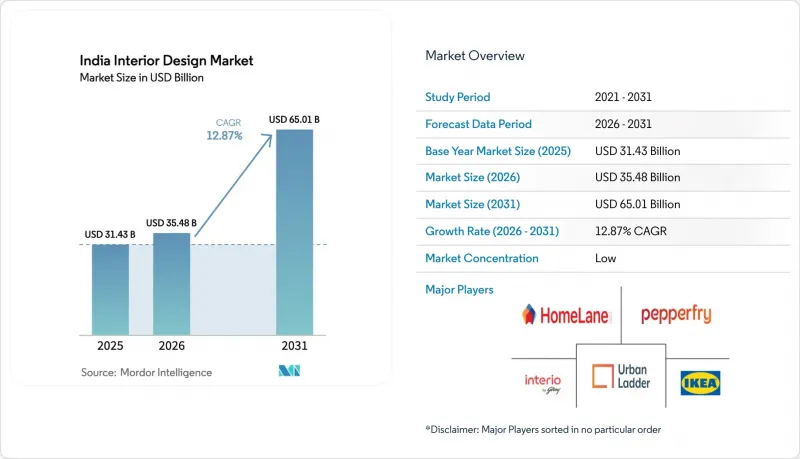
This report is Segmented by End-User (Residential and Commercial), Service Type (New Construction and Renovation/Remodeling), Price Tier (Economy, Mid-Range, and Premium/Luxury), and Geography (North India, West India, South India, East & North-East India). Market Forecasts are Provided in Terms of Value (USD).
India Interior Design Market Trends and Insights
Rapid Urbanization & Rising Disposable Incomes
India's consumption tailwinds are translating into more design-led spending in both premium and mass segments, with metros absorbing larger ticket sizes and non-metros adopting platform-based services for the first time. Urban households are prioritizing space optimization and modular interventions as dual-income families expand, which lifts the adoption of integrated design-and-execution packages. Organized platforms are using store and studio expansion to capture these cohorts, with Livspace and HomeLane scaling city footprints alongside online visualization that reduces friction. As more households cross key income thresholds, preference shifts from unbranded carpentry toward warranties, service-level agreements, and branded modular systems. These shifts are strengthening conversion funnels and pipeline predictability for organized channels in the India interior design market.
Government Housing & Infrastructure Programmes
PMAY-G and PMAY-U 2.0 are sustaining basic interior product demand at scale by standardizing kitchens, washrooms, and core fixtures across sanctioned units and completed homes. PMAY-U 2.0 operational guidelines place clear requirements on finishing quality and installed fittings, which translates into steady volumes for branded suppliers and turnkey installers. The Technology & Innovation Sub-Mission under PMAY promotes innovative construction and passive design, which nudges affordable segments toward better materials and greener specifications. Smart city projects and related urban upgrades catalyze fit-out cycles for Grade-A office, retail spaces, and mixed-use developments, feeding commercial interior pipelines across mission cities. These policies extend the demand runway for the India interior design market through a mix of public funding, mandated specifications, and private investment signals.
Highly Fragmented and Price-Competitive Supply Side
Many transactions still flow through unorganized carpenters and small workshops that compete on price without standardized processes or compliance controls. This fragmentation raises execution risks in complex projects that need assured timelines, multi-vendor coordination, and formal warranties. Organized platforms that do not vertically integrate face margin pressure when material costs and logistics are not under tight control. Vertical integration moves, including investments in component manufacturing and centralized fulfillment, are attempts to stabilize margins and shorten lead times. Until quality norms become universal, mid-market households will continue to evaluate rental and subscription options to avoid large upfront spends and reduce project complexity, which adds a distinct alternative pathway within the India interior design market.
Other drivers and restraints analyzed in the detailed report include:
- Commercial Real-Estate Boom in Office, Retail & Hospitality
- Digital Design Visualisation, Accelerating Customer Acquisition
- Compliance Cost of Building and Green Regulations
For complete list of drivers and restraints, kindly check the Table Of Contents.
Segment Analysis
The commercial segment held 74.44% of India's interior design market share in 2025, with leasing momentum across Grade-A office and retail rolling into multi-quarter fit-out pipelines. Office demand is reinforced by multinational GCCs and technology tenants, which require high-spec interiors aligned to global wellness, energy, and accessibility benchmarks. Retail categories are expanding footprints and upgrading stores with experiential fixtures that elevate dwell time and conversion rates in top city markets. Corporate specifications drive consistent volumes in modular workstations, acoustic systems, and integrated lighting, which organized players deliver with predictable quality. This mix of steady corporate demand and formalized procurement supports repeatable project economics across the India interior design market.
Residential demand is the fastest-growing end-user, expected to expand at a 16.47% CAGR through 2031, energized by rising incomes and government housing programs with explicit finishing requirements. Platforms are differentiating through AI-enabled visualization, warranties, and end-to-end installation that de-risk projects for homeowners who once relied on multiple contractors. Residential throughput has scaled as networks spread across more cities, aided by store openings and franchise formats that lower entry barriers in regional markets. Standardized interior requirements within PMAY-U 2.0 and PMAY-G sustain baseline demand for essential fixtures, further deepening suppliers' addressable volumes. This evolution strengthens the role of organized channels in the India interior design industry, broadening access to design services while improving project reliability.
Complete Report Scope:
- By End-User
- Residential
- Commercial
- By Service Type
- New Construction
- Renovation / Remodeling
- By Price Tier
- Economy
- Mid-Range
- Premium / Luxury
- By Region
- North India
- West India
- South India
- East & North-East India
List of Companies Covered in this Report:
- Livspace
- Homelane
- Asian Paints - Beautiful Homes Service
- Godrej Interio
- Pepperfry Studio
- DesignCafe
- Urban Ladder
- IKEA India - Planning Studio
- Morphogenesis
- Space Matrix
- Sleek Kitchens (Asian Paints)
- Furlenco Designs
- DWP Interics
- Gensler India
- Perkins & Will India
- Studio Lotus
- AECOM India
- HBA India
- Talati & Panthaky Associates (TPA)
- K Raheja Design Group
Additional Benefits:
- The market estimate (ME) sheet in Excel format
- 3 months of analyst support
TABLE OF CONTENTS
1 Introduction
- 1.1 Study Assumptions & Market Definition
- 1.2 Scope of the Study
2 Research Methodology
3 Executive Summary
4 Market Landscape
- 4.1 Market Overview
- 4.2 Market Drivers
- 4.2.1 Rapid urbanisation & rising disposable incomes
- 4.2.2 Government housing & infrastructure programmes (PMAY, Smart Cities)
- 4.2.3 Commercial real-estate boom in office, retail & hospitality
- 4.2.4 Digital design visualisation (VR/AI) accelerating customer acquisition
- 4.2.5 Specialised interiors for senior & assisted-living facilities
- 4.2.6 Tier-2/3 e-commerce turnkey packages for middle-income homes
- 4.3 Market Restraints
- 4.3.1 Highly fragmented & price-competitive supply side
- 4.3.2 Compliance cost of building / green regulations
- 4.3.3 Pandemic-induced project delays & cash-flow pressures
- 4.3.4 Shortage of accredited designers outside metros
- 4.4 Value / Supply-Chain Analysis
- 4.5 Regulatory Landscape
- 4.6 Technological Outlook
- 4.7 Porter's Five Forces
- 4.7.1 Threat of New Entrants
- 4.7.2 Bargaining Power of Suppliers
- 4.7.3 Bargaining Power of Buyers
- 4.7.4 Threat of Substitutes
- 4.7.5 Competitive Rivalry
5 Market Size & Growth Forecasts
- 5.1 By End-User
- 5.1.1 Residential
- 5.1.2 Commercial
- 5.2 By Service Type
- 5.2.1 New Construction
- 5.2.2 Renovation / Remodeling
- 5.3 By Price Tier
- 5.3.1 Economy
- 5.3.2 Mid-Range
- 5.3.3 Premium / Luxury
- 5.4 By Region
- 5.4.1 North India
- 5.4.2 West India
- 5.4.3 South India
- 5.4.4 East & North-East India
6 Competitive Landscape
- 6.1 Strategic Moves
- 6.2 Market Share Analysis
- 6.3 Company Profiles (includes Global level Overview, Market level overview, Core Segments, Financials as available, Strategic Information, Market Rank/Share for key companies, Products & Services, and Recent Developments)
- 6.3.1 Livspace
- 6.3.2 Homelane
- 6.3.3 Asian Paints - Beautiful Homes Service
- 6.3.4 Godrej Interio
- 6.3.5 Pepperfry Studio
- 6.3.6 DesignCafe
- 6.3.7 Urban Ladder
- 6.3.8 IKEA India - Planning Studio
- 6.3.9 Morphogenesis
- 6.3.10 Space Matrix
- 6.3.11 Sleek Kitchens (Asian Paints)
- 6.3.12 Furlenco Designs
- 6.3.13 DWP Interics
- 6.3.14 Gensler India
- 6.3.15 Perkins & Will India
- 6.3.16 Studio Lotus
- 6.3.17 AECOM India
- 6.3.18 HBA India
- 6.3.19 Talati & Panthaky Associates (TPA)
- 6.3.20 K Raheja Design Group
7 Market Opportunities & Future Outlook
- 7.1 ESG-driven sustainable retro-fitting of ageing Grade-A commercial stock
- 7.2 Platform-based Design-as-a-Service for mid-income urban housing

