PUBLISHER: Mordor Intelligence | PRODUCT CODE: 2122660

PUBLISHER: Mordor Intelligence | PRODUCT CODE: 2122660
Interior Design Software - Market Share Analysis, Industry Trends & Statistics, Growth Forecasts (2026 - 2031)
According to Mordor Intelligence, the interior design software market size was valued at USD 6.83 billion in 2025 and estimated to grow from USD 7.59 billion in 2026 to reach USD 12.86 billion by 2031, at a CAGR of 11.12% during the forecast period (2026-2031).
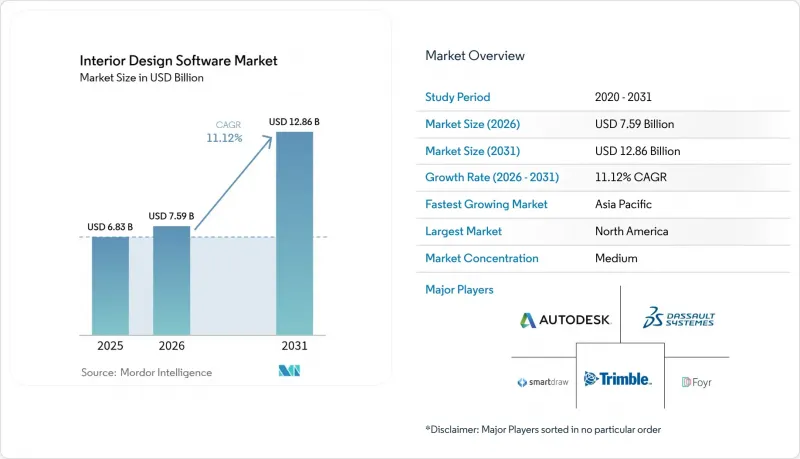
This report is Segmented by Software Type (2D Interior Design Software, 3D Interior Design Software, BIM-Enabled Design Suites, and More), Deployment Mode (On-Premise, and Cloud-Based), End User (Interior Designers and Architects, Furniture and Home Decor Retailers, and More), Application (Residential, Commercial, and More), and Geography. The Market Forecasts are Provided in Terms of Value (USD).
Global Interior Design Software Market Trends and Insights
Adoption of BIM-Integrated Interior Design Workflows
Mandatory BIM standards and client demand for coordinated data are pushing designers toward platforms that handle geometry and information in a single environment. A 2025 Vectorworks survey showed 68% of AEC professionals already use BIM and 65% see the highest ROI from it. Singapore's regulations now require 3D BIM submissions for certain projects, accelerating adoption across Asia. Vendors are responding by embedding ISO 19650-ready data structures, automated clash detection, and cloud-based CDEs inside their interiors modules. Competitive positioning now hinges on seamless hand-off between schematic design, documentation, and facilities management. Smaller providers such as Bricsys lean on cost-effective licensing to lure firms upgrading from 2D CAD. Collectively, these forces add 2.8 percentage points to forecast CAGR as platform upgrades become unavoidable for code compliance and client retention.
Rising Demand for Photorealistic Visualization in E-Commerce and VR Showrooms
Furniture retailers and residential clients increasingly expect 4K renders and VR walk-throughs before approving purchases or layouts. Cloud2Render charges between USD 1.08 and USD 6.48 per GPU-hour, enabling small firms to deliver Hollywood-grade imagery without hardware purchases. Virtual staging has shortened home-sale cycles by 87% and lifted prices by 15% according to Interior AI, demonstrating direct ROI for visualization spend. AiHouse claims to produce 4K renders in under three minutes, reducing iteration time and designer effort. As e-commerce embeds room-view configurators, visualization quality influences conversion rates, driving software upgrades that support ray-traced lighting and material realism. This trend adds 2.1 percentage points to CAGR and accelerates the shift toward SaaS rendering.
High Learning Curve and Training Costs for Professional-Grade Suites
Vectorworks research identifies lack of structured training as the top barrier to digital-tool adoption. Advanced suites now bundle parametric modeling, BIM tagging, and cloud collaboration, which require sustained learning investments. In AR/VR workflows, 50% of early adopters reported hardware purchases and scope revisions before realizing benefits. Smaller studios in emerging markets are deterred by subscription costs plus training outlays, slowing upgrade cycles and trimming 1.6 percentage points from CAGR. Vendors respond with contextual tutorials, AI-driven command suggestions, and tiered user interfaces to lower learning thresholds.
Other drivers and restraints analyzed in the detailed report include:
- Surge in Remote Collaboration Needs Among Distributed Design Teams Post-COVID-19
- Drop in GPU Cloud-Render Costs Enabling SaaS-Based Rendering Services
- Piracy and Availability of Low-Cost Cracked Software in Developing Regions
For complete list of drivers and restraints, kindly check the Table Of Contents.
Segment Analysis
3D Interior Design Software accounted for 56.05% of the interior design software market share in 2025, illustrating the decisive shift from line-based drafting toward immersive spatial modeling. VR/AR-Ready Design Platforms, projected to expand at a 12.1% CAGR, reflect rising client demand for walk-through experiences that de-risk design choices. The interior design software market size attributed to BIM-enabled suites is expected to grow steadily through 2031 as regulatory mandates accelerate adoption of data-rich models. AI-powered generative design further differentiates platforms, with AiHouse offering 4K renders in under three minutes. Legacy 2D applications retain niche relevance for documentation but now often serve as downstream outputs generated automatically from 3D or BIM models, underscoring the convergence of capabilities under single user interfaces.
Competitive positioning hinges on rendering quality, library breadth, and interoperability with manufacturing systems. Dassault Systemes' CATIA R2025x introduces mixed-reality interaction and a Stellar Interactive Rendering Engine that bolsters photorealism and collaboration [3DS.COM]. Dassault's push signals an arms race toward real-time, device-agnostic visualization that transforms client presentations into immersive decision sessions. Smaller challengers court cost-sensitive markets with modular feature sets, while incumbents leverage ecosystems of plugins and certified content to lock in professional users. The long-run trajectory suggests deeper fusion of BIM data, AI layout generation, and cloud streaming, positioning 3D platforms as the operating system for interior space creation.
On-premises deployments commanded 63.05% of revenue in 2025, yet cloud offerings are climbing at a 12.31% CAGR as firms weigh scalability and update convenience against data-sovereignty concerns. Cloud transitions are most rapid among mid-size practices that lack IT staff; automatic patching and elastic rendering offset fears of downtime. Vendors are closing security gaps through zero-trust architectures, audit logging, and compliance frameworks aligned to ISO 19650. Vizcom markets AES-256 encryption, VPC isolation, and SSO links with Azure AD and Okta to reassure enterprise buyers. Autodesk and Nemetschek's revenue reports show subscription portfolios outpacing perpetual licenses, signaling irreversible momentum toward recurring cloud-based monetization.
Hybrid configurations are emerging as compromise models, with large firms hosting confidential assets on-premises while synchronizing lightweight proxies to cloud for visualization and mark-up. Cloud render farms slash design iteration lead times, and AI features often depend on server-side inference, nudging laggard firms across the adoption line. The interior design software market therefore experiences a gradual but firm pivot to SaaS, unlocking data analytics and usage-based pricing that were impossible under local installs.
Complete Report Scope:
- By Software Type
- 2D Interior Design Software
- 3D Interior Design Software
- BIM-Enabled Design Suites
- VR/AR-Ready Design Platforms
- By Deployment Mode
- On-premises
- Cloud-based
- By End User
- Interior Designers and Architects
- Furniture and Home Decor Retailers
- Real-Estate Developers and Builders
- DIY Homeowners
- Other End Users
- By Application
- Residential
- Commercial
- Hospitality
- Healthcare
- Education and Institutional
- Other Applications
- By Geography
- North America
- United States
- Canada
- Mexico
- South America
- Brazil
- Argentina
- Rest of South America
- Europe
- Germany
- United Kingdom
- France
- Italy
- Spain
- Russia
- Rest of Europe
- Asia Pacific
- China
- Japan
- India
- South Korea
- Australia
- Rest of Asia Pacific
- Middle East and Africa
- Middle East
- Saudi Arabia
- United Arab Emirates
- Turkey
- Rest of Middle East
- Africa
- South Africa
- Nigeria
- Rest of Africa
- Middle East
- North America
Geography Analysis
North America led the interior design software market with 38.10% share in 2025, underpinned by mature renovation ecosystems, high technology penetration, and BIM-centric regulatory frameworks. Harvard JCHS data recorded USD 463 billion in U.S. renovation spending during Q1 2024, while 93% of homeowners hired professionals, sustaining software subscriptions that facilitate contractor collaboration. Cloud adoption, already mainstream, is set to deepen as vendors bundle AI drafting tools that are exclusively server-side. The region's growth outlook also benefits from millennial home-equity gains and integration of smart-home devices requiring sophisticated space planning.
Asia Pacific posts the fastest regional CAGR at 11.55% through 2031, driven by urbanization and local policy pushes for digital construction. Indian provider MicroGenesis logged INR 235 crore (USD 28.3 million) revenue while partnering with Nemetschek, illustrating the appetite for international platforms adapted to regional codes. China's modernization of construction workflows and Southeast Asia's infrastructure spend create fertile conditions for BIM-ready interior software. Subscription models priced in local currencies and localized content libraries are accelerating penetration among small studios lacking capital for perpetual licenses.
Europe offers steady expansion anchored by ISO 19650 adoption and sustainability mandates. Nemetschek's 13.1% Design-segment revenue growth in 2024 underscores compliance-driven demand. Multilingual workflows and energy-performance modules are decisive purchase criteria as EU directives tighten carbon-footprint reporting. Meanwhile, Middle East and Africa witness budding opportunities tied to smart-city initiatives, though currency volatility and patchy internet access temper near-term uptake. Vendors pursuing these markets invest in offline-capable clients and regional cloud data centers to satisfy compliance and latency expectations. Collectively, geography patterns indicate convergence toward cloud BIM ecosystems, with local adaptations defining competitive edges.
- Autodesk, Inc.
- Dassault Systemes SE
- Nemetschek SE
- Trimble Inc.
- Chief Architect, Inc.
- Cyncly AS
- SketchUp Inc.
- Bentley Systems, Incorporated
- SmartDraw Software, LLC
- RoomSketcher AS
- Planner 5D UAB
- Cedreo SAS
- Infurnia Technologies Private Limited
- Foyr Pte. Ltd.
- Homestyler, Inc.
- Asynth SAS
- Microvellum, Inc.
- Vectorworks, Inc.
- Floorplanner NV
- Live Home 3D LLC
- eTeks (Sweet Home 3D)
- Morpholio LLC
- Nova Development Corp.
Additional Benefits:
- The market estimate (ME) sheet in Excel format
- 3 months of analyst support
TABLE OF CONTENTS
1 INTRODUCTION
- 1.1 Study Assumptions and Market Definition
- 1.2 Scope of the Study
2 RESEARCH METHODOLOGY
3 EXECUTIVE SUMMARY
4 MARKET LANDSCAPE
- 4.1 Market Overview
- 4.2 Market Drivers
- 4.2.1 Adoption of BIM-integrated interior design workflows
- 4.2.2 Rising demand for photorealistic visualization in e-commerce and VR showrooms
- 4.2.3 Surge in remote collaboration needs among distributed design teams post-COVID-19
- 4.2.4 Drop in GPU cloud-render costs enabling SaaS-based rendering services
- 4.2.5 AI-powered generative design accelerating concept iteration cycles
- 4.2.6 Growing smart home renovation spend from millennial homeowners
- 4.3 Market Restraints
- 4.3.1 High learning curve and training costs for professional-grade suites
- 4.3.2 Piracy and availability of low-cost cracked software in developing regions
- 4.3.3 Limited interoperability between legacy CAD formats and modern 3D engines
- 4.3.4 Data-privacy concerns in cloud-hosted project files for enterprise clients
- 4.4 Regulatory Landscape
- 4.5 Technological Outlook
- 4.6 Porter's Five Forces Analysis
- 4.6.1 Threat of New Entrants
- 4.6.2 Bargaining Power of Suppliers
- 4.6.3 Bargaining Power of Buyers
- 4.6.4 Threat of Substitutes
- 4.6.5 Competitive Rivalry
5 MARKET SIZE AND GROWTH FORECASTS (VALUE)
- 5.1 By Software Type
- 5.1.1 2D Interior Design Software
- 5.1.2 3D Interior Design Software
- 5.1.3 BIM-Enabled Design Suites
- 5.1.4 VR/AR-Ready Design Platforms
- 5.2 By Deployment Mode
- 5.2.1 On-premises
- 5.2.2 Cloud-based
- 5.3 By End User
- 5.3.1 Interior Designers and Architects
- 5.3.2 Furniture and Home Decor Retailers
- 5.3.3 Real-Estate Developers and Builders
- 5.3.4 DIY Homeowners
- 5.3.5 Other End Users
- 5.4 By Application
- 5.4.1 Residential
- 5.4.2 Commercial
- 5.4.3 Hospitality
- 5.4.4 Healthcare
- 5.4.5 Education and Institutional
- 5.4.6 Other Applications
- 5.5 By Geography
- 5.5.1 North America
- 5.5.1.1 United States
- 5.5.1.2 Canada
- 5.5.1.3 Mexico
- 5.5.2 South America
- 5.5.2.1 Brazil
- 5.5.2.2 Argentina
- 5.5.2.3 Rest of South America
- 5.5.3 Europe
- 5.5.3.1 Germany
- 5.5.3.2 United Kingdom
- 5.5.3.3 France
- 5.5.3.4 Italy
- 5.5.3.5 Spain
- 5.5.3.6 Russia
- 5.5.3.7 Rest of Europe
- 5.5.4 Asia Pacific
- 5.5.4.1 China
- 5.5.4.2 Japan
- 5.5.4.3 India
- 5.5.4.4 South Korea
- 5.5.4.5 Australia
- 5.5.4.6 Rest of Asia Pacific
- 5.5.5 Middle East and Africa
- 5.5.5.1 Middle East
- 5.5.5.1.1 Saudi Arabia
- 5.5.5.1.2 United Arab Emirates
- 5.5.5.1.3 Turkey
- 5.5.5.1.4 Rest of Middle East
- 5.5.5.2 Africa
- 5.5.5.2.1 South Africa
- 5.5.5.2.2 Nigeria
- 5.5.5.2.3 Rest of Africa
- 5.5.5.1 Middle East
- 5.5.1 North America
6 COMPETITIVE LANDSCAPE
- 6.1 Market Concentration
- 6.2 Strategic Moves
- 6.3 Market Share Analysis
- 6.4 Company Profiles (includes Global level Overview, Market level overview, Core Segments, Financials as available, Strategic Information, Market Rank/Share for key companies, Products and Services, and Recent Developments)
- 6.4.1 Autodesk, Inc.
- 6.4.2 Dassault Systemes SE
- 6.4.3 Nemetschek SE
- 6.4.4 Trimble Inc.
- 6.4.5 Chief Architect, Inc.
- 6.4.6 Cyncly AS
- 6.4.7 SketchUp Inc.
- 6.4.8 Bentley Systems, Incorporated
- 6.4.9 SmartDraw Software, LLC
- 6.4.10 RoomSketcher AS
- 6.4.11 Planner 5D UAB
- 6.4.12 Cedreo SAS
- 6.4.13 Infurnia Technologies Private Limited
- 6.4.14 Foyr Pte. Ltd.
- 6.4.15 Homestyler, Inc.
- 6.4.16 Asynth SAS
- 6.4.17 Microvellum, Inc.
- 6.4.18 Vectorworks, Inc.
- 6.4.19 Floorplanner NV
- 6.4.20 Live Home 3D LLC
- 6.4.21 eTeks (Sweet Home 3D)
- 6.4.22 Morpholio LLC
- 6.4.23 Nova Development Corp.
7 MARKET OPPORTUNITIES AND FUTURE OUTLOOK
- 7.1 White-space and Unmet-Need Assessment

