PUBLISHER: Mordor Intelligence | PRODUCT CODE: 2115212

PUBLISHER: Mordor Intelligence | PRODUCT CODE: 2115212
Southern Africa Renewable Energy - Market Share Analysis, Industry Trends & Statistics, Growth Forecasts (2026 - 2031)
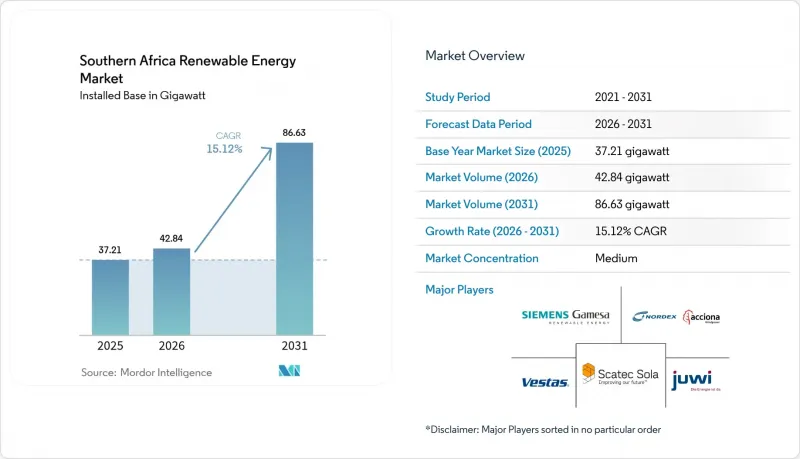
According to Mordor Intelligence, the Southern Africa renewable energy market size was valued at 37.21 gigawatt in 2025 and estimated to grow from 42.84 gigawatt in 2026 to reach 86.63 gigawatt by 2031, at a CAGR of 15.12% during the forecast period (2026-2031).
This report is Segmented by Technology (Solar Energy, Wind Energy, Hydropower, Bioenergy, Geothermal, and Ocean Energy), End-User (Utilities, Commercial and Industrial, and Residential), and Geography (South Africa, Angola, Zambia, Democratic Republic of Congo, Tanzania, Mozambique, and Rest of Southern Africa). The Market Sizes and Forecasts are Provided in Terms of Installed Capacity (GW).
Southern Africa Renewable Energy Market Trends and Insights
Declining LCOE for Solar & Wind
Module oversupply from Asian manufacturers lowered utility-scale solar tariffs below USD 0.03 per kWh in the Northern Cape by late 2024, well under Eskom's average generation cost of ZAR 1.48 per kWh. JinkoSolar and First Solar supplied Bid Window 7 projects at prices 22% below 2022 benchmarks, enabling sub-ZAR 0.50 per kWh twenty-year power purchase agreements. Onshore wind LCOE in the Eastern Cape approached USD 0.04 per kWh, yet logistics bottlenecks and grid delays left wind bids 18% costlier than solar, resulting in zero wind allocations in Bid Window 7. Namibia's Hyphen project secured a blended renewables tariff of USD 0.025 per kWh for its 7 GW portfolio, establishing a regional floor and signaling future price compression. Coupling four-hour batteries with solar now provides dispatchable capacity at roughly USD 0.06 per kWh, eroding the economics of coal peakers and supporting Eskom's just-transition schedule.
Escalating Eskom Tariffs & Load-Shedding Risk
NERSA's 36% tariff hike raises the average industrial power cost above ZAR 2.20 per kWh in 2025/26, reducing the payback period for rooftop solar arrays larger than 500 kW to below four years. Stage 6 load-shedding persisted for 78 days in 2024, prompting mining majors to contract more than 200 MW of captive solar-plus-storage systems. The Electricity Regulation Amendment Act allows private transmission investment and wheeling, enabling corporate buyers in Gauteng to source Northern Cape renewables without Eskom as an intermediary. This reform is expected to reduce Eskom's generation share below 60% by 2030, transitioning the utility toward a pure transmission-system-operator role. Multilateral lenders are linking concessional finance to accelerated grid upgrades, tying future disbursements to measurable reductions in unserved energy.
Transmission Bottlenecks in Cape & Namibia Corridors
Northern Cape lines operate at 92% utilization, curtailing 180 gigawatt-hours (GWh) per year and delaying grid connections by up to 18 months. Eskom deferred the ZAR 4.5 billion Aries-Kronos upgrade due to liquidity constraints, leaving 1.2 GW of awarded projects stranded. NamPower's Kokerboom-Gerus backbone can absorb only 800 MW of additional injections, yet Hyphen alone needs 2.5 GW of export capacity. Private-sector interest exists, but cost-recovery and wheeling-tariff pass-through remain unclear, stalling financial close on the first independent transmission projects. Developers are co-locating batteries to shift output into off-peak transmission windows, adding USD 150-200 per kW to capital expenditures (capex) and trimming equity returns by up to 2 percentage points.
Other drivers and restraints analyzed in the detailed report include:
- REIPPPP & South African Renewable Energy Masterplan
- Surge in Corporate PPAs & Wheeling Frameworks
- Wind-Specific Site Scarcity & Auction Failures
For complete list of drivers and restraints, kindly check the Table Of Contents.
Segment Analysis
Hydropower dominated the Southern African renewable energy market, accounting for a 61.25% share in 2025, as legacy assets, such as Zambia's Kariba and the Democratic Republic of Congo's Inga complexes, continue to supply bulk power. Wind capacity is expected to post a 24.35% CAGR to 2031, the fastest among all technologies, supported by forthcoming REIPPPP carve-outs and expanding corporate PPAs. Solar, including photovoltaic and concentrated solar power, accounted for 28.60% of capacity in 2025; ACWA Power's 420 MW Redstone plant with 12-hour molten-salt storage demonstrated solar's dispatchable potential, a feature utilities favor for evening peaks. Bioenergy remains a niche market, accounting for less than 2% of capacity, primarily concentrated in South Africa's sugarcane belt, where mills co-generate power from bagasse. Geothermal and ocean energy are still in the exploratory stage; Tanzania's Rift Valley sites offer up to 5 GW of potential, but drilling costs of nearly USD 5 million per well dampen near-term prospects.
Developers anticipate that pumped-storage projects at Eskom's Ingula and Drakensberg sites will contribute 1.4 GW to grid balancing by 2030, despite capital costs exceeding USD 2,000 per kW. Small hydropower projects under 10 MW are proliferating in Angola and Mozambique through donor finance, aiming to reach 300 MW by 2030. Wind's upswing hinges on logistics solutions at Port Elizabeth and expedited environmental permits; hybrid solar-wind-storage plants are expected to win contracts as they diversify revenue streams. Ocean-energy pilot programs in Algoa Bay currently remain below commercial readiness levels, making material additions unlikely this decade. Overall, technology diversification is narrowing hydropower's dominance and steering the Southern Africa renewable energy market toward a more balanced mix.
Complete Report Scope:
- By Technology
- Solar Energy (PV and CSP)
- Wind Energy (Onshore and Offshore)
- Hydropower (Small, Large, PSH)
- Bioenergy
- Geothermal
- Ocean Energy (Tidal and Wave)
- By End-User
- Utilities
- Commercial and Industrial
- Residential
- By Geography
- South Africa
- Namibia
- Zambia
- Mozambique
- Botswana
- Angola
- Zimbabwe
- Rest of Southern Africa
List of Companies Covered in this Report:
- Scatec ASA
- EDF Renewables
- Enel Green Power South Africa
- BTE Renewables (BioTherm)
- ACWA Power
- JinkoSolar Holding Co. Ltd
- Vestas Wind Systems A/S
- Siemens Gamesa Renewable Energy SA
- Nordex SE
- First Solar Inc.
- Juwi AG
- Sola Group
- ABO Energy South Africa
- ACED ( African Clean Energy Developments)
- Pylontech South Africa
- Distributed Power Africa
- Freedom Won
- Eskom Renewable IPP Office
Additional Benefits:
- The market estimate (ME) sheet in Excel format
- 3 months of analyst support
TABLE OF CONTENTS
1 Introduction
- 1.1 Study Assumptions & Market Definition
- 1.2 Scope of the Study
2 Research Methodology
3 Executive Summary
4 Market Landscape
- 4.1 Market Overview
- 4.2 Market Drivers
- 4.2.1 Declining LCOE for solar & wind
- 4.2.2 Escalating Eskom tariffs & load-shedding risk
- 4.2.3 REIPPPP & new Renewable Energy Masterplan (SAREM)
- 4.2.4 Surge in corporate PPAs & wheeling frameworks
- 4.2.5 Green-hydrogen export corridors (Namibia, SA Northern Cape)
- 4.2.6 Monetisation of carbon markets & EU-CBAM avoidance
- 4.3 Market Restraints
- 4.3.1 Transmission bottlenecks in Cape & Namibia corridors
- 4.3.2 Wind-specific site scarcity & auction failures
- 4.3.3 Currency & sovereign-credit risk deterring project finance
- 4.3.4 Skills gap for utility-scale BESS & O&M
- 4.4 Supply-Chain Analysis
- 4.5 Regulatory Outlook
- 4.6 Technological Outlook
- 4.7 Porters Five Forces
- 4.7.1 Threat of New Entrants
- 4.7.2 Bargaining Power of Suppliers
- 4.7.3 Bargaining Power of Buyers
- 4.7.4 Threat of Substitutes
- 4.7.5 Industry Rivalry
5 Market Size & Growth Forecasts
- 5.1 By Technology
- 5.1.1 Solar Energy (PV and CSP)
- 5.1.2 Wind Energy (Onshore and Offshore)
- 5.1.3 Hydropower (Small, Large, PSH)
- 5.1.4 Bioenergy
- 5.1.5 Geothermal
- 5.1.6 Ocean Energy (Tidal and Wave)
- 5.2 By End-User
- 5.2.1 Utilities
- 5.2.2 Commercial and Industrial
- 5.2.3 Residential
- 5.3 By Geography
- 5.3.1 South Africa
- 5.3.2 Namibia
- 5.3.3 Zambia
- 5.3.4 Mozambique
- 5.3.5 Botswana
- 5.3.6 Angola
- 5.3.7 Zimbabwe
- 5.3.8 Rest of Southern Africa
6 Competitive Landscape
- 6.1 Market Concentration
- 6.2 Strategic Moves (M&A, JVs, Funding, PPAs)
- 6.3 Market Share Analysis (Market Rank/Share for key companies)
- 6.4 Company Profiles (includes Global-level Overview, Market-level Overview, Core Segments, Financials, Strategic Information, Products & Services, Recent Developments)
- 6.4.1 Scatec ASA
- 6.4.2 EDF Renewables
- 6.4.3 Enel Green Power South Africa
- 6.4.4 BTE Renewables (BioTherm)
- 6.4.5 ACWA Power
- 6.4.6 JinkoSolar Holding Co. Ltd
- 6.4.7 Vestas Wind Systems A/S
- 6.4.8 Siemens Gamesa Renewable Energy SA
- 6.4.9 Nordex SE
- 6.4.10 First Solar Inc.
- 6.4.11 Juwi AG
- 6.4.12 Sola Group
- 6.4.13 ABO Energy South Africa
- 6.4.14 ACED ( African Clean Energy Developments)
- 6.4.15 Pylontech South Africa
- 6.4.16 Distributed Power Africa
- 6.4.17 Freedom Won
- 6.4.18 Eskom Renewable IPP Office
7 Market Opportunities & Future Outlook
- 7.1 White-space & Unmet-Need Assessment

