PUBLISHER: Mordor Intelligence | PRODUCT CODE: 2115822

PUBLISHER: Mordor Intelligence | PRODUCT CODE: 2115822
Railway Management System - Market Share Analysis, Industry Trends & Statistics, Growth Forecasts (2026 - 2031)
According to Mordor Intelligence, railway management system market size market size in 2026 is estimated at USD 65.55 billion, growing from 2025 value of USD 59.79 billion with 2031 projections showing USD 103.68 billion, growing at 9.62% CAGR over 2026-2031.
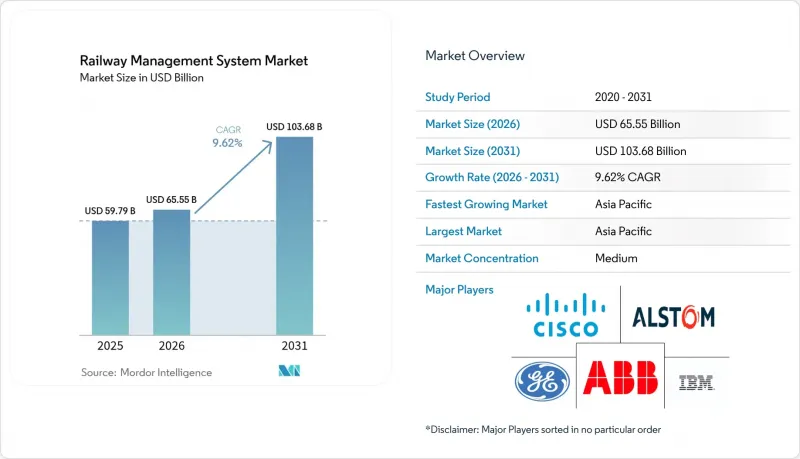
This report is Segmented by Component (Solutions, Services), Deployment Mode (On-Premise, Cloud), Rail Type (Passenger Rail, Freight Rail, and More), Deployment Mode (On-Premises, Cloud), End-User (Railway Operators, Infrastructure Managers, and More), and Geography. The Market Forecasts are Provided in Terms of Value (USD).
Global Railway Management System Market Trends and Insights
Mandated ERTMS Baseline 3 Adoption Across Core EU Corridors by 2030
Regulation-driven adoption of ERTMS Baseline 3 across the Trans-European Network has become the strongest systemic catalyst for the railway management system market. By early 2023, 52% of the 59,055 km core network had migrated, and 21,744 rolling-stock units are due for ETCS upgrades by 2030. The mandate sparks a worldwide cascade effect because suppliers must deliver interoperable software stacks ready for multi-region deployment. Hitachi Rail's EUR 1.66 billion (USD 1.8 billion) purchase of Thales' Ground Transportation Systems signals early-stage consolidation aimed at vertically unifying digital signaling IP. As implementation costs have doubled since 2018, network owners increasingly favor single-platform vendors to ease budget pressure and compress delivery risk.
Digital-Twin-Enabled Predictive Maintenance Roll-outs on Asian High-Speed Lines
China now operates more than 48,000 km of high-speed track using AI-imbued digital twins capable of processing 200 terabytes within 40 minutes, achieving 95% alert accuracy and cutting minor track faults by 80%. Coupled with LTE-M-supported CBTC networks in cities such as Shenyang, this shift moves maintenance strategy from reactive to predictive, slashing unplanned downtime and labor overhead . These gains place competitive pressure on Western incumbents and embed predictive analytics as a baseline requirement across the railway management system market.
Legacy Signaling Interfaces Hindering Full-Stack Integration
London's Crossrail recorded GBP 2-3 billion overruns after complex handoffs between ERTMS, CBTC, and vintage TPWS hardware delayed commissioning. Similar PTC interoperability issues in the U.S. expose knowledge gaps, widen project timelines, and entrench incumbents. These friction points elevate integration services cost curves across the railway management system market.
Other drivers and restraints analyzed in the detailed report include:
- Government Decarbonization Stimulus Boosting Energy-Optimization Modules
- Rapid CBTC Deployment in GCC Urban Networks
- Budget Overruns Delaying Software Refresh Cycles
For complete list of drivers and restraints, kindly check the Table Of Contents.
Segment Analysis
Solutions carved out 69.35% of the 2025 railway management system market, underscoring operator reliance on unified application suites amid rising digital complexity. Revenue growth is anchored in rail traffic management platforms, asset management engines, and control systems optimized for ERTMS roll-outs. In parallel, the managed-services niche is forecast to expand at 9.8% CAGR between 2026-2031, as operators externalize lifecycle risk to specialists, often under availability-based arrangements embedded in concession agreements. Training and consulting grow steadily, driven by workforce skills gaps around AI analytics and cybersecurity protocols.
Services strength mirrors a structural tilt toward outcome-based relationships, where performance KPIs replace one-off hardware sales. System integrators monetize cross-vendor complexity, and managed-service partners embed continuous improvement charters into multi-year SLAs. Regulatory audits around cyber, safety, and signaling drive demand for niche advisory capabilities, allowing professional services teams to wield premium hourly rates or subscription models. Together, these forces reinforce the solutions-as-a-service paradigm, cementing solutions at the core of the railway management system market.
Passenger rail currently represents the largest slice of the railway management system market size, with a 54.25% share in 2025, propelled by high-speed and urban mobility projects in Europe and Asia. Freight rail, however, delivers the sharper 10.04% CAGR trajectory to 2031, reflecting urgent shipper demand for predictive asset monitoring, real-time ETAs, and emissions reporting. High-speed and inter-city applications ride on sustained state funding for capacity upgrades, while light-rail corridors in GCC capitals leverage greenfield CBTC roll-outs to compress implementation cycles.
North American freight digitalization illustrates the upside: Union Pacific's open API suite enables real-time status calls for 30,000 customers, and RailPulse fuses GPS, accelerometer, and impact sensors across fleet operators. Asset-heavy bulk carriers can thus shrink dwell, improve wagon turn, and solidify case studies that accelerate copycat adoption in Brazil, South Africa, and India, bolstering long-run demand in the railway management system market.
Complete Report Scope:
- By Component
- Solutions
- Rail Asset Management System
- Rail Traffic Management System
- Rail Operation Management System
- Rail Control System
- Rail Maintenance Management System
- Passenger Information System
- Rail Security and Safety
- Revenue Management and Ticketing
- Services
- Training and Consulting
- System Integration and Deployment
- Support and Maintenance Service
- Managed Service
- Professional Service
- Solutions
- By Rail Type
- Passenger Rail
- Freight Rail
- High-Speed / Inter-city Rail
- Urban and Light Rail
- By Deployment Mode
- On-Premises
- Cloud
- By End-User
- Railway Operators
- Infrastructure Managers
- Station Managers
- Freight Service Providers
- By Geography
- North America
- United States
- Canada
- Mexico
- South America
- Brazil
- Argentina
- Rest of South America
- Europe
- United Kingdom
- Germany
- France
- Italy
- Spain
- Rest of Europe
- Asia Pacific
- China
- Japan
- South Korea
- India
- Australia
- Rest of Asia Pacific
- Middle East and Africa
- GCC
- South Africa
- Rest of Middle East and Africa
- North America
Geography Analysis
Europe retained 31.45% of 2025 revenue in the railway management system market, reflecting robust public funding and the legislative power of ERTMS Baseline 3. Germany alone will invest EUR 4.7 billion (USD 5.1 billion) by 2030 to unlock 35% capacity gains through digital signaling and automated operations. Siemens Mobility's EUR 2.8 billion (USD 3.0 billion) framework with Deutsche Bahn further illustrates the scale of multi-year digitalization envelopes. Although Europe hosts dense legacy networks, vendors that master interface orchestration capture recurring upgrade fees, reinforcing Europe's anchor position in the railway management system market.
Asia stands as the fastest expanding geography at a 9.96% CAGR through 2031. China has lengthened its rail footprint to 162,000 km, including 48,000 km high-speed, and plans CNY 590 billion (USD 81 billion) of 2025 investments. AI-based predictive maintenance combined with government-backed capacity additions fosters a broad market for digital twins and cloud analytics. India complements the growth narrative with a USD 30 billion budget committed to high-speed corridors and signaling upgrades, catalyzing supplier entry and value-chain localization. Collectively, these factors elevate Asia as the most attractive near-term volume prize in the railway management system market.
North America provides a stable but lower-beta trajectory compared to Asia. Federal decarbonization incentives and demand for freight visibility raise per-route digital spend, while BNSF's USD 3.8 billion capex plan demonstrates Class I appetite for track and technology investment. The Middle East, anchored by the GCC's metro pipelines, and Africa, constrained by fiber scarcity yet buoyed by pan-continental rail corridors, contribute emerging-market upside to the railway management system market. Here, turnkey vendors secure project wins by bundling private wireless, CBTC, and cyber-secure cloud to fill capability gaps.
- Siemens AG
- Alstom SA
- Hitachi Rail Ltd.
- Cisco Systems Inc.
- Huawei Technologies Co. Ltd.
- ABB Ltd.
- General Electric Co.
- IBM Corporation
- Thales Group
- Indra Sistemas SA
- Sqills
- Stadler Rail
- Wabtec Corporation
- Nokia Corp.
- Ansaldo STS (Hitachi)
- CAF S.A.
- Trimble Inc.
- Hexagon AB
- Schneider Electric SE
- Knorr-Bremse AG
Additional Benefits:
- The market estimate (ME) sheet in Excel format
- 3 months of analyst support
TABLE OF CONTENTS
1 INTRODUCTION
- 1.1 Study Assumptions and Market Definition
- 1.2 Scope of the Study
2 RESEARCH METHODOLOGY
3 EXECUTIVE SUMMARY
4 MARKET LANDSCAPE
- 4.1 Market Overview
- 4.2 Market Drivers
- 4.2.1 Mandated ERTMS Baseline 3 Adoption Across Core EU Corridors by 2030
- 4.2.2 Digital-Twin Enabled Predictive Maintenance Roll-outs on Asian High-Speed Lines
- 4.2.3 Government Decarbonisation Stimulus Boosting Energy-Optimisation Modules
- 4.2.4 Rapid CBTC Deployment in GCC Urban Networks
- 4.2.5 North-American Freight Rail Demand for End-to-End Visibility
- 4.2.6 Escalating Ransomware Threats Driving Cyber-secure Rail Control Investments
- 4.3 Market Restraints
- 4.3.1 Legacy Signalling Interfaces Hindering Full-Stack Integration
- 4.3.2 Budget Overruns Delaying Software Refresh Cycles
- 4.3.3 Inter-vendor OT-IT Interoperability Challenges
- 4.3.4 Fibre-Backhaul Scarcity in Sub-Saharan Corridors
- 4.4 Value / Supply-Chain Analysis
- 4.5 Regulatory and Technological Outlook
- 4.6 Porter's Five Forces
- 4.6.1 Threat of New Entrants
- 4.6.2 Bargaining Power of Buyers
- 4.6.3 Bargaining Power of Suppliers
- 4.6.4 Threat of Substitutes
- 4.6.5 Intensity of Rivalry
- 4.7 Investment Analysis
5 MARKET SIZE AND GROWTH FORECASTS (VALUE)
- 5.1 By Component
- 5.1.1 Solutions
- 5.1.1.1 Rail Asset Management System
- 5.1.1.2 Rail Traffic Management System
- 5.1.1.3 Rail Operation Management System
- 5.1.1.4 Rail Control System
- 5.1.1.5 Rail Maintenance Management System
- 5.1.1.6 Passenger Information System
- 5.1.1.7 Rail Security and Safety
- 5.1.1.8 Revenue Management and Ticketing
- 5.1.2 Services
- 5.1.2.1 Training and Consulting
- 5.1.2.2 System Integration and Deployment
- 5.1.2.3 Support and Maintenance Service
- 5.1.2.4 Managed Service
- 5.1.2.5 Professional Service
- 5.1.1 Solutions
- 5.2 By Rail Type
- 5.2.1 Passenger Rail
- 5.2.2 Freight Rail
- 5.2.3 High-Speed / Inter-city Rail
- 5.2.4 Urban and Light Rail
- 5.3 By Deployment Mode
- 5.3.1 On-Premises
- 5.3.2 Cloud
- 5.4 By End-User
- 5.4.1 Railway Operators
- 5.4.2 Infrastructure Managers
- 5.4.3 Station Managers
- 5.4.4 Freight Service Providers
- 5.5 By Geography
- 5.5.1 North America
- 5.5.1.1 United States
- 5.5.1.2 Canada
- 5.5.1.3 Mexico
- 5.5.2 South America
- 5.5.2.1 Brazil
- 5.5.2.2 Argentina
- 5.5.2.3 Rest of South America
- 5.5.3 Europe
- 5.5.3.1 United Kingdom
- 5.5.3.2 Germany
- 5.5.3.3 France
- 5.5.3.4 Italy
- 5.5.3.5 Spain
- 5.5.3.6 Rest of Europe
- 5.5.4 Asia Pacific
- 5.5.4.1 China
- 5.5.4.2 Japan
- 5.5.4.3 South Korea
- 5.5.4.4 India
- 5.5.4.5 Australia
- 5.5.4.6 Rest of Asia Pacific
- 5.5.5 Middle East and Africa
- 5.5.5.1 GCC
- 5.5.5.2 South Africa
- 5.5.5.3 Rest of Middle East and Africa
- 5.5.1 North America
6 COMPETITIVE LANDSCAPE
- 6.1 Market Concentration
- 6.2 Strategic Moves
- 6.3 Market Share Analysis
- 6.4 Company Profiles (includes Global and Market-level Overview, Core Segments, Financials, Strategic Info, Rank/Share, Products and Services, Recent Developments)
- 6.4.1 Siemens AG
- 6.4.2 Alstom SA
- 6.4.3 Hitachi Rail Ltd.
- 6.4.4 Cisco Systems Inc.
- 6.4.5 Huawei Technologies Co. Ltd.
- 6.4.6 ABB Ltd.
- 6.4.7 General Electric Co.
- 6.4.8 IBM Corporation
- 6.4.9 Thales Group
- 6.4.10 Indra Sistemas SA
- 6.4.11 Sqills
- 6.4.12 Stadler Rail
- 6.4.13 Wabtec Corporation
- 6.4.14 Nokia Corp.
- 6.4.15 Ansaldo STS (Hitachi)
- 6.4.16 CAF S.A.
- 6.4.17 Trimble Inc.
- 6.4.18 Hexagon AB
- 6.4.19 Schneider Electric SE
- 6.4.20 Knorr-Bremse AG
7 MARKET OPPORTUNITIES AND FUTURE OUTLOOK

