PUBLISHER: Mordor Intelligence | PRODUCT CODE: 2115878

PUBLISHER: Mordor Intelligence | PRODUCT CODE: 2115878
India Transformer - Market Share Analysis, Industry Trends & Statistics, Growth Forecasts (2026 - 2031)
According to Mordor Intelligence, the India transformer market size is expected to grow from USD 3 billion in 2025 to USD 3.25 billion in 2026 and is forecast to reach USD 4.82 billion by 2031 at 8.22% CAGR over 2026-2031.
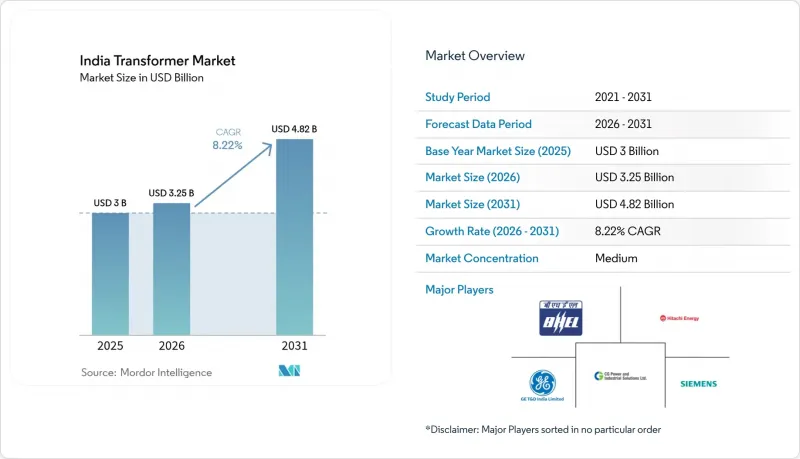
This report is Segmented by Power Rating (Large, Medium, and Small), Cooling Type (Air-Cooled and Oil-Cooled), Phase (Single-Phase and Three-Phase), Transformer Type (Power and Distribution), and End-User (Power Utilities, Industrial, Commercial, and Residential). The Market Sizes and Forecasts are Provided in Terms of Value (USD).
India Transformer Market Trends and Insights
Modernisation & expansion of T&D infrastructure
The India transformer market benefits most strongly from large-scale grid build-outs authorized in the National Electricity Plan, which envisages 123,577 circuit km of new lines between 2022-2027. More than 193,000 circuit kilometers were already completed between 2014 and 2024, and 3,000 new substations were commissioned, creating consistent demand for power and auto-transformers across 220 kV to 800 kV classes. Power Grid Corporation's Pan-India HVDC corridors, such as the Raigarh-Pugalur link, rely on specialized converter transformers, cementing domestic capability upgrades. The Green Energy Corridor-II, set to evacuate 33 GW of renewables, further tilts specifications toward 765 kV equipment, stimulating high-margin orders for extra-large units. Manufacturers with test bays above 800 kV are thus favored in utility tenders.
Surge in renewable-energy grid integration
Installed renewable capacity increased from 76.37 GW in 2014 to 226.79 GW by June 2025, with an additional 176.70 GW under construction. Solar additions alone soared to 110.9 GW, necessitating step-up transformers at solar parks, while wind farms totaling 51.3 GW require units capable of managing variable reactive loads. The Central Electricity Authority also calls for 236.22 GWh of battery storage, implying the upcoming demand for converter transformers suited to bidirectional power flow. Hybrid wind-solar plants, which outpaced standalone solar bids in 2024, need transformers that integrate power electronics, creating new product niches. States with high renewable targets are therefore fast-tracking grid-connected transformer procurements.
Volatile prices of CRGO steel & copper
CRGO steel and copper account for up to 70% of production costs, exposing manufacturers to annual price swings of 25-30% on global exchanges. Limited global CRGO suppliers heighten import risk during trade frictions, prompting makers to hedge or seek long-term contracts. The Ministry of Steel's PLI scheme encourages domestic CRGO production, but capacity additions remain at least two years away. In the meantime, OEMs use price-variation clauses in tenders, although state utilities often cap pass-throughs, thereby squeezing margins. Some vendors substitute amorphous alloys; however, the higher initial costs limit their use to select distribution transformers.
Other drivers and restraints analyzed in the detailed report include:
- Government funding under RDSS, IPDS, Saubhagya
- Growing industrial & commercial power demand
- Utility cap-ex delays & bid-price pressures
For complete list of drivers and restraints, kindly check the Table Of Contents.
Segment Analysis
In 2025, medium-rating transformers (10-100 MVA) held the largest 40.78% slice of the India transformer market. They underpin sub-transmission grids that feed rapidly growing industrial zones and metropolitan areas. Utilities favor these sizes for 220 kV substations that bridge generation clusters to urban loads. The India transformer market size for large units above 100 MVA is poised to climb 9.75% CAGR, thanks to HVDC corridor roll-outs and renewable evacuation mandates. Each 800 kV-rated link displaces multiple 400 kV circuits, resulting in fewer but higher-value contracts that lift average selling prices. Vendors are expected to ensure that the India transformer market continues to shift, with a 600-ton test bay capacity enjoying a competitive edge in this premium tier.
Demand for smaller units, below 10 MVA, remains steady in rural feeders and for rooftop solar interconnections. Programs such as PM KUSUM create pockets of growth by subsidizing agricultural pump electrification, but thinner margins offset volume gains. Overall, rising voltage levels and corridor lengths ensure the India transformer market continues shifting toward higher-capacity products over the forecast period.
Oil-cooled transformers held a dominant 61.95% share in 2025, reflecting their cost efficiency at high power levels. They remain indispensable for 220 kV and above, where thermal loads are extensive. However, air-cooled units are expanding at an 8.86% CAGR, aided by urban fire safety norms and lower maintenance cycles. City metros and data centers are increasingly specifying dry-type or cast-resin designs to mitigate the risk of oil leaks. Ester-based fluids further diversify demand, particularly where environmental clearances dictate biodegradable coolants. Given growing policy emphasis, vendors are redesigning tank geometries and insulation systems to accommodate multiple cooling media within the same production line, maximizing flexibility in the India transformer industry.
Complete Report Scope:
- By Power Rating
- Large (Above 100 MVA)
- Medium (10 to 100 MVA)
- Small (Up to 10 MVA)
- By Cooling Type
- Air-cooled
- Oil-cooled
- By Phase
- Single-Phase
- Three-Phase
- By Transformer Type
- Power
- Distribution
- By End-User
- Power Utilities (includes, Renewables, Non-renewables, and T&D)
- Industrial
- Commercial
- Residential
List of Companies Covered in this Report:
- Bharat Heavy Electricals Ltd (BHEL)
- Hitachi Energy India Ltd
- Siemens Ltd (India)
- CG Power & Industrial Solutions Ltd
- GE T&D India Ltd
- Kirloskar Electric Co Ltd
- Voltamp Transformers Ltd
- Transformers & Rectifiers (India) Ltd
- Toshiba Transmission & Distribution Systems (India)
- Schneider Electric SE (India operations)
- Mitsubishi Electric India Pvt Ltd
- ABB India Ltd (Traction & LV Dry Units)
- KRYFS Power Components Ltd
- Diamond Power Transformers Ltd
- Bharat Bijlee Ltd
- Marsons Electrical Industries Ltd
- Macroplast Transformers Ltd
- Panasonic Life Solutions India Pvt Ltd
- Electrotherm (India) Ltd
- Raychem RPG Pvt Ltd
Additional Benefits:
- The market estimate (ME) sheet in Excel format
- 3 months of analyst support
TABLE OF CONTENTS
1 Introduction
- 1.1 Study Assumptions & Market Definition
- 1.2 Scope of the Study
2 Research Methodology
3 Executive Summary
4 Market Landscape
- 4.1 Market Overview
- 4.2 Market Drivers
- 4.2.1 Modernisation & expansion of T&D infrastructure
- 4.2.2 Surge in renewable-energy grid integration
- 4.2.3 Government funding under RDSS, IPDS, Saubhagya
- 4.2.4 Growing industrial & commercial power demand
- 4.2.5 Digital substations & IoT-enabled smart transformers
- 4.2.6 Eco-friendly ester-filled transformers gaining traction
- 4.3 Market Restraints
- 4.3.1 Volatile prices of CRGO steel & copper
- 4.3.2 Utility cap-ex delays & bid-price pressures
- 4.3.3 Skilled workforce shortage in design & testing
- 4.3.4 Rising compliance cost for end-of-life oil disposal
- 4.4 Supply-Chain Analysis
- 4.5 Regulatory Landscape
- 4.6 Technological Outlook
- 4.7 Porter's Five Forces
- 4.7.1 Threat of New Entrants
- 4.7.2 Bargaining Power of Suppliers
- 4.7.3 Bargaining Power of Buyers
- 4.7.4 Threat of Substitutes
- 4.7.5 Competitive Rivalry
- 4.8 PESTLE Analysis
5 Market Size & Growth Forecasts
- 5.1 By Power Rating
- 5.1.1 Large (Above 100 MVA)
- 5.1.2 Medium (10 to 100 MVA)
- 5.1.3 Small (Up to 10 MVA)
- 5.2 By Cooling Type
- 5.2.1 Air-cooled
- 5.2.2 Oil-cooled
- 5.3 By Phase
- 5.3.1 Single-Phase
- 5.3.2 Three-Phase
- 5.4 By Transformer Type
- 5.4.1 Power
- 5.4.2 Distribution
- 5.5 By End-User
- 5.5.1 Power Utilities (includes, Renewables, Non-renewables, and T&D)
- 5.5.2 Industrial
- 5.5.3 Commercial
- 5.5.4 Residential
6 Competitive Landscape
- 6.1 Market Concentration
- 6.2 Strategic Moves (M&A, Partnerships, PPAs)
- 6.3 Market Share Analysis (Market Rank/Share for key companies)
- 6.4 Company Profiles (includes Global level Overview, Market level overview, Core Segments, Financials as available, Strategic Information, Products & Services, and Recent Developments)
- 6.4.1 Bharat Heavy Electricals Ltd (BHEL)
- 6.4.2 Hitachi Energy India Ltd
- 6.4.3 Siemens Ltd (India)
- 6.4.4 CG Power & Industrial Solutions Ltd
- 6.4.5 GE T&D India Ltd
- 6.4.6 Kirloskar Electric Co Ltd
- 6.4.7 Voltamp Transformers Ltd
- 6.4.8 Transformers & Rectifiers (India) Ltd
- 6.4.9 Toshiba Transmission & Distribution Systems (India)
- 6.4.10 Schneider Electric SE (India operations)
- 6.4.11 Mitsubishi Electric India Pvt Ltd
- 6.4.12 ABB India Ltd (Traction & LV Dry Units)
- 6.4.13 KRYFS Power Components Ltd
- 6.4.14 Diamond Power Transformers Ltd
- 6.4.15 Bharat Bijlee Ltd
- 6.4.16 Marsons Electrical Industries Ltd
- 6.4.17 Macroplast Transformers Ltd
- 6.4.18 Panasonic Life Solutions India Pvt Ltd
- 6.4.19 Electrotherm (India) Ltd
- 6.4.20 Raychem RPG Pvt Ltd
7 Market Opportunities & Future Outlook
- 7.1 White-space & Unmet-Need Assessment

