PUBLISHER: Mordor Intelligence | PRODUCT CODE: 2115885

PUBLISHER: Mordor Intelligence | PRODUCT CODE: 2115885
Europe Transformer - Market Share Analysis, Industry Trends & Statistics, Growth Forecasts (2026 - 2031)
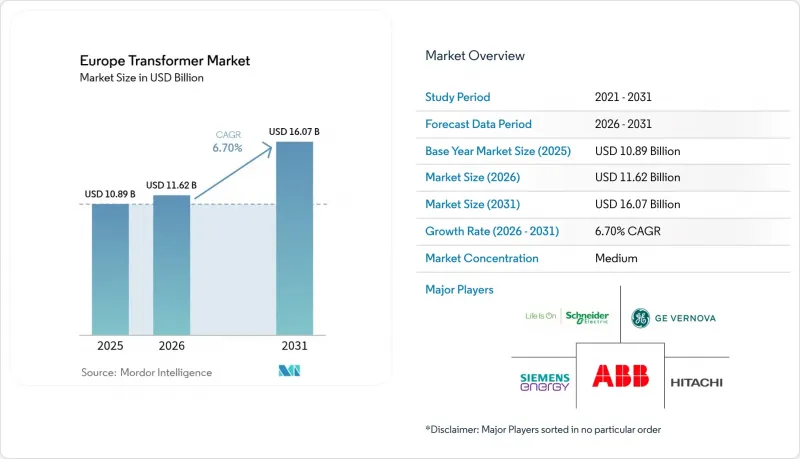
According to Mordor Intelligence, Europe transformer market size in 2026 is estimated at USD 11.62 billion, growing from 2025 value of USD 10.89 billion with 2031 projections showing USD 16.07 billion, growing at 6.7% CAGR over 2026-2031.
This report is Segmented by Power Rating (Large, Medium, and Small), Cooling Type (Air-Cooled and Oil-Cooled), Phase (Single-Phase and Three-Phase), Transformer Type (Power and Distribution), End-User (Power Utilities, Industrial, Commercial, and Residential), and Geography (Germany, United Kingdom, France, Spain, NORDIC Countries, Turkey, Russia, and Rest of Europe).
Europe Transformer Market Trends and Insights
Grid Modernization Investments Drive Infrastructure Renaissance
Transmission operators lead unprecedented spending. TenneT alone earmarks EUR 200 billion through 2034 to enlarge German and Dutch networks. Germany's network plan schedules 500,000 new transformers and 3,500 km of lines by 2045. In the United Kingdom, the GBP 58 billion Beyond 2030 blueprint aims to connect 21 GW of additional offshore wind. These capital flows ensure multi-year orders for medium- and ultra-high-voltage units, making the European transformer market a global test bed for advanced grid technologies.
Renewable Energy Integration Surge Reshapes Grid Architecture
Wind and solar additions demand transformers that regulate variable flows and maintain power-quality thresholds. Distribution units absorb rooftop solar backfeed, while HVDC converter transformers support the 1.4 GW Viking Link and the LionLink project, which links the Netherlands and the UK. Nordic grids prove early adopters, trading surplus hydropower across Nord Pool and increasing transformer utilization factors. This feedback loop of capacity and reinforcement accelerates deployment across the European transformer market.
Core Steel and Copper Price Volatility Pressures Margins
EUROFER reports only a 3.2% rebound in European steel demand for 2024 after a 9% fall in 2023, while imports still make up 28% of consumption. High variability in grain-oriented electrical steel pricing complicates transformer quotations, as core material constitutes as much as 40% of the total unit cost. Copper prices remain elevated due to surging grid expansion needs worldwide, lifting working-capital requirements for manufacturers. Utilities counter by extending tender validity periods and indexing contracts to metal exchanges, yet margin pressure persists during multi-year projects.
Other drivers and restraints analyzed in the detailed report include:
- Replacement of Aging Transformer Fleet Accelerates Modernization Cycles
- EV Charging Network Build-out Creates New Demand Vectors
- Lengthy Lead Times and Supply Chain Bottlenecks Constrain Growth
For complete list of drivers and restraints, kindly check the Table Of Contents.
Segment Analysis
The European transformer market size for large transformers, exceeding 100 MVA, is expanding at an 8.78% CAGR, reflecting booming demand from HVDC corridors such as the 1.4 GW Viking Link and the 2 GW LionLink, which connect renewable clusters to urban load centers. These high-capacity links require converter transformers capable of +-525 kV operation and rigid harmonic-filter tolerances, which increase the average unit price and drive suppliers to upgrade their insulation systems. Meanwhile, medium transformers (10-100 MVA) maintain leadership with a 44.92% share of the European transformer market in 2025, as their standardized designs anchor sub-transmission upgrades, enable energy storage coupling, and facilitate wind farm intertie circuits. Utilities prefer modular skid-mounted 40 MVA designs that fit tighter substation footprints and shorten energization schedules. Small ratings, up to 10 MVA, hold niche roles in municipal substations, rural feeders, and rooftop solar clusters that proliferate under net-metering incentives.
Grid planners increasingly sequence projects so that large-rating orders precede local reinforcements, creating a cascade of tender waves that keeps factories operating at high utilization. Hitachi Energy's EUR 80 million Cordoba upgrade scales shell-type production, tackling growing European backlogs and aligning with its USD 6.75 billion global expansion. Suppliers integrate digital winding hot-spot sensors even in small units to harmonize data streams across entire fleets. As cross-border trading expands through ENTSO-E's flow-based market coupling, demand for 500-1,000 MVA autotransformers is expected to surge, solidifying their large-rating prominence while maintaining steady volumes for medium-rating workhorses.
Oil-cooled designs captured 67.32% of the European transformer market share in 2025, a testament to their high dielectric strength and superior thermal dissipation for peak-load cycling. Natural-ester fluids now comprise a growing segment of this market because they are biodegradable and exhibit higher flash points than mineral oil, facilitating placement in densely populated areas. Manufacturers promote factory-filled ester units certified to Ecodesign Tier 2, ensuring utilities a 30-year service life and 20% lower total losses, which helps meet the tightened July 2024 efficiency rules. Air-cooled technology, although accounting for a smaller base, is the fastest-growing at a 6.74% CAGR, as data-center operators, hospitals, and metro-rail projects favor dry-type SAF-class insulation that eliminates the risk of oil spills.
Technological spillovers blur the categorical boundary: several German projects now specify forced-air/forced-oil hybrids with ester insulation, combining compact radiators with low-sound fans to meet urban noise codes. The European transformer market share of dry-type units also benefits from mounting hydrogen valley pilots, where non-flammable resins permit placement near electrolyzers. Research by MDPI indicates ester-filled prototypes slow gasket hardening at 150 °C, extending sealing reliability and offsetting the higher upfront cost. Over the forecast window, competitive intensity will pivot on suppliers' ability to certify ester compatibility across larger ratings, ensuring oil-filled dominance while allowing air-cooled alternatives to carve sustainable inroads.
Complete Report Scope:
- By Power Rating
- Large (Above 100 MVA)
- Medium (10 to 100 MVA)
- Small (Up to 10 MVA)
- By Cooling Type
- Air-Cooled
- Oil-Cooled
- By Phase
- Single-Phase
- Three-Phase
- By Transformer Type
- Power
- Distribution
- By End-User
- Power Utilities (includes, Renewables, Non-renewables, and T&D)
- Industrial
- Commercial
- Residential
- By Geography
- Germany
- United Kingdom
- France
- Spain
- NORDIC Countries
- Turkey
- Russia
- Rest of Europe
List of Companies Covered in this Report:
- Siemens Energy
- Hitachi Energy
- ABB Ltd.
- Schneider Electric SE
- General Electric Vernova
- Mitsubishi Electric Corp.
- Eaton Corporation plc
- CG Power & Industrial Solutions
- SGB-SMIT Group
- Wilson Power Solutions
- Hyosung Heavy Industries
- Toshiba Energy Systems
- SPX Transformer Solutions
- Weg Transformers
- Ormazabal (Velatia)
- Pauwels Transformers
- Arteche Group
- TRAFOELETTRO
- Alstom (traction transformers)
- Breimer-Roth Transformatoren
Additional Benefits:
- The market estimate (ME) sheet in Excel format
- 3 months of analyst support
TABLE OF CONTENTS
1 Introduction
- 1.1 Study Assumptions & Market Definition
- 1.2 Scope of the Study
2 Research Methodology
3 Executive Summary
4 Market Landscape
- 4.1 Market Overview
- 4.2 Market Drivers
- 4.2.1 Grid modernisation investments
- 4.2.2 Renewable-energy integration surge
- 4.2.3 Replacement of ageing transformer fleet
- 4.2.4 EV-charging network build-out
- 4.2.5 EU Tier-3 eco-design push for ester-filled units
- 4.2.6 Digital-twin based procurement mandates
- 4.3 Market Restraints
- 4.3.1 Core-steel & copper price volatility
- 4.3.2 Lengthy lead-times & supply-chain bottlenecks
- 4.3.3 Scarcity of transformer design engineers
- 4.3.4 Rising grid harmonics cutting asset life
- 4.4 Supply-Chain Analysis
- 4.5 Regulatory Landscape
- 4.6 Technological Outlook
- 4.7 Porter's Five Forces
- 4.7.1 Bargaining Power of Suppliers
- 4.7.2 Bargaining Power of Buyers
- 4.7.3 Threat of New Entrants
- 4.7.4 Threat of Substitutes
- 4.7.5 Intensity of Competitive Rivalry
5 Market Size & Growth Forecasts
- 5.1 By Power Rating
- 5.1.1 Large (Above 100 MVA)
- 5.1.2 Medium (10 to 100 MVA)
- 5.1.3 Small (Up to 10 MVA)
- 5.2 By Cooling Type
- 5.2.1 Air-Cooled
- 5.2.2 Oil-Cooled
- 5.3 By Phase
- 5.3.1 Single-Phase
- 5.3.2 Three-Phase
- 5.4 By Transformer Type
- 5.4.1 Power
- 5.4.2 Distribution
- 5.5 By End-User
- 5.5.1 Power Utilities (includes, Renewables, Non-renewables, and T&D)
- 5.5.2 Industrial
- 5.5.3 Commercial
- 5.5.4 Residential
- 5.6 By Geography
- 5.6.1 Germany
- 5.6.2 United Kingdom
- 5.6.3 France
- 5.6.4 Spain
- 5.6.5 NORDIC Countries
- 5.6.6 Turkey
- 5.6.7 Russia
- 5.6.8 Rest of Europe
6 Competitive Landscape
- 6.1 Market Concentration
- 6.2 Strategic Moves (M&A, Partnerships, PPAs)
- 6.3 Market Share Analysis (Market Rank/Share for key companies)
- 6.4 Company Profiles (includes Global level Overview, Market level overview, Core Segments, Financials as available, Strategic Information, Products & Services, and Recent Developments)
- 6.4.1 Siemens Energy
- 6.4.2 Hitachi Energy
- 6.4.3 ABB Ltd.
- 6.4.4 Schneider Electric SE
- 6.4.5 General Electric Vernova
- 6.4.6 Mitsubishi Electric Corp.
- 6.4.7 Eaton Corporation plc
- 6.4.8 CG Power & Industrial Solutions
- 6.4.9 SGB-SMIT Group
- 6.4.10 Wilson Power Solutions
- 6.4.11 Hyosung Heavy Industries
- 6.4.12 Toshiba Energy Systems
- 6.4.13 SPX Transformer Solutions
- 6.4.14 Weg Transformers
- 6.4.15 Ormazabal (Velatia)
- 6.4.16 Pauwels Transformers
- 6.4.17 Arteche Group
- 6.4.18 TRAFOELETTRO
- 6.4.19 Alstom (traction transformers)
- 6.4.20 Breimer-Roth Transformatoren
7 Market Opportunities & Future Outlook
- 7.1 White-space & Unmet-Need Assessment

