PUBLISHER: Mordor Intelligence | PRODUCT CODE: 2116130

PUBLISHER: Mordor Intelligence | PRODUCT CODE: 2116130
Germany Prefabricated Houses - Market Share Analysis, Industry Trends & Statistics, Growth Forecasts (2026 - 2031)
According to Mordor Intelligence, the Germany prefabricated housing market size was valued at USD 7.64 billion in 2025 and estimated to grow from USD 8.08 billion in 2026 to reach USD 10.66 billion by 2031, at a CAGR of 5.72% during the forecast period (2026-2031).
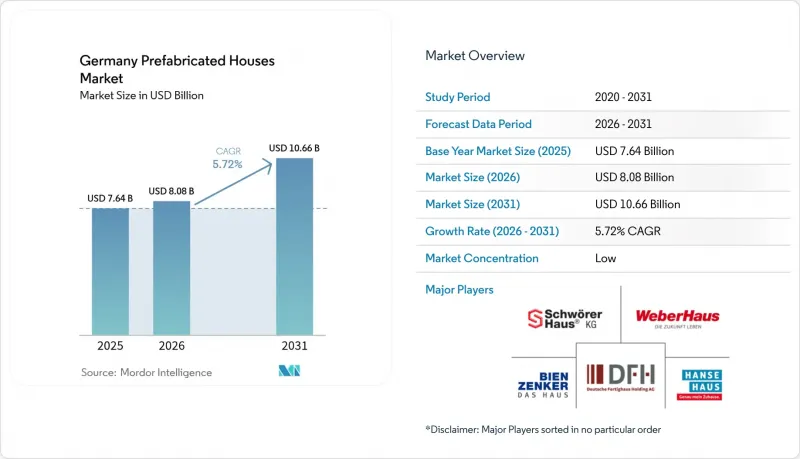
This report is Segmented by Material Type (Concrete, Glass, Metal, Timber and Other Materials), by Type (Single-Family and Multi-Family), by Product Type (Modular Homes, Panelised & Componentised Systems, Manufactured Homes and Other Prefab Types), and by Key Cities (Berlin, Hamburg, Munich, Cologne, Frankfurt and the Rest of Germany). The Market Forecasts are Provided in Terms of Value (USD).
Germany Prefabricated Houses Market Trends and Insights
Chronic 800,000-unit housing deficit promotes serial-construction tenders
Germany's urban centers collectively miss annual completion targets by tens of thousands of units, a shortfall that has prompted cities such as Cologne and Hamburg to specify prefab formats in social-housing tenders. Serial construction frameworks cut costs by 22% and slash delivery schedules by well over a year, yielding predictable outcomes that satisfy value-for-money audits. The evolution from lowest-price bids toward life-cycle-value scoring further tilts procurement rules toward industrialized builders able to guarantee energy-performance metrics upfront. Policy signals are now explicit: Berlin's latest statewide guidelines set a 30% prefab allocation for new municipal projects, locking in market visibility for suppliers. Developers who ignore serial bidding risk exclusion from a pipeline likely to exceed USD 35 billion in public-sector spending to 2030.
KfW / BEG subsidies accelerate demand for energy-efficient prefab homes
Germany's flagship KfW and BEG programs now cover up to 70% of eligible renewable-heating costs, driving middle-income buyers toward factory-produced dwellings that integrate heat pumps and solar arrays before leaving the plant. Loan volumes for energy-efficiency upgrades rose 17% in 2024, confirming that homeowners view subsidies as decisive. Prefab makers fold these incentives into turnkey offers, which lowers the effective entry price and allows rapid disbursement once on-site work is verified. Urban municipalities further sweeten the proposition by reducing permit fees for projects that meet KfW Efficiency House 40 standards. Continued political backing appears strong for 2025, but future budgets could tighten, making cost-optimized production essential to maintain momentum.
Double-digit cost inflation for prefab inputs since 2022 erodes price edge
Timber, insulation foam, and structural steel rose more than 10% per year from 2022 to 2024, squeezing profit margins across the German prefabricated housing market. Factory efficiency cannot fully neutralize such spikes because raw materials account for over half of ex-works cost. Municipal buyers operating under fixed-price frameworks sometimes postpone awards when bids exceed budget ceilings, delaying revenue recognition for manufacturers. The strain is most visible in the affordable segment, where final selling prices hover near upper limits set by social programs. Suppliers respond by forward-buying inventories and adopting digital twins to engineer out material waste, tactics that lessen but do not eliminate upward cost pressure.
Other drivers and restraints analyzed in the detailed report include:
- Factory automation & robotics offset skilled-labor shortages
- CO2-pricing, timber-quota targets & GEG 2024 favour low-carbon wood modules
- Shortfall of certified timber-frame assemblers & crane crews
For complete list of drivers and restraints, kindly check the Table Of Contents.
Segment Analysis
Timber secured a commanding 60.35% of the German prefabricated housing market share in 2025, underscoring the material's long-standing cultural resonance and its regulatory advantages under GEG 2024. Concrete, while holding a smaller base, is on track to post the fastest 6.28% CAGR through 2031, buoyed by 3D-printing breakthroughs that slash labor hours and emit fewer greenhouse gases than conventional mixes. Timber's leadership rests on established saw-mill networks, predictable moisture behavior, and end-of-life recyclability, all of which dovetail with rising environmental product declarations demanded by lenders. GOLDBECK's Blue Concrete, formulated to cut embodied carbon by 35%, demonstrates how mineral materials can claw back relevance when sustainability metrics tighten.
In this competitive landscape, the German prefabricated housing market size for concrete modules could exceed USD 2.46 billion by 2031 if its current momentum holds. Wood remains entrenched because Baden-Wurttemberg, Bavaria, and Thuringia continue to subsidize timber innovation clusters, translating policy into factory orders. Yet hybrid systems combining engineered wood beams with printed concrete cores are emerging to meet greater fire-rating demands in multi-story projects. Manufacturers that develop flexible lines able to pivot between pure timber, pure concrete, and hybrid bills of materials will insulate themselves from commodity price whiplash while winning specification slots in diverse project briefs.
Complete Report Scope:
- By Material Type
- Concrete
- Glass
- Metal
- Timber
- Other Materials
- By Type
- Single-Family
- Multi-Family
- By Product Type
- Modular Homes
- Panelised & Componentised Systems
- Manufactured Homes
- Other Prefab Types
- By Key Cities
- Berlin
- Hamburg
- Munich
- Cologne
- Frankfurt
- Rest of Germany
List of Companies Covered in this Report:
- SchworerHaus
- Hanse Haus GmbH
- WeberHaus GmbH & Co.
- Bien-Zenker GmbH
- DFH Haus Holding AG (Massa / Allkauf)
- ScanHaus Marlow GmbH
- Goldbeck GmbH (Modular Housing)
- HUF Haus GmbH
- Danwood S.A. (German Ops.)
- Kampa GmbH
- FingerHaus GmbH
- Baufritz GmbH & Co.
- Luxhaus GmbH
- Kleusberg GmbH
- Redbloc Elemente GmbH
- Clayton Homes (Berkshire Hathaway)
- Skyline Champion Corporation
- Cavco Industries Inc.
- Sekisui House Ltd (North America arm)
- Clayton Homes (Berkshire Hathaway)
Additional Benefits:
- The market estimate (ME) sheet in Excel format
- 3 months of analyst support
TABLE OF CONTENTS
1 Introduction
- 1.1 Study Assumptions & Market Definition
- 1.2 Scope of the Study
2 Research Methodology
3 Executive Summary
4 Market Landscape
- 4.1 Market Overview
- 4.2 Market Drivers
- 4.2.1 KfW / BEG subsidies accelerate demand for energy-efficient prefab homes
- 4.2.2 Chronic 800 k-unit housing deficit promotes serial-construction tenders
- 4.2.3 Factory automation & robotics offset skilled-labour shortages
- 4.2.4 BIM-centred design plus 3-D-printed parts shorten planning cycles
- 4.2.5 CO2-pricing, timber-quota targets & GEG 2024 favour low-carbon wood modules
- 4.2.6 Bundeswehr & disaster-relief contracts spur rapid-deploy volumetric units
- 4.3 Market Restraints
- 4.3.1 Double-digit cost inflation for prefab inputs since 2022 erodes price edge
- 4.3.2 Shortfall of certified timber-frame assemblers & crane crews
- 4.3.3 Divergent state building codes (16 Lander LBOs) delay approvals
- 4.3.4 Tight road-escort rules boost logistics costs for oversized modules
- 4.3.5 "Catalogue-house" image & resale-value doubts curb urban uptake
- 4.4 Value / Supply-Chain Analysis
- 4.5 Regulatory Landscape
- 4.6 Technological Outlook
- 4.7 Porter's Five Forces
- 4.7.1 Threat of New Entrants
- 4.7.2 Bargaining Power of Buyers
- 4.7.3 Bargaining Power of Suppliers
- 4.7.4 Threat of Substitutes
- 4.7.5 Intensity of Competitive Rivalry
- 4.8 Brief on Different Structures Used in Prefabricated Housing
- 4.9 Cost Structure Analysis of Prefabricated Housing
5 Market Size & Growth Forecasts (Value)
- 5.1 By Material Type
- 5.1.1 Concrete
- 5.1.2 Glass
- 5.1.3 Metal
- 5.1.4 Timber
- 5.1.5 Other Materials
- 5.2 By Type
- 5.2.1 Single-Family
- 5.2.2 Multi-Family
- 5.3 By Product Type
- 5.3.1 Modular Homes
- 5.3.2 Panelised & Componentised Systems
- 5.3.3 Manufactured Homes
- 5.3.4 Other Prefab Types
- 5.4 By Key Cities
- 5.4.1 Berlin
- 5.4.2 Hamburg
- 5.4.3 Munich
- 5.4.4 Cologne
- 5.4.5 Frankfurt
- 5.4.6 Rest of Germany
6 Competitive Landscape
- 6.1 Market Concentration
- 6.2 Strategic Moves
- 6.3 Market Share Analysis
- 6.4 Company Profiles (includes Global-level Overview, Market-level Overview, Core Segments, Financials, Strategic Information, Market Rank/Share, Products & Services, Recent Developments)
- 6.4.1 SchworerHaus
- 6.4.2 Hanse Haus GmbH
- 6.4.3 WeberHaus GmbH & Co.
- 6.4.4 Bien-Zenker GmbH
- 6.4.5 DFH Haus Holding AG (Massa / Allkauf)
- 6.4.6 ScanHaus Marlow GmbH
- 6.4.7 Goldbeck GmbH (Modular Housing)
- 6.4.8 HUF Haus GmbH
- 6.4.9 Danwood S.A. (German Ops.)
- 6.4.10 Kampa GmbH
- 6.4.11 FingerHaus GmbH
- 6.4.12 Baufritz GmbH & Co.
- 6.4.13 Luxhaus GmbH
- 6.4.14 Kleusberg GmbH
- 6.4.15 Redbloc Elemente GmbH
- 6.4.16 Clayton Homes (Berkshire Hathaway)
- 6.4.17 Skyline Champion Corporation
- 6.4.18 Cavco Industries Inc.
- 6.4.19 Sekisui House Ltd (North America arm)
- 6.4.20 Clayton Homes (Berkshire Hathaway)
7 Market Opportunities & Future Outlook
- 7.1 White-space & Unmet-Need Assessment

