PUBLISHER: Mordor Intelligence | PRODUCT CODE: 2116293

PUBLISHER: Mordor Intelligence | PRODUCT CODE: 2116293
Germany Fintech - Market Share Analysis, Industry Trends & Statistics, Growth Forecasts (2026 - 2031)
According to Mordor Intelligence, Germany fintech market size in 2026 is estimated at USD 16.71 billion, growing from 2025 value of USD 14.57 billion with 2031 projections showing USD 33.16 billion, growing at 14.71% CAGR over 2026-2031.
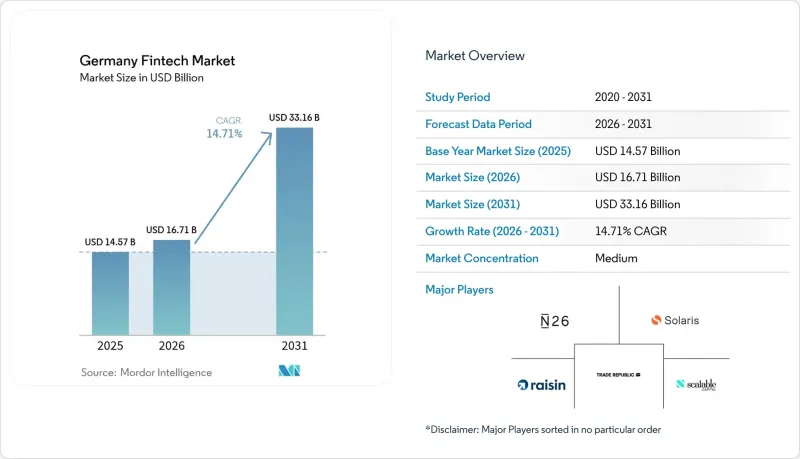
This report is Segmented by Service Proposition (Digital Payments, Digital Lending and Financing, Digital Investments, Insurtech, and Neobanking), by End-User (Retail and Businesses), and by User Interface (Mobile Applications, Web / Browser, and POS / IoT Devices). The Market Forecasts are Provided in Terms of Value (USD).
Germany Fintech Market Trends and Insights
PSD2-driven open banking accelerates API innovation
Mandatory API gateways introduced under PSD2 have moved German banks from resistance to monetization. BaFin's secure-API mandate spawned 187 registered third-party providers in 2024, a 23% jump year-on-year. Institutions now compete on developer experience: Deutsche Bank's XS2A sandbox underpins account aggregation, and savings-bank groups package real-time payment initiation for e-commerce checkouts. Strong customer authentication, once viewed as friction, reduces fraud exposure and standardizes security, allowing fintechs to scale without bespoke integrations. The shift from compliance to commercial API portfolios positions open banking as a durable growth rail for the Germany fintech market.
Demographic shift toward mobile-first banking among urban Gen Z and millennials
Consumers under 35 rarely visit branches and expect instant onboarding, account insights, and investment execution on a smartphone. Urban adoption rates translate into usage rather than just downloads: active mobile-bank users log in 15-20 times a month, double 2022 levels. This mobile bias extends to investing, where fractional-share platforms eclipse traditional advisors for first-time investors. Providers that pair sleek UX with deposit protection win share, while slower incumbents risk brand relevance.
Persistent cash preference among older Germans
Cash still accounts for a significant portion of transactions, with the 65+ cohort driving most usage. Rural merchants reinforce habits by offering cash discounts. Fintechs respond with hybrid rails: Paysafe and Deutsche Bank co-develop cash-in/cash-out at post offices, while G+D pilots a CBDC that mimics banknotes offline. Yet acquisition costs rise when digital onboarding must coexist with in-store education, capping the upside for fully cashless propositions.
Other drivers and restraints analyzed in the detailed report include:
- Surge in German e-commerce volumes fuels embedded payment solutions
- Digital treasury modernization expands B2B fintech demand
- Stringent BaFin licensing extends time-to-market
For complete list of drivers and restraints, kindly check the Table Of Contents.
Segment Analysis
Digital payments held a 37.65% share of Germany fintech market. Merchant adoption of contactless POS, QR codes, and embedded checkout APIs has made payment services the default monetization rail. Insurtech, in contrast, captures a modest slice today yet is forecasted to grow at an 17.98% CAGR, reflecting parametric crop cover, usage-based auto policies, and AI-driven claims. Payment specialists defend share through loyalty add-ons, while insurance challengers bundle underwriting, distribution, and policy administration on cloud cores.
Neobanking, lending, and wealth-tech form the middle ranks. Lending moves from consumer instalments to working-capital lines scored on real-time ERP data. Wealth-tech democratizes ETFs and fractions, but fee pressure forces platforms to upsell crypto custody, ESG filters, and tax optimization. The Germany fintech market, therefore, tilts from horizontal "finance-super-apps" toward vertical leaders that monetize a single profit pool deeply.
Complete Report Scope:
- By Service Proposition
- Digital Payments
- Digital Lending and Financing
- Digital Investments
- Insurtech
- Neobanking
- By End-User
- Retail
- Businesses
- By User Interface
- Mobile Applications
- Web / Browser
- POS / IoT Devices
List of Companies Covered in this Report:
- N26 GmbH
- Solaris SE
- Trade Republic Bank GmbH
- Raisin DS GmbH
- Penta Bank GmbH (Qonto Group)
- Scalable Capital GmbH
- Clark Germany GmbH
- Getsafe Digital GmbH
- Wefox Germany GmbH
- Fidor Bank AG
- Unzer GmbH
- Payone GmbH
- RatePAY GmbH
- Billie GmbH
- Mambu GmbH
- Deposit Solutions GmbH
- Vivid Money GmbH
- Tomorrow Bank GmbH
- Auxmoney GmbH
- Moonfare GmbH
Additional Benefits:
- The market estimate (ME) sheet in Excel format
- 3 months of analyst support
TABLE OF CONTENTS
1 Introduction
- 1.1 Study Assumptions & Market Definition
- 1.2 Scope of the Study
2 Research Methodology
3 Executive Summary
4 Market Landscape
- 4.1 Market Overview
- 4.2 Market Drivers
- 4.2.1 PSD2-Driven Open Banking Adoption Accelerating API-Based Innovation in Germany
- 4.2.2 Demographic Shift Toward Mobile-First Banking Among Urban Gen Z & Millennials
- 4.2.3 Surge in German E-Commerce Volumes Fueling Embedded Payment Solutions
- 4.2.4 Digital Treasury Modernization Expanding B2B Fintech Demand
- 4.2.5 Instant Payment Settlement Enabling Real-Time Payment Proliferation
- 4.2.6 EU Green Finance Policies Steering Growth of Sustainable Fintech Products
- 4.3 Market Restraints
- 4.3.1 Persistent Cash Preference Among Older German Consumers
- 4.3.2 Stringent BaFin Licensing Process Extending Time-to-Market
- 4.3.3 VC Funding Contraction in Series B+ Stage Limiting Scale-ups
- 4.3.4 Legacy IT Fragmentation at Incumbent Banks Hindering Fintech Integrations
- 4.4 Value / Supply-Chain Analysis
- 4.5 Regulatory Outlook
- 4.6 Technological Outlook
- 4.7 Porter's Five Forces
- 4.7.1 Threat of New Entrants
- 4.7.2 Bargaining Power of Suppliers
- 4.7.3 Bargaining Power of Buyers
- 4.7.4 Threat of Substitutes
- 4.7.5 Competitive Rivalry
- 4.8 Investment & Funding Trend Analysis
5 Market Size & Growth Forecasts (Value)
- 5.1 By Service Proposition
- 5.1.1 Digital Payments
- 5.1.2 Digital Lending and Financing
- 5.1.3 Digital Investments
- 5.1.4 Insurtech
- 5.1.5 Neobanking
- 5.2 By End-User
- 5.2.1 Retail
- 5.2.2 Businesses
- 5.3 By User Interface
- 5.3.1 Mobile Applications
- 5.3.2 Web / Browser
- 5.3.3 POS / IoT Devices
6 Competitive Landscape
- 6.1 Market Concentration
- 6.2 Strategic Moves
- 6.3 Market Share Analysis
- 6.4 Company Profiles (includes Global level Overview, Market Level Overview, Core Segments, Financials as available, Strategic Information, Market Rank/Share for Key Companies, Products & Services, and Recent Developments)
- 6.4.1 N26 GmbH
- 6.4.2 Solaris SE
- 6.4.3 Trade Republic Bank GmbH
- 6.4.4 Raisin DS GmbH
- 6.4.5 Penta Bank GmbH (Qonto Group)
- 6.4.6 Scalable Capital GmbH
- 6.4.7 Clark Germany GmbH
- 6.4.8 Getsafe Digital GmbH
- 6.4.9 Wefox Germany GmbH
- 6.4.10 Fidor Bank AG
- 6.4.11 Unzer GmbH
- 6.4.12 Payone GmbH
- 6.4.13 RatePAY GmbH
- 6.4.14 Billie GmbH
- 6.4.15 Mambu GmbH
- 6.4.16 Deposit Solutions GmbH
- 6.4.17 Vivid Money GmbH
- 6.4.18 Tomorrow Bank GmbH
- 6.4.19 Auxmoney GmbH
- 6.4.20 Moonfare GmbH
7 Market Opportunities & Future Outlook
- 7.1 White-Space & Unmet-Need Assessment

