PUBLISHER: Mordor Intelligence | PRODUCT CODE: 2123731

PUBLISHER: Mordor Intelligence | PRODUCT CODE: 2123731
India Fintech - Market Share Analysis, Industry Trends & Statistics, Growth Forecasts (2026 - 2031)
According to Mordor Intelligence, the India fintech market size is USD 51.30 billion in 2026 and is projected to reach USD 109.06 billion by 2031 at a 16.27% CAGR during the forecast period (2026-2031).
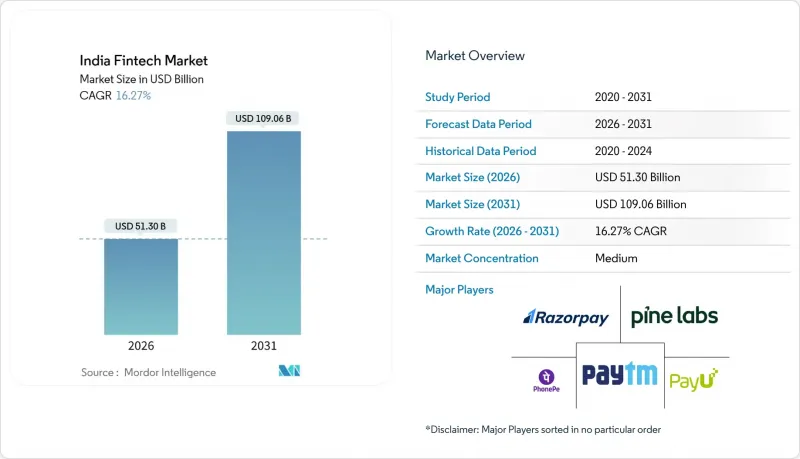
This report is Segmented by Service Proposition (Digital Payments, Digital Lending and Financing, Digital Investments, Insurtech, Neobanking), End-User (Retail, Businesses), and User Interface (Mobile Applications, Web/Browser, POS/IoT Devices). The Market Forecasts are Provided in Terms of Value (USD).
India Fintech Market Trends and Insights
Government-Built Digital Public Infrastructure (UPI, Aadhaar, OCEN) Accelerating Mass-Market Adoption
India's real-time payments infrastructure, Aadhaar-based identity, and interoperable data-sharing rails together remove friction that previously slowed onboarding and transactions at scale. India's share of global real-time payments reached 49% in 2023, which supports recurring payment behaviours and merchant acceptance models that monetize at large daily volumes. Aadhaar authentication hit 2.21 billion in August 2025, with adult coverage at 99.7%, which closes KYC gaps and shortens onboarding in the India fintech market. The Account Aggregator network has linked consented users to over 2.61 billion enabled accounts, allowing lenders and insurance distributors to retrieve verified financial data within seconds, which compresses underwriting timelines for thin-file customers. Together, these rails power scale economics that favour embedded journeys across payments, credit, insurance, and investments as the India fintech market deepens coverage in semi-urban and rural districts.
Account Aggregator Framework Unlocking Data-Driven Credit Underwriting
The Account Aggregator framework normalizes consent-based access to financial data and reduces the cost of risk assessment for banks and NBFCs partnering with fintech platforms. With users connecting bank accounts and other financial repositories through licensed AAs, lenders derive a real-time view of cash flows, which supports extensions of small-ticket working capital and personal credit to thin-file customers. RBI's broader regulatory sandbox and digital lending directions strengthen disclosures and grievance processes, which support sustainable scale for the India fintech market as more lenders shift from screen-scraping to auditable consent models. Standardization across APIs and consent flows lowers manual verification delays that once kept micro-entrepreneurs and gig workers outside formal credit. Over time, underwriting that relies on verified transaction trails improves portfolio quality while increasing access for first-time borrowers in the India fintech market.
RBI's Stricter Digital-Lending and FLDG Norms Raising Compliance Cost
RBI's digital lending directions strengthen disclosures, escrow segregation, and grievance handling, which increases fixed compliance costs for platforms and their regulated partners in the India fintech market. Clarifications around risk retention and default guarantees shift capital requirements to lenders and co-lenders, which compresses margins for models that depended on risk transfer to bank partners. Larger lenders and well-capitalized platforms can absorb these costs, while smaller entities face exit or consolidation as compliance becomes a scale advantage in the India fintech market. RBI's sandbox and supervisory focus push product design toward transparency and customer protection, which reduces regulatory risk but slows experimental rollouts. This recalibration prioritizes sustainable origination over rapid growth, which tempers expansion in digital lending before a new equilibrium emerges in the India fintech market.
Other drivers and restraints analyzed in the detailed report include:
- Embedded-Finance Demand from E-commerce and Gig-Economy Platforms
- Formalization of MSMEs Post-GST Creating New SME Fintech Demand Pools
- Zero-MDR Policy Compressing Payment-Gateway Profit Pools
For complete list of drivers and restraints, kindly check the Table Of Contents.
Segment Analysis
Digital payments captured 42.87% of the India fintech market share in 2025, anchored by UPI's scale and merchant acceptance that sustains habitual usage across daily purchases. India's real-time rail supports checkout conversion and merchant trust, which anchors cross-sell into protection, loan, and wealth products across the India fintech market. The India fintech industry uses app-first journeys and interoperable rails to reduce acquisition friction and extend reach beyond metros into semi-urban districts. Aggregators ship enterprise and SMB tools, including buyer protection and export settlement accounts, which create monetization beyond MDR in the India fintech market. As regulatory guidance on payment aggregators raises net worth thresholds, scale advantages, and compliance maturity, it drives consolidation within payments.
The India fintech market size for neobanking is projected to expand at a 19.64% CAGR between 2026 and 2031 as multi-bank UPI models and app-centric accounts deepen usage among digital-first customers. Neobanks layer budgeting, credit access, and business banking features on top of existing rails, which improves retention and fee capture in the India fintech market. Digital lending growth moderates in the near term as risk retention norms and disclosure-heavy processes add cost, which encourages co-lending models with banks and more selective origination. Wealth and insurance aggregators scale by combining distribution with service layers, while maintaining customer acquisition through cross-sell on a large payment basis in the India fintech market. Over the forecast period, propositions that bundle payments, credit, and protection into unified interfaces are positioned to capture higher lifetime value per user in the India fintech market.
Complete Report Scope:
- By Service Proposition
- Digital Payments
- Digital Lending and Financing
- Digital Investments
- Insurtech
- Neobanking
- By End-User
- Retail
- Businesses
- By User Interface
- Mobile Applications
- Web / Browser
- POS / IoT Devices
List of Companies Covered in this Report:
- Paytm (One97 Communications Ltd)
- PhonePe Pvt Ltd
- Razorpay Software Pvt Ltd
- Pine Labs Pvt Ltd
- PayU Payments Pvt Ltd
- BharatPe (Resilient Innovations Pvt Ltd)
- MobiKwik (One MobiKwik Systems Ltd)
- PolicyBazaar (PB Fintech Ltd)
- Zerodha Broking Ltd
- Upstox (RKSV Securities India Pvt Ltd)
- Groww (Nextbillion Technology Pvt Ltd)
- Cred Financial Technologies Pvt Ltd
- Slice (GaragePreneurs Internet Pvt Ltd)
- KreditBee (Finnov Pvt Ltd)
- Lendingkart Finance Ltd
- Capital Float (Axio Digital)
- NeoGrowth Credit Pvt Ltd
- Navi Technologies Ltd
- Jupiter (Amica Finance Pvt Ltd)
- NIYO Solutions Pvt Ltd
Additional Benefits:
- The market estimate (ME) sheet in Excel format
- 3 months of analyst support
TABLE OF CONTENTS
1 Introduction
- 1.1 Study Assumptions & Market Definition
- 1.2 Scope of the Study
2 Research Methodology
3 Executive Summary
4 Market Landscape
- 4.1 Market Overview
- 4.2 Market Drivers
- 4.2.1 Government-Built Digital Public Infrastructure (UPI, Aadhaar, OCEN) Accelerating Mass-Market Adoption
- 4.2.2 Account Aggregator Framework Unlocking Data-Driven Credit Underwriting
- 4.2.3 Embedded-Finance Demand from E-commerce & Gig-Economy Platforms
- 4.2.4 Formalization of MSMEs post-GST Creating New SME Fintech Demand Pools
- 4.2.5 Millennial & Gen-Z Wealth Creation Driving Low-Cost Robo-Advisory Uptake
- 4.2.6 Cross-Border UPI Linkages (e.g., Singapore, UAE) Opening New Remittance Revenues
- 4.3 Market Restraints
- 4.3.1 RBI's Stricter Digital-Lending & FLDG Norms Raising Compliance Cost
- 4.3.2 Zero-MDR Policy Compressing Payment-Gateway Profit Pools
- 4.3.3 Escalating Cyber-Fraud Incidents Undermining Consumer Trust
- 4.3.4 Post-2022 Funding Winter Constraining Scale-Up Capital
- 4.4 Value Chain Analysis
- 4.5 Regulatory or Technological Outlook
- 4.6 Porter's Five Forces Analysis
- 4.6.1 Threat of New Entrants
- 4.6.2 Bargaining Power of Suppliers
- 4.6.3 Bargaining Power of Buyers
- 4.6.4 Threat of Substitutes
- 4.6.5 Competitive Rivalry
- 4.7 Investment & Funding Trend Analysis
5 Market Size & Growth Forecasts (Value)
- 5.1 By Service Proposition
- 5.1.1 Digital Payments
- 5.1.2 Digital Lending and Financing
- 5.1.3 Digital Investments
- 5.1.4 Insurtech
- 5.1.5 Neobanking
- 5.2 By End-User
- 5.2.1 Retail
- 5.2.2 Businesses
- 5.3 By User Interface
- 5.3.1 Mobile Applications
- 5.3.2 Web / Browser
- 5.3.3 POS / IoT Devices
6 Competitive Landscape
- 6.1 Market Concentration
- 6.2 Strategic Moves
- 6.3 Market Share Analysis
- 6.4 Company Profiles {(includes Global level Overview, Market level overview, Core Segments, Financials as available, Strategic Information, Market Rank/Share for key companies, Products & Services, and Recent Developments)}
- 6.4.1 Paytm (One97 Communications Ltd)
- 6.4.2 PhonePe Pvt Ltd
- 6.4.3 Razorpay Software Pvt Ltd
- 6.4.4 Pine Labs Pvt Ltd
- 6.4.5 PayU Payments Pvt Ltd
- 6.4.6 BharatPe (Resilient Innovations Pvt Ltd)
- 6.4.7 MobiKwik (One MobiKwik Systems Ltd)
- 6.4.8 PolicyBazaar (PB Fintech Ltd)
- 6.4.9 Zerodha Broking Ltd
- 6.4.10 Upstox (RKSV Securities India Pvt Ltd)
- 6.4.11 Groww (Nextbillion Technology Pvt Ltd)
- 6.4.12 Cred Financial Technologies Pvt Ltd
- 6.4.13 Slice (GaragePreneurs Internet Pvt Ltd)
- 6.4.14 KreditBee (Finnov Pvt Ltd)
- 6.4.15 Lendingkart Finance Ltd
- 6.4.16 Capital Float (Axio Digital)
- 6.4.17 NeoGrowth Credit Pvt Ltd
- 6.4.18 Navi Technologies Ltd
- 6.4.19 Jupiter (Amica Finance Pvt Ltd)
- 6.4.20 NIYO Solutions Pvt Ltd
7 Market Opportunities & Future Outlook
- 7.1 White-Space & Unmet-Need Assessment

