PUBLISHER: Mordor Intelligence | PRODUCT CODE: 2116295

PUBLISHER: Mordor Intelligence | PRODUCT CODE: 2116295
Asia-Pacific Fintech - Market Share Analysis, Industry Trends & Statistics, Growth Forecasts (2026 - 2031)
According to Mordor Intelligence, Asia-Pacific fintech market size in 2026 is estimated at USD 167.71 billion, growing from 2025 value of USD 144.87 billion with 2031 projections showing USD 348.1 billion, growing at 15.76% CAGR over 2026-2031.
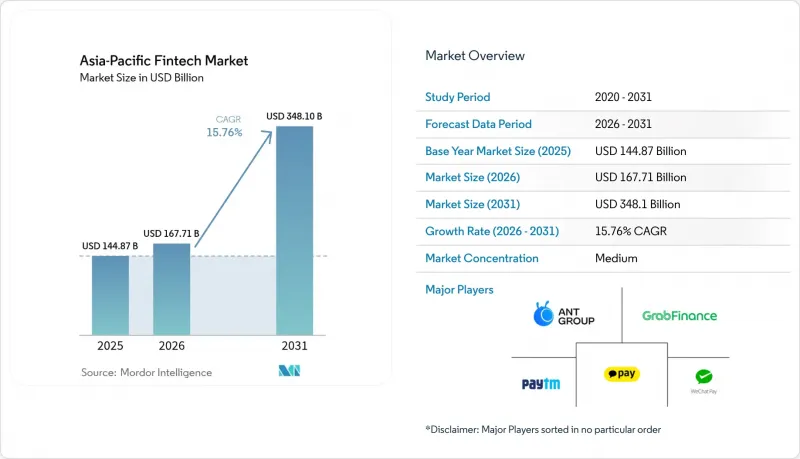
This report is Segmented by Service Proposition (Digital Payments, Digital Lending and Financing, Digital Investments, Insurtech, Neobanking), End-User (Retail, Businesses), User Interface (Mobile Applications, Web/Browser, POS/IoT Devices), and Geography (India, China, Japan, Australia, South Korea, South-East Asia). The Market Forecasts are Provided in Terms of Value (USD).
Asia-Pacific Fintech Market Trends and Insights
Real-Time Payment Rails Proliferation Across APAC
The rollout of instant payment networks such as India's UPI, Singapore's PayNow, and Thailand's PromptPay removes settlement lags, reduces interchange fees, and shifts consumer preference away from cash. UPI processed 131 billion transactions worth USD 1.8 trillion in 2024. PayNow and PromptPay achieved bilateral interoperability, allowing Singaporean tourists in Thailand to pay merchants at mid-market FX rates without card surcharges. Real-time rails consequently become embedded layers that fintech applications can tap through open APIs, creating low-code paths to launch P2P remittance, payroll, and merchant settlement products. Merchants favor QR rails for lower device costs and faster cash conversion, resulting in cannibalization of card volumes, especially under USD 25 ticket sizes. Governments continue subsidizing POS upgrades, signaling that instant push payments will remain the default standard by mid-decade.
Government-Led Financial Inclusion & e-ID Programs
Digital ID frameworks materially lower KYC friction, cut onboarding times from days to minutes, and thereby expand the Asia-Pacific fintech market addressable base. India's Aadhaar underpins over 1.3 billion biometric IDs, enabling one-tap verification across banking, insurance, and investment apps. Indonesia's e-ID scheme follows suit for 270 million citizens, while the Philippines targets 50 million unbanked adults by 2028. These programs standardize data fields, which allows regional interoperability and supports cross-border financial products. Providers reduce customer acquisition costs by up to 40%, reallocating savings toward product R&D and geographic expansion. The inclusion wave also drives account ownership among women and rural micro-enterprises, linking public welfare transfers directly into wallet accounts.
Fragmented Multi-Jurisdiction Compliance Burden
Each Asia-Pacific jurisdiction prescribes its own payment licenses, capital ratios, and AML tests. Indonesia mandates local data storage and higher reserve thresholds, clashing with Singapore's risk-based MAS framework. Cross-border payment providers face particular challenges as each jurisdiction maintains distinct AML/CTF requirements, forcing platforms like Wise and Remitly to implement country-specific compliance systems that increase operational costs by an estimated 15-20% compared to single-market operations. The fragmentation particularly impacts smaller fintech startups that lack resources to navigate multiple regulatory regimes, creating competitive advantages for established players with dedicated compliance teams.
Other drivers and restraints analyzed in the detailed report include:
- Mobile-First Super-App Ecosystems Accelerating Adoption
- Renewed VC & Corporate Funding Momentum Post-2024
- Escalating Cyber-Fraud Incidents and Associated Losses
For complete list of drivers and restraints, kindly check the Table Of Contents.
Segment Analysis
Neobanking represents the fastest-growing service segment at 30.46% CAGR through 2031, despite digital payments commanding 64.93% market share in 2025. This growth differential reflects regulatory liberalization across Australia, Hong Kong, and Singapore that enables new banking licenses for digital-first providers, while established payment networks reach maturity in core markets. Tonik Bank in the Philippines achieved 2 million customers within 3 years of launch by offering 6% annual savings rates enabled by lower operational costs, while Australia's Judo Bank focuses exclusively on SME lending through digital channels to capture market share from traditional business banking. Digital lending and financing maintain steady growth as regulatory clarity improves, particularly in India, where RBI guidelines enable fintech-bank partnerships for co-lending arrangements.
Digital investments and insurtech segments benefit from wealth accumulation trends across middle-class populations in China, India, and Southeast Asia. Robo-advisory platforms like Singapore's StashAway and Indonesia's Bibit democratize investment access through low minimum thresholds and automated portfolio management, while insurtech providers embed coverage within e-commerce and mobility platforms to reach previously underserved segments. The integration of financial services within super-app ecosystems accelerates adoption rates, as users access investment and insurance products through familiar interfaces rather than standalone applications.
Complete Report Scope:
- By Service Proposition
- Digital Payments
- Digital Lending and Financing
- Digital Investments
- Insurtech
- Neobanking
- By End-User
- Retail
- Businesses
- By User Interface
- Mobile Applications
- Web / Browser
- POS / IoT Devices
- By Geography
- India
- China
- Japan
- Australia
- South Korea
- South-East Asia
- Singapore
- Malaysia
- Thailand
- Indonesia
- Vietnam
- Philippines
- Rest of Asia-Pacific
List of Companies Covered in this Report:
- Ant Group (Alipay)
- Tencent Holdings (WeChat Pay)
- Paytm (One97 Communications)
- Grab Financial Group
- Kakao Pay Corp.
- GCash (Mynt)
- Nium
- Afterpay (Block Inc.)
- Zip Co
- Tonik Bank
- TymeBank
- Judo Bank
- Revolut
- Wise plc
- Airwallex
- Xendit
- Ascend Money (TrueMoney)
- Kredivo Holdings
- KreditBee
- HashKey Group
- MioTech
Additional Benefits:
- The market estimate (ME) sheet in Excel format
- 3 months of analyst support
TABLE OF CONTENTS
1 Introduction
- 1.1 Study Assumptions & Market Definition
- 1.2 Scope of the Study
2 Research Methodology
3 Executive Summary
4 Market Landscape
- 4.1 Market Overview
- 4.2 Market Drivers
- 4.2.1 Real-time payment rails proliferation across APAC
- 4.2.2 Government-led financial-inclusion & e-ID programs
- 4.2.3 Mobile-first super-app ecosystems accelerating adoption
- 4.2.4 Renewed VC & corporate funding momentum post-2024
- 4.2.5 Retail CBDC pilots unlocking programmable-payment use cases
- 4.2.6 ESG-linked fintech modules driven by disclosure mandates
- 4.3 Market Restraints
- 4.3.1 Fragmented multi-jurisdiction compliance burden
- 4.3.2 Escalating cyber-fraud incidents and associated losses
- 4.3.3 Data-localization / cloud-sovereignty rules hindering scale
- 4.3.4 Nascent AI-model-risk regulations raising deployment costs
- 4.4 Value / Supply-Chain Analysis
- 4.5 Regulatory Landscape
- 4.6 Technological Outlook
- 4.7 Porter's Five Forces
- 4.7.1 Threat of New Entrants
- 4.7.2 Bargaining Power of Suppliers
- 4.7.3 Bargaining Power of Buyers
- 4.7.4 Threat of Substitutes
- 4.7.5 Competitive Rivalry
5 Market Size & Growth Forecasts
- 5.1 By Service Proposition
- 5.1.1 Digital Payments
- 5.1.2 Digital Lending and Financing
- 5.1.3 Digital Investments
- 5.1.4 Insurtech
- 5.1.5 Neobanking
- 5.2 By End-User
- 5.2.1 Retail
- 5.2.2 Businesses
- 5.3 By User Interface
- 5.3.1 Mobile Applications
- 5.3.2 Web / Browser
- 5.3.3 POS / IoT Devices
- 5.4 By Geography
- 5.4.1 India
- 5.4.2 China
- 5.4.3 Japan
- 5.4.4 Australia
- 5.4.5 South Korea
- 5.4.6 South-East Asia
- 5.4.6.1 Singapore
- 5.4.6.2 Malaysia
- 5.4.6.3 Thailand
- 5.4.6.4 Indonesia
- 5.4.6.5 Vietnam
- 5.4.6.6 Philippines
- 5.4.7 Rest of Asia-Pacific
6 Competitive Landscape
- 6.1 Market Concentration
- 6.2 Strategic Moves
- 6.3 Market Share Analysis
- 6.4 Company Profiles (includes Global level Overview, Market level overview, Core Segments, Financials as available, Strategic Information, Market Rank/Share for key companies, Products & Services, and Recent Developments)
- 6.4.1 Ant Group (Alipay)
- 6.4.2 Tencent Holdings (WeChat Pay)
- 6.4.3 Paytm (One97 Communications)
- 6.4.4 Grab Financial Group
- 6.4.5 Kakao Pay Corp.
- 6.4.6 GCash (Mynt)
- 6.4.7 Nium
- 6.4.8 Afterpay (Block Inc.)
- 6.4.9 Zip Co
- 6.4.10 Tonik Bank
- 6.4.11 TymeBank
- 6.4.12 Judo Bank
- 6.4.13 Revolut
- 6.4.14 Wise plc
- 6.4.15 Airwallex
- 6.4.16 Xendit
- 6.4.17 Ascend Money (TrueMoney)
- 6.4.18 Kredivo Holdings
- 6.4.19 KreditBee
- 6.4.20 HashKey Group
- 6.4.21 MioTech
7 Market Opportunities & Future Outlook
- 7.1 Cross-border real-time remittance corridors (UPI-PayNow-PromptPay)
- 7.2 Embedded green-finance APIs for SME sustainability-linked loans

