PUBLISHER: Mordor Intelligence | PRODUCT CODE: 2124691

PUBLISHER: Mordor Intelligence | PRODUCT CODE: 2124691
North America Fintech - Market Share Analysis, Industry Trends & Statistics, Growth Forecasts (2026 - 2031)
According to Mordor Intelligence, the North America fintech market size is projected to be USD 67.01 billion in 2025, USD 77.01 billion in 2026, and reach USD 154.33 billion by 2031, growing at a CAGR of 14.92% from 2026 to 2031.
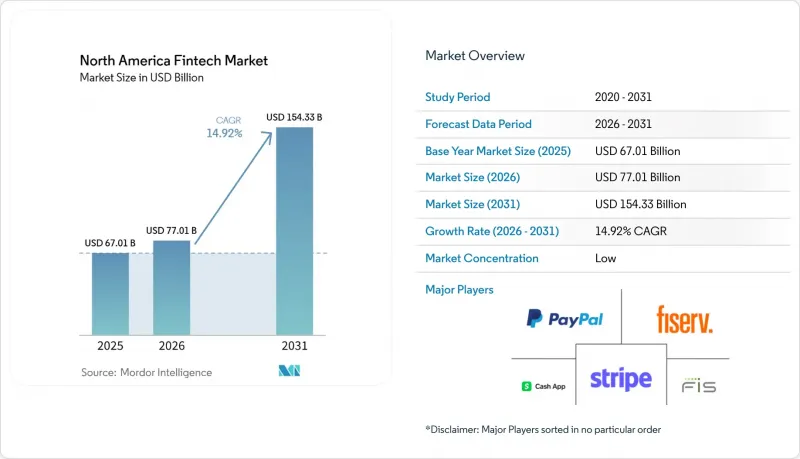
This report is Segmented by Service Proposition (Digital Payments, Digital Lending & Financing, Digital Investments, Insurtech, Neobanking), End-User (Retail, Businesses), User Interface (Mobile Applications, Web/Browser, POS/IoT Devices), and Geography (Canada, United States, Mexico). The Market Forecasts are Provided in Terms of Value (USD).
North America Fintech Market Trends and Insights
P2P and Card-Funded Digital-Wallet Dominance
Card-backed wallets such as Apple Pay, PayPal, and Cash App processed more than USD 1.7 trillion in combined volume during 2024, illustrating the scale advantage gained by remaining inside established card networks. Consumers continue to prefer wallets that keep existing credit lines intact, and Venmo's quarterly throughput climbed 10% to USD 75.6 billion, reinforcing the stickiness of P2P ecosystems. FedNow's request-to-pay functionality is expected to open complementary revenue streams for wallet providers that overlay value-added messaging and invoice services. At the same time, a January 2025 CFPB rule brings nonbank payment apps handling more than 50 million annual transactions under direct federal examination, raising the fixed-cost bar for smaller entrants.
SME Uptake of Integrated POS/ISV Suites
Small merchants are turning to software-embedded payments that consolidate ordering, loyalty, payroll, and lending. Toast derived 87% of its 2024 top line from payments, hardware, and ancillary financial services rather than license fees, revealing the monetization power of bundled offerings. Community banks acknowledge that losing the merchant cash-management relationship threatens low-cost core deposits, and several have begun white-labeling point-of-sale fintech products to defend share. Market observers expect the embedded-finance revenue pool to grow from USD 185 billion in 2024 to USD 228 billion in 2028, implying a North America fintech market expansion path that rewards vertically integrated players.
Intensifying CFPB and State Compliance Costs
Direct CFPB supervision now applies to about seven large nonbank payment providers, expanding examination scope to data privacy, fraud-refund timing, and account closures. California and New York regulators initiated 37% of fintech enforcement actions in 2024, collecting USD 30 million in consumer restitution. Although an April 2025 CFPB memo signals fewer federal sweeps, the requirement to publicly file all settlement orders under the nonbank registry rule raises reputational stakes for compliance lapses.
Other drivers and restraints analyzed in the detailed report include:
- Bank-Fintech BaaS/API Partnerships
- AI-Based Fraud-Orchestration Savings
- Rising Cyber-Insurance Premiums Post-Ransomware
For complete list of drivers and restraints, kindly check the Table Of Contents.
Segment Analysis
Digital payments controlled 47.86% of the North America fintech market share in 2025, translating to roughly USD 32.1 billion in segment revenue. Card-funded wallets ride the installed card-network rails, providing instant scale and merchant acceptance. PayPal alone processed USD 1.7 trillion in total payment volume, while Cash App's monthly active users surpassed 55 million. Digital lending gained ground as AI underwriting models cut approval times to under 10 seconds, and digital investment portals grew assets by waiving commissions.
Neobanking, although smaller today, is forecast to race ahead at a 21.95% CAGR and could command more than one-fifth of the North America fintech market by 2031. Chime's eight-million-plus account base illustrates the low-cost viral growth economics; its customer acquisition cost averages USD 20, versus nearly USD 925 for traditional banks. Insurtech startups using telematics and behavioral data are shaving loss ratios for auto and home policies. Across propositions, incumbents are embedding financing, insurance, and wealth modules directly inside consumer wallets, expanding average revenue per user without raising switching friction.
Complete Report Scope:
- By Service Proposition
- Digital Payments
- Digital Lending & Financing
- Digital Investments
- Insurtech
- Neobanking
- By End-User
- Retail
- Businesses
- By User Interface
- Mobile Applications
- Web / Browser
- POS / IoT Devices
- By Geography
- Canada
- United States
- Mexico
List of Companies Covered in this Report:
- PayPal
- Stripe
- Block (Square)
- Fiserv
- FIS
- Intuit
- Visa
- Mastercard
- Chime
- SoFi
- LendingClub
- Juspay Technologies (Hyperswitch)
- Brex
- Coinbase
- Robinhood
- Plaid
- Avant
- Upstart
- OnDeck
- Lemonade
- Root
Additional Benefits:
- The market estimate (ME) sheet in Excel format
- 3 months of analyst support
TABLE OF CONTENTS
1 Introduction
- 1.1 Study Assumptions & Market Definition
- 1.2 Scope of the Study
2 Research Methodology
3 Executive Summary
4 Market Landscape
- 4.1 Market Overview
- 4.2 Market Drivers
- 4.2.1 P2P & card-funded digital-wallet dominance
- 4.2.2 SME uptake of integrated POS/ISV fintech suites
- 4.2.3 Bank-fintech BaaS/API partnerships
- 4.2.4 FedNow & Real-Time Rail monetization layers
- 4.2.5 AI-based fraud-orchestration cost reductions
- 4.2.6 Tokenized deposits & program-mable money pilots
- 4.3 Market Restraints
- 4.3.1 Intensifying CFPB & state compliance costs
- 4.3.2 Rising cyber-insurance premiums post-ransomware
- 4.3.3 Cloud-compute price inflation squeezing unit-economics
- 4.3.4 Talent gap in GenAI & zero-trust security stacks
- 4.4 Value / Supply-Chain Analysis
- 4.5 Regulatory Landscape
- 4.6 Technological Outlook
- 4.7 Porter's Five Forces
- 4.7.1 Bargaining Power of Suppliers
- 4.7.2 Bargaining Power of Buyers
- 4.7.3 Threat of New Entrants
- 4.7.4 Threat of Substitutes
- 4.7.5 Competitive Rivalry
5 Market Size & Growth Forecasts
- 5.1 By Service Proposition
- 5.1.1 Digital Payments
- 5.1.2 Digital Lending & Financing
- 5.1.3 Digital Investments
- 5.1.4 Insurtech
- 5.1.5 Neobanking
- 5.2 By End-User
- 5.2.1 Retail
- 5.2.2 Businesses
- 5.3 By User Interface
- 5.3.1 Mobile Applications
- 5.3.2 Web / Browser
- 5.3.3 POS / IoT Devices
- 5.4 By Geography
- 5.4.1 Canada
- 5.4.2 United States
- 5.4.3 Mexico
6 Competitive Landscape
- 6.1 Market Concentration
- 6.2 Strategic Moves
- 6.3 Market Share Analysis
- 6.4 Company Profiles (includes Global level Overview, Market level overview, Core Segments, Financials as available, Strategic Information, Market Rank/Share for key companies, Products & Services, and Recent Developments)
- 6.4.1 PayPal
- 6.4.2 Stripe
- 6.4.3 Block (Square)
- 6.4.4 Fiserv
- 6.4.5 FIS
- 6.4.6 Intuit
- 6.4.7 Visa
- 6.4.8 Mastercard
- 6.4.9 Chime
- 6.4.10 SoFi
- 6.4.11 LendingClub
- 6.4.12 Juspay Technologies (Hyperswitch)
- 6.4.13 Brex
- 6.4.14 Coinbase
- 6.4.15 Robinhood
- 6.4.16 Plaid
- 6.4.17 Avant
- 6.4.18 Upstart
- 6.4.19 OnDeck
- 6.4.20 Lemonade
- 6.4.21 Root
7 Market Opportunities & Future Outlook
- 7.1 Cross-Border B2B Payment Orchestration for Mid-Market Exporters
- 7.2 GenAI-Driven Hyper-Personalized Wealth-Management Micro-Pods

