PUBLISHER: Mordor Intelligence | PRODUCT CODE: 2116335

PUBLISHER: Mordor Intelligence | PRODUCT CODE: 2116335
North America Transportation Infrastructure Construction - Market Share Analysis, Industry Trends & Statistics, Growth Forecasts (2026 - 2031)
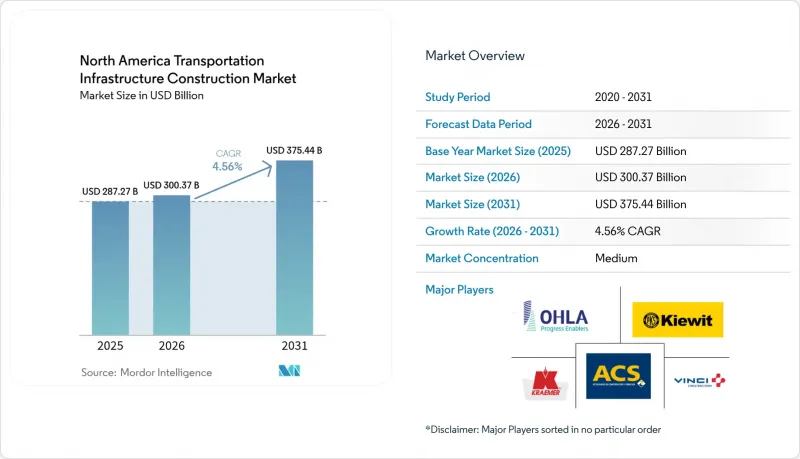
According to Mordor Intelligence, North America transportation infrastructure construction market size in 2026 is estimated at USD 300.37 billion, growing from 2025 value of USD 287.27 billion with 2031 projections showing USD 375.44 billion, growing at 4.56% CAGR over 2026-2031.
This report is Segmented by Type (Roadways, Railways, Airways and Ports and Inland Waterways), by Construction Type (New Construction and Renovation), by Investment Source (Public and Private) and by Country (United States, Canada and Mexico). The Report Offers Market Size and Forecasts in Value (USD) for all the Above Segments.
North America Transportation Infrastructure Construction Market Trends and Insights
Federal and Provincial Infrastructure Stimulus Programs Driving Long-Term Transport Investment Across the Region
Unprecedented fiscal support is flowing into highways, bridges, rail and transit. The United States has budgeted more than USD 350 billion for federal highway programs through 2026, with formula allocations and competitive grants already supporting more than 66,000 projects and sustaining nearly 1 million construction jobs. Provinces follow similar paths: Quebec's ten-year plan designates USD 131.2 billion for wide-ranging infrastructure additions, including USD 28.7 billion for road networks and USD 11.6 billion for public transit. Staggered release of funds has produced a counter-cyclical buffer that shelters the construction supply chain from wider economic slowdowns, while multi-year capital plans give contractors line-of-sight on workloads and foster longer equipment-leasing and workforce-training commitments.
Widespread Modernisation of Aging Bridges, Tunnels and Transit Systems to Meet Safety and Capacity Demands
An expanding share of public dollars is earmarked for repairing infrastructure rated structurally deficient. The 2025 Infrastructure Report Card shows 6.7% of U.S. bridges in poor condition, prompting large-scale rehabilitation programs such as the Portal North Bridge upgrade, now three-quarters complete, and New York's Grand Central Artery restoration. Modernisation extends beyond steel and concrete replacement: asset owners are embedding digital twins, fibre-optic sensing and condition-based maintenance to prolong asset life and cut lifecycle cost. The Metropolitan Transportation Authority's USD 68.4 billion capital plan prioritises power-system upgrades and flood resilience, signalling a pivot to performance-based asset management instead of piecemeal repairs.
Chronic Shortages of Skilled Labour in Civil and Transportation Trades Increasing Project Delivery Risk
Labour availability remains the principal hurdle for on-time project delivery. Ninety-three percent of contractors report open craft positions, while vocational enrolment declines and retirements accelerate-41% of transportation construction workers reach retirement eligibility by 2031. The industry recorded 248,000 unfilled jobs in April 2025, pressuring wages and elongating bid schedules. Owners are responding with larger contingency allowances, while contractors expand modular fabrication, invest in machine control and widen outreach to under-represented workforce segments. Federal and state apprenticeship incentives are helping, yet the gap between project authorisation and crew mobilisation threatens schedule certainty for megaprojects.
Other drivers and restraints analyzed in the detailed report include:
- Expansion of Multimodal Freight and Passenger Corridors to Enhance Regional Connectivity and Trade Efficiency
- Rise of Electric and Autonomous Mobility Accelerating Deployment of Smart Highways and Intelligent Transport Systems
- Persistently High Construction Material Prices Undermining Budget Reliability and Delaying Procurement Decisions
For complete list of drivers and restraints, kindly check the Table Of Contents.
Segment Analysis
Spending on roadways reached USD 153.4 billion in 2025, equating to 53.40% of the North American transportation infrastructure construction market. State and provincial highway programmes fund extensive resurfacing, lane-widening and interchange reconstructions aimed at relieving chronic congestion. Emission-reduction mandates encourage agencies to experiment with warm-mix asphalt, reclaimed pavement and permeable shoulders, broadening material specifications and opening new niches for suppliers.
Railways, which represented 28.70% of 2025 outlays, is slated for a 5.45% CAGR through 2031-the fastest among modal types. Federal passenger-rail grants, freight-operator capital plans and binational high-frequency corridors anchor this momentum. Recent service-quality lapses on congested rail links have prompted urgent investments in signalling, track duplication and grade-separation works. Consequently, the North American transportation infrastructure construction market size allocated to railways is projected to grow steadily, gaining ground on the historically dominant highway segment.
Complete Report Scope:
- By Type
- Roadways
- Railways
- Airways
- Ports and Inland Waterways
- By Construction Type
- New Construction
- Renovation
- By Investment Source
- Public
- Private
- By Country
- United States
- Canada
- Mexico
List of Companies Covered in this Report:
- Bechtel Corporation
- ACS Group (Dragados & Hochtief)
- Fluor Corporation
- AECOM
- Kiewit Corporation
- Skanska AB
- Vinci SA
- SNC-Lavalin Group Inc.
- Granite Construction Inc.
- Tutor Perini Corporation
- PCL Construction Enterprises
- Ferrovial SE
- Parsons Corporation
- Jacobs Solutions Inc.
- HDR Inc.
- Flatiron Construction Corp.
- The Walsh Group
- Zachry Construction Corp.
- Balfour Beatty plc
- Lane Construction Corporation
- WSP Global Inc.
- Black & Veatch
- Lunda Construction Company
- Gilbane Building Company
Additional Benefits:
- The market estimate (ME) sheet in Excel format
- 3 months of analyst support
TABLE OF CONTENTS
1 Introduction
- 1.1 Study Assumptions & Market Definition
- 1.2 Scope of the Study
2 Research Methodology
3 Executive Summary
4 Market Insights and Dynamic
- 4.1 Market Overview
- 4.2 Market Drivers
- 4.2.1 Federal and Provincial Infrastructure Stimulus Programs Driving Long-Term Transport Investment Across the Region
- 4.2.2 Widespread Modernization of Aging Bridges, Tunnels, and Transit Systems to Meet Safety and Capacity Demands
- 4.2.3 Expansion of Multimodal Freight and Passenger Corridors to Enhance Regional Connectivity and Trade Efficiency
- 4.2.4 Rise of Electric and Autonomous Mobility Accelerating Deployment of Smart Highways and Intelligent Transport Systems
- 4.3 Market Restraints
- 4.3.1 Chronic Shortages of Skilled Labor in Civil and Transportation Trades Increasing Project Delivery Risk
- 4.3.2 Persistently High Construction Material Prices Undermining Budget Reliability and Delaying Procurement Decisions
- 4.4 Value / Supply-Chain Analysis
- 4.5 Government Initiatives and Vision
- 4.6 Regulatory Outlook
- 4.7 Technological Outlook
- 4.8 Porter's Five Forces
- 4.8.1 Bargaining Power of Suppliers
- 4.8.2 Bargaining Power of Buyers
- 4.8.3 Threat of New Entrants
- 4.8.4 Threat of Substitutes
- 4.8.5 Competitive Rivalry
- 4.9 Pricing (Construction Materials) and Construction Cost (Materials, Labour, Equipment) Analysis
- 4.10 Comparison of Key Industry Metrics of North American Countries with Other Countries
- 4.11 Key Upcoming/Ongoing Projects (with a focus on Mega Projects)
5 Market Size & Growth Forecasts
- 5.1 By Type
- 5.1.1 Roadways
- 5.1.2 Railways
- 5.1.3 Airways
- 5.1.4 Ports and Inland Waterways
- 5.2 By Construction Type
- 5.2.1 New Construction
- 5.2.2 Renovation
- 5.3 By Investment Source
- 5.3.1 Public
- 5.3.2 Private
- 5.4 By Country
- 5.4.1 United States
- 5.4.2 Canada
- 5.4.3 Mexico
6 Competitive Landscape
- 6.1 Market Concentration
- 6.2 Strategic Moves
- 6.3 Market Share Analysis
- 6.4 Company Profiles {(includes Global level Overview, Market level overview, Core Segments, Financials as available, Strategic Information, Market Rank/Share for key companies, Products & Services, and Recent Developments)}
- 6.4.1 Bechtel Corporation
- 6.4.2 ACS Group (Dragados & Hochtief)
- 6.4.3 Fluor Corporation
- 6.4.4 AECOM
- 6.4.5 Kiewit Corporation
- 6.4.6 Skanska AB
- 6.4.7 Vinci SA
- 6.4.8 SNC-Lavalin Group Inc.
- 6.4.9 Granite Construction Inc.
- 6.4.10 Tutor Perini Corporation
- 6.4.11 PCL Construction Enterprises
- 6.4.12 Ferrovial SE
- 6.4.13 Parsons Corporation
- 6.4.14 Jacobs Solutions Inc.
- 6.4.15 HDR Inc.
- 6.4.16 Flatiron Construction Corp.
- 6.4.17 The Walsh Group
- 6.4.18 Zachry Construction Corp.
- 6.4.19 Balfour Beatty plc
- 6.4.20 Lane Construction Corporation
- 6.4.21 WSP Global Inc.
- 6.4.22 Black & Veatch
- 6.4.23 Lunda Construction Company
- 6.4.24 Gilbane Building Company
7 Market Opportunities & Future Outlook

