PUBLISHER: Mordor Intelligence | PRODUCT CODE: 2125267

PUBLISHER: Mordor Intelligence | PRODUCT CODE: 2125267
Italy Transportation Infrastructure Construction - Market Share Analysis, Industry Trends & Statistics, Growth Forecasts (2026 - 2031)
According to Mordor Intelligence, the Italy transportation infrastructure construction market size is expected to grow from USD 19.22 billion in 2025 to USD 20.09 billion in 2026 and is forecast to reach USD 25.05 billion by 2031 at 4.52% CAGR over 2026-2031.
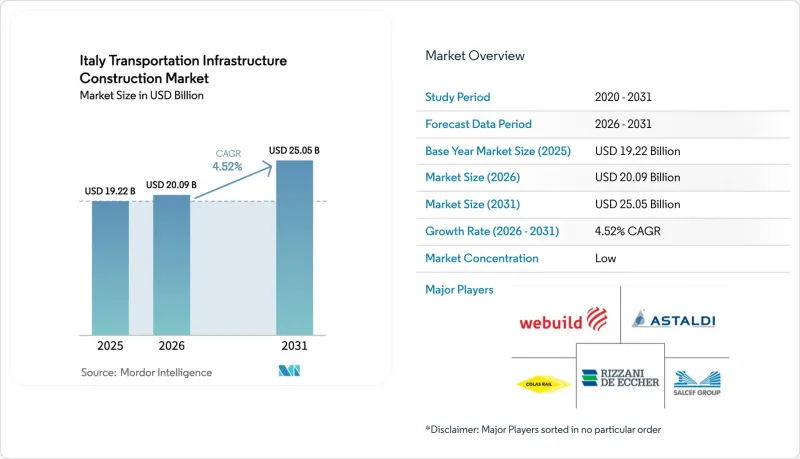
This report is Segmented by Type (Roadways, Railways, Airports, Ports, and More), by Construction Activity (New Construction and Renovation), by Investment Source (Public and Private), and by Key Cities (Rome, Turin, and More). The Report Offers Market Size and Forecasts in Value (USD) for all the Above Segments.
Italy Transportation Infrastructure Construction Market Trends and Insights
Government-backed Investment Programs to Modernize Road and Rail Networks
The government channels unprecedented capital into the Italy transportation infrastructure construction market through the PNRR, assigning USD 211.9 billion to modernisation initiatives. Ferrovie dello Stato Italiane has earmarked USD 54.5 billion for rail and USD 43.6 billion for road upgrades between 2025 and 2029, narrowing the logistics gap with northern Europe. Extraordinary commissioners oversee 57 strategic projects worth USD 90.14 billion, creating 68,000 annual jobs and peaking at 100,000 in 2025. This state-led momentum is matched by the state-owned Cassa Depositi e Prestiti, whose USD 88.29 billion plan leverages finance to mobilise USD 170 billion of total investments. Collectively, these moves strengthen domestic supply chains and anchor long-term demand for design, engineering, and construction services.
EU Funding Support for Sustainable and Trans-European Transport Corridors
EU mechanisms are a potent tailwind for the Italy transportation infrastructure construction market. The 2024 Connecting Europe Facility allocated USD 7.63 billion, 80% of which is rail-oriented, supporting core TEN-T routes such as the Mediterranean and Rhine-Alps corridors. The landmark Lyon-Turin Base Tunnel has already awarded USD 4.36 billion in civil works contracts and excavated 39.5 km of tunnels, underscoring the momentum of cross-border megaprojects. Italy's sovereign green bonds channel USD 15.15 billion into low-carbon transport infrastructure, integrating EU climate goals with national infrastructure blueprints. The revised TEN-T regulation sets a 2030 deadline for core-network completion, concentrating funding and political support on timely delivery.
Prolonged Regulatory Approval Timelines Delaying Project Execution
Complex permitting frameworks still prolong delivery in the Italy transportation infrastructure construction market. Public works average 4.4 years from tender to completion, with major schemes exceeding USD 54 million taking even longer. Although a 2023 Public Contracts Code reform trimmed rail authorisation cycles from 11 to 6 months, overlapping local and national approvals persist. Extraordinary commissioners mitigate some bottlenecks yet introduce parallel governance tracks. Continued digitalisation and one-stop authorisation portals are essential to lock in recent time-saving gains and reduce investor risk.
Other drivers and restraints analyzed in the detailed report include:
- High Demand for Intermodal Logistics and Port Expansion Projects
- Urban Mobility Initiatives Driving Metro and Tramway Infrastructure Upgrades
- Rising Construction Material and Labor Costs Affecting Project Viability
For complete list of drivers and restraints, kindly check the Table Of Contents.
Segment Analysis
Roadways delivered 48.40% of the Italy transportation infrastructure construction market share in 2025, reflecting the country's dense 6,000 km motorway grid and ongoing climate-proofing upgrades. Autostrade per l'Italia invested USD 1.85 billion in the first nine months of 2024 to reinforce viaducts and tunnels exposed to extreme weather, showing sustained capital flows into the dominant segment. Despite this lead, railways outpace all other modes with a 5.05% CAGR to 2031 as the government prioritises carbon-efficient transport. The USD 14.40 billion high-speed rail programme adds 274 km of new southern lines and 165 km of northern links, compressing domestic travel times and freeing capacity for freight. The rail surge feeds orders for signalling, track, and catenary suppliers, positioning rolling-stock makers and civil contractors for steady award pipelines. The Italy transportation infrastructure construction market size for rail schemes is forecast to expand quickly as EU taxonomy rules steer funds into low-carbon corridors.
The shift toward a greener network triggers rising interest in multimodal nodes where rail connects to road and port facilities. Under the Italy transportation infrastructure construction market, the Liguria-Alps high-speed connection worth USD 4.69 billion forms the backbone of the Genoa Logistic System, complementing the Third Giovi Pass and boosting port throughput. Road contractors respond by embedding recycled asphalt and smart-traffic sensors into upgrade works to align with environmental tender criteria. Conversely, rail builders leverage modular bridge designs and digital twins to shorten construction cycles. Together, these advances create a more resilient, technology-enhanced network that's better suited to shifting freight patterns and climate risks.
Complete Report Scope:
- By Type
- Roadways
- Railways
- Airways
- Ports & Inland Waterways
- By Construction Type
- New Construction
- Renovation
- By Investment Source
- Public
- Private
- By Key Cities
- Rome
- Milan
- Turin
- Rest of Italy
List of Companies Covered in this Report:
- WeBuild
- Salcef Group
- Astaldi
- Rizzani de Eccher
- Colas Rail Italia
- Impresa Pizzarotti
- Itinera
- Grandi Lavori Fincosit
- Cooperativa Muratori Cementisti Ravenna
- Ferrovie dello Stato Italiane (FS Group)
- Strabag SE
- Ghella S.p.A.
- Toto Holding
- Societa Italiana per Condotte d'Acqua
- Tecnimont Civil Construction
- Salini Impregilo Infrastructure
- Fincantieri Infrastructure
- Interporto Campano
- Aeroports de Roma (ADR)
- SEA Milano Airports
Additional Benefits:
- The market estimate (ME) sheet in Excel format
- 3 months of analyst support
TABLE OF CONTENTS
1 Introduction
- 1.1 Study Assumptions & Market Definition
- 1.2 Scope of the Study
2 Research Methodology
3 Executive Summary
4 Market Insights and Dynamics
- 4.1 Market Overview
- 4.2 Market Drivers
- 4.2.1 Government-backed investment programs to modernize road and rail networks
- 4.2.2 EU funding support for sustainable and trans-European transport corridors
- 4.2.3 High demand for intermodal logistics and port expansion projects
- 4.2.4 Urban mobility initiatives driving metro and tramway infrastructure upgrades
- 4.2.5 Increasing focus on climate-resilient transport infrastructure development
- 4.2.6 Infrastructure-led regional development plans in Southern Italy and inland areas
- 4.3 Market Restraints
- 4.3.1 Prolonged regulatory approval timelines delaying project execution
- 4.3.2 Rising construction material and labor costs affecting project viability
- 4.3.3 Fragmented tendering and procurement processes limiting efficiency and competition
- 4.4 Value / Supply-Chain Analysis
- 4.4.1 Overview
- 4.4.2 Real Estate Developers and Contractors - Key Quantitative and Qualitative Insights
- 4.4.3 Architectural and Engineering Companies - Key Quantitative and Qualitative Insights
- 4.4.4 Building Material and Equipment Companies - Key Quantitative and Qualitative Insights
- 4.5 Government Initiatives & Vision
- 4.6 Regulatory Outlook
- 4.7 Porter's Five Forces
- 4.7.1 Threat of New Entrants
- 4.7.2 Bargaining Power of Suppliers
- 4.7.3 Bargaining Power of Contractors
- 4.7.4 Threat of Substitutes
- 4.7.5 Competitive Rivalry
- 4.8 Pricing (Construction Materials) and Construction Cost (Materials, Labour, Equipment) Analysis
- 4.9 Comparison of Key Industry Metrics of Qatar with Other Countries
- 4.10 Key Upcoming/Ongoing Projects (with a focus on Mega Projects)
- 4.11 Insights on Technological Innovations
5 Market Size & Growth Forecasts (Value,USD)
- 5.1 By Type
- 5.1.1 Roadways
- 5.1.2 Railways
- 5.1.3 Airways
- 5.1.4 Ports & Inland Waterways
- 5.2 By Construction Type
- 5.2.1 New Construction
- 5.2.2 Renovation
- 5.3 By Investment Source
- 5.3.1 Public
- 5.3.2 Private
- 5.4 By Key Cities
- 5.4.1 Rome
- 5.4.2 Milan
- 5.4.3 Turin
- 5.4.4 Rest of Italy
6 Competitive Landscape
- 6.1 Market Concentration
- 6.2 Strategic Moves
- 6.3 Market Share Analysis
- 6.4 Company Profiles (includes Global level Overview, Market level overview, Core Segments, Financials as available, Strategic Information, Market Rank/Share for key companies, Products & Services, and Recent Developments)
- 6.4.1 WeBuild
- 6.4.2 Salcef Group
- 6.4.3 Astaldi
- 6.4.4 Rizzani de Eccher
- 6.4.5 Colas Rail Italia
- 6.4.6 Impresa Pizzarotti
- 6.4.7 Itinera
- 6.4.8 Grandi Lavori Fincosit
- 6.4.9 Cooperativa Muratori Cementisti Ravenna
- 6.4.10 Ferrovie dello Stato Italiane (FS Group)
- 6.4.11 Strabag SE
- 6.4.12 Ghella S.p.A.
- 6.4.13 Toto Holding
- 6.4.14 Societa Italiana per Condotte d'Acqua
- 6.4.15 Tecnimont Civil Construction
- 6.4.16 Salini Impregilo Infrastructure
- 6.4.17 Fincantieri Infrastructure
- 6.4.18 Interporto Campano
- 6.4.19 Aeroports de Roma (ADR)
- 6.4.20 SEA Milano Airports
7 Market Opportunities & Future Outlook

