PUBLISHER: Mordor Intelligence | PRODUCT CODE: 2116423

PUBLISHER: Mordor Intelligence | PRODUCT CODE: 2116423
United States Transportation Infrastructure Construction - Market Share Analysis, Industry Trends & Statistics, Growth Forecasts (2026 - 2031)
According to Mordor Intelligence, the United States transportation infrastructure construction market size is expected to grow from USD 233.03 billion in 2025 to USD 242.8 billion in 2026 and is forecast to reach USD 298.12 billion by 2031 at 4.19% CAGR over 2026-2031.
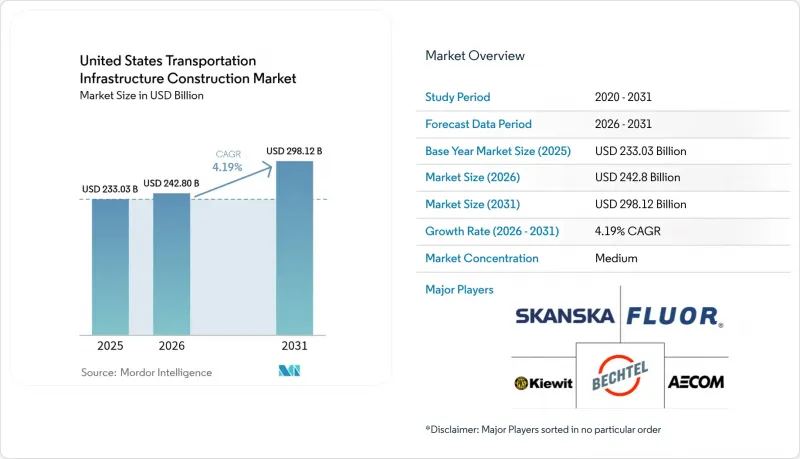
This report is Segmented by Type (Roadways, Railways, Airways and Ports and Inland Waterways), by Construction Type (New Construction and Renovation), by Investment Source (Public and Private) and by States (Texas, California, Florida, New York, Illinois and Rest of US). The Report Offers Market Size and Forecasts in Value (USD) for all the Above Segments.
United States Transportation Infrastructure Construction Market Trends and Insights
Ongoing Federal and State Rail Initiatives Supporting Long-Distance and Regional Corridor Upgrades
The USD 66 billion rail allocation embedded in the IIJA is triggering a wave of projects aimed at capacity, safety, and passenger-service improvements. Since January 2025, the Railroad Crossing Elimination Grant Program has awarded USD 1.1 billion across 123 projects, removing chokepoints that slow both freight and passenger services. Amtrak's goal of 64 million riders by 2040, up from 33 million pre-pandemic, is sharpening the focus on double-tracking, signaling upgrades, and station overhauls. Private rail operators are complementing federal outlays; Norfolk Southern's USD 200 million freight-corridor upgrade in Alabama exemplifies this synergy.
E-Commerce Expansion Driving Nationwide Demand for Freight Terminals, Warehousing, and Intermodal Connectivity
E-commerce sales volumes are heightening the need for freight-terminal capacity, short-haul rail spurs, and last-mile delivery depots. Colorado's 2024 Freight Plan cites rising parcel traffic as a catalyst for intermodal yard redesigns. Warehouse construction costs climbed 38% between 2020 and 2023 before stabilizing in 2024, underscoring the capital intensity of logistics real estate. Containerized freight movements reached record highs in 2024, further stretching terminal throughput.
Gaps in Federal-State Matching Requirements Creating Bottlenecks for Transportation Projects in Underserved Regions
The Congressional Research Service projects a USD 40 billion annual shortfall in the Highway Trust Fund by decade-end if current outflows persist. Rural counties often lack fiscal headroom to supply matching dollars, delaying bridge reconstructions, road widenings, and rural transit hubs. Proposed cuts in the House continuing-resolution draft would remove USD 2 billion earmarked for local safety projects, aggravating already thin capital pipelines.
Other drivers and restraints analyzed in the detailed report include:
- Airport Revitalization Programs Advancing Terminal Expansions, Runway Upgrades, and Safety Enhancements
- Nationwide EV Infrastructure Deployment Integrating Charging Stations Across Highway Networks and Urban Centers
- Widespread Skilled Labor Deficits Driving Higher Construction Costs and Project Delays
For complete list of drivers and restraints, kindly check the Table Of Contents.
Segment Analysis
The roadways segment kept its lead in 2025, accounting for 54.60% of total spending. Highways remain the backbone of U.S. mobility, and investors took notice: contract awards for highways and bridges hit a record USD 121 billion in 2024. Federal backing is equally strong. The Infrastructure Investment and Jobs Act set aside about USD 350 billion for highway programs through 2026, while the Biden-Harris Administration sent USD 62 billion to states for FY 2025, USD 18.8 billion more than in FY 2021. Industry leaders such as Bechtel, AECOM, and Skanska are vying for new interstate widenings and bridge replacements that upgrade aging assets.
Railways are growing fastest, with a 5.18% CAGR projected for 2026-2031. A USD 66 billion federal infusion under the IIJA is the main catalyst. In January 2025, the Federal Railroad Administration awarded USD 1.1 billion across 123 projects to remove grade crossings and improve safety. The airways segment benefits from an annual USD 1 billion Airport Terminal Program that funds terminal upgrades. Ports and inland waterways receive another USD 450 million through the FY 2025 Port Infrastructure Development Program. Better links among these modes are now essential: Colorado's 2024 Freight Plan highlights intermodal projects that align highways, rail spurs, and distribution hubs to meet e-commerce demand freight.colorado.gov.
Complete Report Scope:
- By Type
- Roadways
- Railways
- Airways
- Ports and Inland Waterways
- By Construction Type
- New Construction
- Renovation
- By Investment Source
- Public
- Private
- By States
- Texas
- California
- Florida
- New York
- Illinois
- Rest of US
List of Companies Covered in this Report:
- Bechtel Corp.
- Fluor Corp.
- Kiewit Corp.
- AECOM
- Skanska USA
- Turner Construction
- Granite Construction
- Walsh Group
- Clark Group
- Jacobs
- HDR Inc.
- Parsons Corp.
- Flatiron Construction
- Hensel Phelps
- Zachry Construction
- Ferrovial USA
- Webcor Builders
- Suffolk Construction
- Hoffman Construction
- Hunter Roberts Construction
Additional Benefits:
- The market estimate (ME) sheet in Excel format
- 3 months of analyst support
TABLE OF CONTENTS
1 Introduction
- 1.1 Study Assumptions & Market Definition
- 1.2 Scope of the Study
2 Research Methodology
3 Executive Summary
4 Market Insights and Dynamics
- 4.1 Market Overview
- 4.2 Market Drivers
- 4.2.1 Ongoing Federal and State Rail Initiatives Supporting Long-Distance and Regional Corridor Upgrades
- 4.2.2 E-Commerce Expansion Driving Nationwide Demand for Freight Terminals, Warehousing, and Intermodal Connectivity
- 4.2.3 Airport Revitalization Programs Advancing Terminal Expansions, Runway Upgrades, and Safety Enhancements
- 4.2.4 Nationwide EV Infrastructure Deployment Integrating Charging Stations Across Highway Networks and Urban Centers
- 4.3 Market Restraints
- 4.3.1 Gaps in Federal-State Matching Requirements Creating Bottlenecks for Transportation Projects in Underserved Regions
- 4.3.2 Widespread Skilled Labor Deficits Driving Higher Construction Costs and Project Delays
- 4.3.3 Price Volatility in Key Construction Inputs Such as Asphalt, Steel, and Cement Disrupting Budget Planning
- 4.4 Value / Supply-Chain Analysis
- 4.4.1 Overview
- 4.4.2 Real Estate Developers and Contractors - Key Quantitative and Qualitative Insights
- 4.4.3 Architectural and Engineering Companies - Key Quantitative and Qualitative Insights
- 4.4.4 Building Material and Equipment Companies - Key Quantitative and Qualitative Insights
- 4.5 Government Initiatives & Vision 2047 Alignment
- 4.6 Regulatory Outlook
- 4.7 Porter's Five Forces
- 4.7.1 Threat of New Entrants
- 4.7.2 Bargaining Power of Buyers/Owners
- 4.7.3 Bargaining Power of Suppliers
- 4.7.4 Threat of Substitutes
- 4.7.5 Intensity of Competitive Rivalry
- 4.8 Pricing (Construction Materials) and Construction Cost (Materials, Labour, Equipment) Analysis
- 4.9 Comparison of Key Industry Metrics of US with Other Countries
- 4.10 Key Upcoming/Ongoing Projects (with a focus on Mega Projects)
5 Market Size & Growth Forecasts (Value, USD)
- 5.1 By Type
- 5.1.1 Roadways
- 5.1.2 Railways
- 5.1.3 Airways
- 5.1.4 Ports and Inland Waterways
- 5.2 By Construction Type
- 5.2.1 New Construction
- 5.2.2 Renovation
- 5.3 By Investment Source
- 5.3.1 Public
- 5.3.2 Private
- 5.4 By States
- 5.4.1 Texas
- 5.4.2 California
- 5.4.3 Florida
- 5.4.4 New York
- 5.4.5 Illinois
- 5.4.6 Rest of US
6 Competitive Landscape
- 6.1 Market Concentration
- 6.2 Strategic Moves
- 6.3 Market Share Analysis
- 6.4 Company Profiles {(includes Global level Overview, Market level overview, Core Segments, Financials as available, Strategic Information, Market Rank/Share for key companies, Products & Services, and Recent Developments)}
- 6.4.1 Bechtel Corp.
- 6.4.2 Fluor Corp.
- 6.4.3 Kiewit Corp.
- 6.4.4 AECOM
- 6.4.5 Skanska USA
- 6.4.6 Turner Construction
- 6.4.7 Granite Construction
- 6.4.8 Walsh Group
- 6.4.9 Clark Group
- 6.4.10 Jacobs
- 6.4.11 HDR Inc.
- 6.4.12 Parsons Corp.
- 6.4.13 Flatiron Construction
- 6.4.14 Hensel Phelps
- 6.4.15 Zachry Construction
- 6.4.16 Ferrovial USA
- 6.4.17 Webcor Builders
- 6.4.18 Suffolk Construction
- 6.4.19 Hoffman Construction
- 6.4.20 Hunter Roberts Construction
7 Market Opportunities & Future Outlook

