PUBLISHER: Mordor Intelligence | PRODUCT CODE: 2125462

PUBLISHER: Mordor Intelligence | PRODUCT CODE: 2125462
Spain Container Glass - Market Share Analysis, Industry Trends & Statistics, Growth Forecasts (2026 - 2031)
According to Mordor Intelligence, the Spain container glass market size was valued at 2.88 million tonnes in 2025 and estimated to grow from 2.96 million tonnes in 2026 to reach 3.39 million tonnes by 2031, at a CAGR of 2.78% during the forecast period (2026-2031).
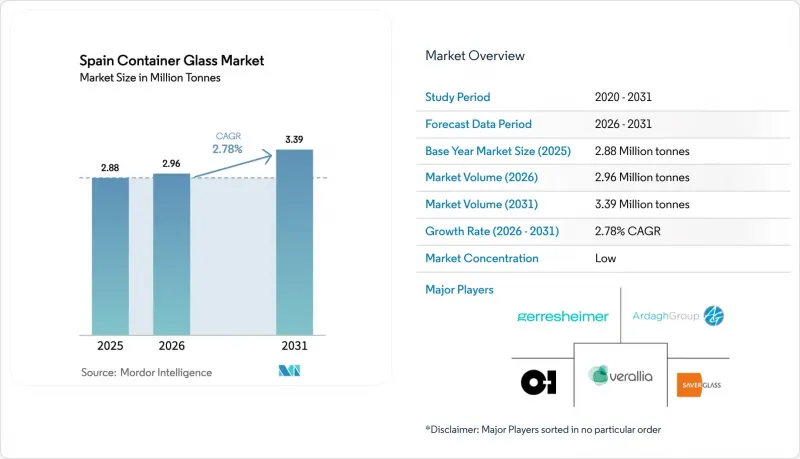
This report is Segmented by End-User (Beverages [Alcoholic {Beer, Wine, Spirits, and More}, and Non-Alcoholic {Juices, Carbonated Drinks (CSDs), Dairy Product Based Drinks, and More}], Food [Jam, Jelly, Marmalades, Oil, Pickles, and More], Cosmetics and Personal Care, Pharmaceuticals, and More), Color (Flint, Green, Amber, and More). The Market Forecasts are Provided in Terms of Volume (Tonnes).
Spain Container Glass Market Trends and Insights
Increasing Demand for Sustainable Packaging Solutions
EU legislation mandating 90% collection and 85% recycling of glass by 2030 amplifies corporate sustainability targets, steering brand owners toward the Spain container glass market. Premium wine producers such as Torres have switched to 15-20% lighter bottles, reducing scope 3 emissions while retaining shelf appeal. Manufacturers able to deliver lighter yet structurally robust containers gain priority in supplier rosters. This alignment of regulatory pull, investor scrutiny, and consumer sentiment collectively lifts baseline demand despite higher unit costs than plastic, sustaining growth momentum for the Spain container glass market.
Growing Preference for Recyclable and Eco-Friendly Glass
Consumer surveys show willingness to pay price premiums for products in infinitely recyclable glass, particularly among health-conscious demographics in Spain's larger cities. Glass retains flavor and aroma better than plastics that degrade after limited recycling loops, reinforcing quality perceptions. Ecovidrio's network of 240,302 green bins underpins Spain's 79.8% glass collection rate, ensuring an abundant cullet supply that lowers furnace energy by 2-3% per 10% cullet usage. As virtuous collection-recycling cycles strengthen, cost competitiveness improves, further anchoring glass as the preferred premium pack in the Spain container glass market.
High Production Costs of Glass Containers
Energy accounts for 35-39% of glass production costs, and although Spanish industrial electricity averaged EUR 0.17/kWh (USD 0.19/kWh) in 2023 29% below the broader EU, furnaces operating at 1,600 °C remain exposed to price spikes. O-I Glass absorbed USD 175 million in incremental expenses in 2024, prompting its "Fit to Win" plan to shed at least 7% European capacity by mid-2025. Soda-ash and silica volatility compounds the pressure, forcing relentless efficiency drives across the Spain container glass market.
Other drivers and restraints analyzed in the detailed report include:
- Rising Consumption of Alcoholic Beverages in Spain
- Premiumization Trends in Wine, Olive Oil, and Cosmetics Packaging
- Intense Competition from Plastic and Metal Packaging
For complete list of drivers and restraints, kindly check the Table Of Contents.
Segment Analysis
Beverages accounted for 62.46% of Spain's container glass market share in 2025, led by wine, beer, and spirits. The alcoholic-beverage subsegment benefits from premium cues, oxygen impermeability, and export authenticity requirements, ensuring stable demand. Craft brewers also prefer embossed amber bottles that protect against UV and reinforce artisanal positioning. Non-alcoholic drinks lean on glass for niche organic juices and kombucha, where provenance matters. Cosmetics and personal care are the fastest-growing applications at a 3.95% CAGR to 2031, buoyed by luxury skincare, perfumery, and wellness products packaged in heavy, custom-shaped jars.
The Spain container glass market size for cosmetics is projected to rise steadily as deluxe brands favor tactile heft and sustainable storytelling. Food applications such as olive oil, jam, and gourmet sauces sustain stable tonnage, underpinned by Spain's agricultural export engine. Pharmaceuticals retain moderate demand for neutral borosilicate bottles outside vial niches, while perfumery leverages intricate glass sculpting to bolster brand equity. Segment diversity shields the Spain container glass market from cyclical shocks in any single end-use stream.
Complete Report Scope:
- By End-user
- Beverages
- Alcoholic
- Beer
- Wine
- Spirits
- Other Alcoholic Beverages (Cider and Other Fermented Drinks)
- Non-Alcoholic
- Juices
- Carbonated Drinks (CSDs)
- Dairy Product Based Drinks
- Other Non-Alcoholic Beverages
- Alcoholic
- Food (Jam, Jelly, Marmalades, Honey, Sausages and Condiments, Oil, Pickles)
- Cosmetics and Personal Care
- Pharmaceuticals (excluding Vials and Ampoules)
- Perfumery
- Beverages
- By Color
- Green
- Amber
- Flint
- Other Colors
List of Companies Covered in this Report:
- Verallia Spain S.A.
- O-I Manufacturing Spain, S.L.
- Ramon Clemente, S.A.
- BA Glass Iberia, S.A.
- ALGLASS, S.A.
- Vidrala, S.A.
- Verescence La Granja, S.L.
- Gerresheimer Zaragoza S.A.
- Saverglass Iberica S.A.U.
- Botellas del Mediterraneo, S.L.
- Vicrila Industrias del Vidrio, S.L.U.
- Vidra Foc, S.A.
- Astiglass, S.L.
- Grupo Glass Madrid S.L.
- Inphinity Glass S.L.
- Dream Glass Group S.L.
- Ardagh Group S.A.
Additional Benefits:
- The market estimate (ME) sheet in Excel format
- 3 months of analyst support
TABLE OF CONTENTS
1 INTRODUCTION
- 1.1 Study Assumptions and Market Definition
- 1.2 Scope of the Study
2 RESEARCH METHODOLOGY
3 EXECUTIVE SUMMARY
4 MARKET LANDSCAPE
- 4.1 Market Overview
- 4.2 Market Drivers
- 4.2.1 Increasing Demand for Sustainable Packaging Solutions
- 4.2.2 Growing Preference for Recyclable and Eco-Friendly Glass
- 4.2.3 Rising Consumption of Alcoholic Beverages in Spain
- 4.2.4 Technological Advancements in Glass Bottle Manufacturing
- 4.2.5 Government Incentives for Circular Economy and Recycling
- 4.2.6 Premiumization Trends in Wine, Olive Oil, and Cosmetics Packaging
- 4.3 Market Restraints
- 4.3.1 High Production Costs of Glass Containers
- 4.3.2 Intense Competition from Plastic and Metal Packaging
- 4.3.3 Energy-Intensive Manufacturing Process
- 4.3.4 Supply Chain Disruptions and Raw Material Volatility
- 4.4 PESTEL Analysis
- 4.5 Industry Supply-Chain Analysis
- 4.6 Container Glass Furnace Capacity and Locations in Spain
- 4.6.1 Plant Locations and Year of Commencement
- 4.6.2 Production Capacities
- 4.6.3 Types of Furnaces
- 4.6.4 Color of Glass Produced
- 4.7 Export-Import Data of Container Glass - Covering Key Import and Export Destinations
- 4.7.1 Import Volume and Value, 2021-2024
- 4.7.2 Export Volume and Value, 2021-2024
- 4.8 Porter's Five Forces Analysis
- 4.8.1 Threat of New Entrants
- 4.8.2 Bargaining Power of Suppliers
- 4.8.3 Bargaining Power of Buyers
- 4.8.4 Threat of Substitutes
- 4.8.5 Competitive Rivalry
- 4.9 Raw Material Analysis
- 4.10 Recycling Trends for Glass Packaging
- 4.11 Demand vs Supply Analysis for Glass Packaging
5 MARKET SIZE AND GROWTH FORECASTS (VOLUME)
- 5.1 By End-user
- 5.1.1 Beverages
- 5.1.1.1 Alcoholic
- 5.1.1.1.1 Beer
- 5.1.1.1.2 Wine
- 5.1.1.1.3 Spirits
- 5.1.1.1.4 Other Alcoholic Beverages (Cider and Other Fermented Drinks)
- 5.1.1.2 Non-Alcoholic
- 5.1.1.2.1 Juices
- 5.1.1.2.2 Carbonated Drinks (CSDs)
- 5.1.1.2.3 Dairy Product Based Drinks
- 5.1.1.2.4 Other Non-Alcoholic Beverages
- 5.1.1.1 Alcoholic
- 5.1.2 Food (Jam, Jelly, Marmalades, Honey, Sausages and Condiments, Oil, Pickles)
- 5.1.3 Cosmetics and Personal Care
- 5.1.4 Pharmaceuticals (excluding Vials and Ampoules)
- 5.1.5 Perfumery
- 5.1.1 Beverages
- 5.2 By Color
- 5.2.1 Green
- 5.2.2 Amber
- 5.2.3 Flint
- 5.2.4 Other Colors
6 COMPETITIVE LANDSCAPE
- 6.1 Market Concentration
- 6.2 Strategic Moves and Developments
- 6.3 Company Market Share Analysis, (Based on Latest Production Capacity)
- 6.4 Company Profiles (includes Global level Overview, Market level overview, Core Segments, Financials as available, Strategic Information, Market Rank/Share for key companies, Products and Services, and Recent Developments)
- 6.4.1 Verallia Spain S.A.
- 6.4.2 O-I Manufacturing Spain, S.L.
- 6.4.3 Ramon Clemente, S.A.
- 6.4.4 BA Glass Iberia, S.A.
- 6.4.5 ALGLASS, S.A.
- 6.4.6 Vidrala, S.A.
- 6.4.7 Verescence La Granja, S.L.
- 6.4.8 Gerresheimer Zaragoza S.A.
- 6.4.9 Saverglass Iberica S.A.U.
- 6.4.10 Botellas del Mediterraneo, S.L.
- 6.4.11 Vicrila Industrias del Vidrio, S.L.U.
- 6.4.12 Vidra Foc, S.A.
- 6.4.13 Astiglass, S.L.
- 6.4.14 Grupo Glass Madrid S.L.
- 6.4.15 Inphinity Glass S.L.
- 6.4.16 Dream Glass Group S.L.
- 6.4.17 Ardagh Group S.A.
7 MARKET OPPORTUNITIES AND FUTURE OUTLOOK
- 7.1 White-space and Unmet-Need Assessment

