PUBLISHER: Mordor Intelligence | PRODUCT CODE: 2125452

PUBLISHER: Mordor Intelligence | PRODUCT CODE: 2125452
France Container Glass - Market Share Analysis, Industry Trends & Statistics, Growth Forecasts (2026 - 2031)
According to Mordor Intelligence, the France container glass market size was valued at 6 million tonnes in 2025 and estimated to grow from 6.13 million tonnes in 2026 to reach 6.84 million tonnes by 2031, at a CAGR of 2.21% during the forecast period (2026-2031).
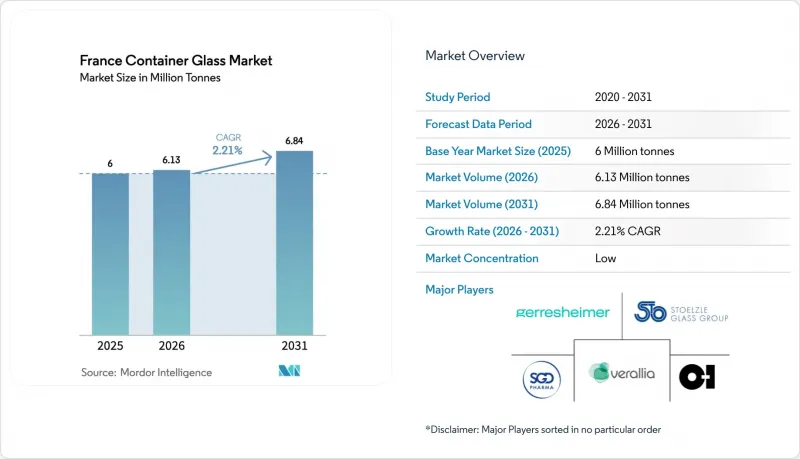
This report is Segmented by End-User (Beverages [Alcoholic {Beer, Wine, Spirits, Other Alcoholic Beverages}, and Non-Alcoholic {Carbonated Drinks (CSDs), Dairy Product Based Drinks, and More}], Food [Jam and Jelly, Condiments and Sauces, and More], Cosmetics and Personal Care, Perfumery, and More), Color (Flint, Amber, Green, and More). The Market Forecasts are Provided in Terms of Volume (Tonnes).
France Container Glass Market Trends and Insights
Growth in Premium Alcoholic Beverages
Champagne and cognac houses continue to specify thick-wall flint and specialty amber flasks to reinforce brand heritage, making glass effectively non-substitutable despite price sensitivity in other beverage niches. Wine export earnings rose to EUR 9.58 billion (USD 10.83 billion) in 2024, even as volumes plateaued, illustrating value migration to premium SKUs where elaborate punted bottles and embossing justify higher unit economics. Diageo's stated goal of seizing 12% of French spirits sales by 2030 underscores external appetite for high-margin formats anchored in glass. Protected-designation rules under AOC further cement glass's role in authenticity verification, locking in structural demand.
Expansion of Cosmetics and Luxury Perfumes Sector
Luxury perfume houses in Grasse and Paris favor intricately molded flacons with metallized necks and acid-etched logos that only container glass can deliver at scale. The segment is growing at 2.83% CAGR through 2030, outpacing the broader France container glass market, helped by regulatory curbs on certain plastic components and consumer pursuit of recyclable prestige packaging. SGD Pharma invested EUR 31 million (USD 35 million) in 2024 to modernize two domestic furnaces geared toward cosmetic formats, signaling entrenched demand. Internal siliconization treatments such as SEALIAN mitigate interaction with volatile fragrance bases while enabling further lightweighting.
High Energy Consumption in Glass Production
Melting temperatures of 1,600°C keep energy intensity elevated, amplifying exposure to electricity prices that nearly doubled for French industry in 2024. Phase IV of the EU ETS slices free allocations, lifting carbon compliance costs by EUR 80-90 (USD 90-102) per ton of CO2 emitted for a standard end-fired furnace. Verallia's 8.7% revenue drop in 2024 shows immediate margin erosion when price hikes cannot fully cover energy surcharges.
Other drivers and restraints analyzed in the detailed report include:
- Consumer Preference for Non-Toxic Packaging
- Technological Advancements in Lightweight Glass Manufacturing
- Competition from Lightweight Alternatives
For complete list of drivers and restraints, kindly check the Table Of Contents.
Segment Analysis
The beverages channel generated 59.62% of 2025 shipments, equal to 3,577.2 kilotons of the France container glass market size. Growth in Champagne, cognac, and premium still wines secures baseline volume even as lighter PET erodes entry-level cider and juice bottles. Premium alcoholic labels retain glass for superior oxygen ingress protection and tactile cues that rationalize higher shelf prices. Domestic microbreweries lean into embossed, returnable glass to emphasize craft provenance, slightly offsetting aluminum's surge among mass-market lagers.
Food, cosmetics, and pharmaceuticals collectively account for the remaining 40.38% of France's container glass market volume, yet cosmetics and personal care are expanding at a 2.69% CAGR on strong luxury exports.Cartier, Dior, and Hermes launch limited-edition scents in sculptural flacons, stimulating demand for specialty furnaces with color-changing forehearths. Pharmaceutical firms adhere to type-I borosilicate vials for biologics, reinforcing baseline throughput during beverage cyclicality.
Complete Report Scope:
- By End-user
- Beverages
- Alcoholic
- Beer
- Wine
- Spirits
- Other Alcoholic Beverages (Cider and Other Fermented Drinks)
- Non-Alcoholic
- Juices
- Carbonated Drinks (CSDs)
- Dairy Product Based Drinks
- Other Non-Alcoholic Beverages
- Alcoholic
- Food (Jam, Jelly, Marmalades, Honey, Sausages and Condiments, Oil, Pickles)
- Cosmetics and Personal Care
- Pharmaceuticals (excluding Vials and Ampoules)
- Perfumery
- Beverages
- By Color
- Green
- Amber
- Flint
- Other Colors
List of Companies Covered in this Report:
- O-I Glass, Inc.
- Verallia Packaging SAS
- Verescence S.A.
- Saverglass Group
- SGD S.A.
- Stoelzle Glass Group
- Pochet Group
- Gerresheimer AG
- Zignago Vetro SpA
- Ardagh Glass S.A.
- Vidrala, S.A
- Coverpla S.A.S.
- Id Labo
Additional Benefits:
- The market estimate (ME) sheet in Excel format
- 3 months of analyst support
TABLE OF CONTENTS
1 INTRODUCTION
- 1.1 Study Assumptions and Market Definition
- 1.2 Scope of the Study
2 RESEARCH METHODOLOGY
3 EXECUTIVE SUMMARY
4 MARKET LANDSCAPE
- 4.1 Market Overview
- 4.2 Market Drivers
- 4.2.1 Growth in Premium Alcoholic Beverages (Champagne, Cognac, Wine)
- 4.2.2 Expansion of Cosmetics and Luxury Perfumes Sector
- 4.2.3 Consumer Preference for Non-Toxic Packaging
- 4.2.4 Technological Advancements in Lightweight Glass Manufacturing
- 4.2.5 Rise in Eco-Conscious Consumer Behavior
- 4.2.6 Export Demand for French Packaged Goods
- 4.3 Market Restraints
- 4.3.1 High Energy Consumption in Glass Production
- 4.3.2 Competition from Lightweight Alternatives
- 4.3.3 Fragility and Higher Transportation Costs
- 4.3.4 Volatility in Raw Material Prices
- 4.4 PESTEL Analysis
- 4.5 Industry Supply-Chain Analysis
- 4.6 Container Glass Furnace Capacity and Locations in France
- 4.6.1 Plant Locations and Year of Commencement
- 4.6.2 Production Capacities
- 4.6.3 Types of Furnaces
- 4.6.4 Color of Glass Produced
- 4.7 Export-Import Data of Container Glass - Covering Key Import and Export Destinations
- 4.7.1 Import Volume and Value, 2021-2024
- 4.7.2 Export Volume and Value, 2021-2024
- 4.8 Porter's Five Forces Analysis
- 4.8.1 Threat of New Entrants
- 4.8.2 Bargaining Power of Suppliers
- 4.8.3 Bargaining Power of Buyers
- 4.8.4 Threat of Substitutes
- 4.8.5 Competitive Rivalry
- 4.9 Raw Material Analysis
- 4.10 Recycling Trends for Glass Packaging
- 4.11 Demand vs Supply Analysis for Glass Packaging
5 MARKET SIZE AND GROWTH FORECASTS (VOLUME)
- 5.1 By End-user
- 5.1.1 Beverages
- 5.1.1.1 Alcoholic
- 5.1.1.1.1 Beer
- 5.1.1.1.2 Wine
- 5.1.1.1.3 Spirits
- 5.1.1.1.4 Other Alcoholic Beverages (Cider and Other Fermented Drinks)
- 5.1.1.2 Non-Alcoholic
- 5.1.1.2.1 Juices
- 5.1.1.2.2 Carbonated Drinks (CSDs)
- 5.1.1.2.3 Dairy Product Based Drinks
- 5.1.1.2.4 Other Non-Alcoholic Beverages
- 5.1.1.1 Alcoholic
- 5.1.2 Food (Jam, Jelly, Marmalades, Honey, Sausages and Condiments, Oil, Pickles)
- 5.1.3 Cosmetics and Personal Care
- 5.1.4 Pharmaceuticals (excluding Vials and Ampoules)
- 5.1.5 Perfumery
- 5.1.1 Beverages
- 5.2 By Color
- 5.2.1 Green
- 5.2.2 Amber
- 5.2.3 Flint
- 5.2.4 Other Colors
6 COMPETITIVE LANDSCAPE
- 6.1 Market Concentration
- 6.2 Strategic Moves and Developments
- 6.3 Company Market Share Analysis, (Based on Latest Production Capacity)
- 6.4 Company Profiles (includes Global level Overview, Market level overview, Core Segments, Financials as available, Strategic Information, Market Rank/Share for key companies, Products and Services, and Recent Developments)
- 6.4.1 O-I Glass, Inc.
- 6.4.2 Verallia Packaging SAS
- 6.4.3 Verescence S.A.
- 6.4.4 Saverglass Group
- 6.4.5 SGD S.A.
- 6.4.6 Stoelzle Glass Group
- 6.4.7 Pochet Group
- 6.4.8 Gerresheimer AG
- 6.4.9 Zignago Vetro SpA
- 6.4.10 Ardagh Glass S.A.
- 6.4.11 Vidrala, S.A
- 6.4.12 Coverpla S.A.S.
- 6.4.13 Id Labo
7 MARKET OPPORTUNITIES AND FUTURE OUTLOOK
- 7.1 White-space and Unmet-Need Assessment

