PUBLISHER: Mordor Intelligence | PRODUCT CODE: 2116754

PUBLISHER: Mordor Intelligence | PRODUCT CODE: 2116754
Singapore Plant-Based Food And Beverages - Market Share Analysis, Industry Trends & Statistics, Growth Forecasts (2026 - 2031)
According to Mordor Intelligence, the Singapore plant-based foods market size is expected to grow from USD 484.63 million in 2025 to USD 522.28 million in 2026 and is forecast to reach USD 758.9 million by 2031 at 7.77% CAGR over 2026-2031.
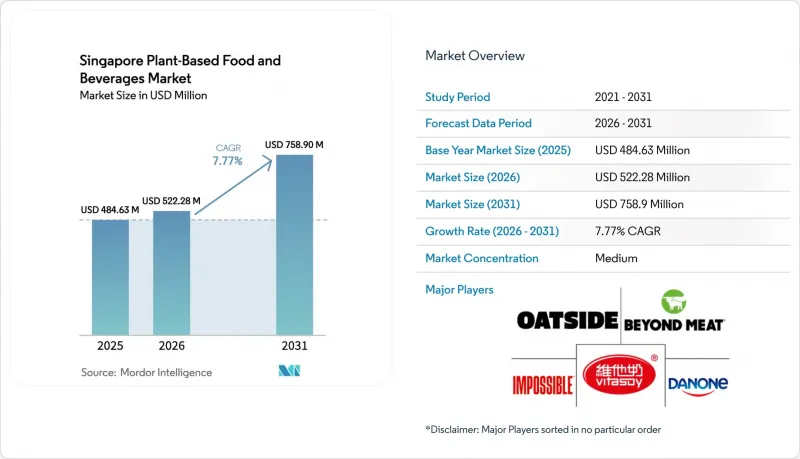
This report is Segmented by Product Type (Meat Substitutes, Dairy-Alternative Beverages, Non-Dairy Cheese, Non-Dairy Yogurt, Non-Dairy Ice-Cream, and More) and Distribution Channel (Supermarkets/Hypermarkets, Convenience Stores, Online Retail, Food-Service HoReCa, Other Channels). The Market Forecasts are Provided in Terms of Value (USD).
Singapore Plant-Based Food And Beverages Market Trends and Insights
Rising flexitarian and health-conscious consumer base
In Singapore, a demographic shift towards flexitarian diets is propelling the adoption of plant-based foods, moving beyond the confines of traditional vegetarianism. Surveys conducted among the city's diverse Asian populace reveal a pronounced preference for plant-based proteins, sidelining cultivated meat alternatives. With retail food sales surpassing USD 11 billion in 2023, Singapore's affluent consumers are primed for premium plant-based products, especially those touting health and sustainability benefits. Given that 90% of the Asian population is lactose-intolerant, there's a burgeoning demand for dairy alternatives, driven by heightened health consciousness. Studies on consumer acceptance highlight the pivotal role of halal considerations for Muslim Singaporeans in their reception of alternative proteins, underscoring the influence of family and social media figures on their consumption choices. Furthermore, Singapore's rising status as a vegan gastronomy hotspot is evident, with online chatter celebrating plant-based twists on local favorites like Singapore Noodles, marking a blend of health-driven choices and culinary creativity.
Government "30 by 30" food-security push for alt-proteins
Singapore's "30 by 30" initiative, backed by the Agri-food Cluster Transformation (ACT) Fund, is steering the nation towards enhanced food security via alternative protein development. The ACT Fund, which offers co-funding to local farms for capability upgrades and technological advancements, is set to continue its support until December 31, 2025. The government's USD 165 million Singapore Food Story 2.0 program focuses on alternative protein research and development, notably funding precision fermentation research, highlighted by the USD 14.8 million PreFerS project at the University of Illinois Urbana-Champaign. Regulatory frameworks are expediting novel food approvals, with the SFA's Novel Food Safety Expert Working Group trimming evaluation timelines to 9-12 months while upholding safety standards. The initiative also champions import diversification. The Farm-to-Table Recognition Programme incentivizes the HoReCa sector to embrace local and alternative protein sources. Singapore's move as the first nation to greenlight cultivated meat sets a regulatory benchmark and draws global investments. Esco Aster plans to inaugurate an 80,000 sq ft cultivated meat facility in Changi by 2025, aiming for an annual output of 400-500 tonnes.
Premium pricing versus animal products
Despite improvements in economies of scale, plant-based categories still face cost disadvantages. For instance, TurtleTree's precision fermentation ingredient, lactoferrin, is priced at a premium compared to conventional counterparts. However, TurtleTree anticipates scaling production and reducing costs by 2029. Local producers in Singapore face pricing challenges due to high operational costs, notably in energy and labor. Several high-tech farms, despite hefty investments in advanced production technologies, struggle to break even. Retail dynamics reveal consumer price sensitivity. FairPrice's tactic of pricing house-brand plant-based products 10-15% below international brands underscores demand for affordable options. This premium pricing challenge is pronounced in the food service sector, where restaurants need cost-competitive ingredients to protect profit margins. Yet, certain consumer segments are open to paying premiums for health and sustainability perks. With Singapore's high disposable income levels, market segmentation strategies balance premium positioning with accessible pricing tiers.
Other drivers and restraints analyzed in the detailed report include:
- Supermarket and quick-commerce shelf expansion
- Precision-fermentation research and development incentives attracting alt-dairy start-ups
- Taste/texture fidelity gaps
For complete list of drivers and restraints, kindly check the Table Of Contents.
Segment Analysis
In 2025, dairy-alternative beverages claimed a dominant 41.42% share of Singapore's plant-based foods market revenue. This surge in demand is driven by high levels of lactose intolerance and a trend towards premiumization. Highlighting the potential of Asian flavor innovation, local brand OATSIDE stands out as a testament to scalability. The segment is making strides with precision-fermented functional proteins, and is set to debut its first ready-to-drink coffee infused with animal-free lactoferrin by mid-2025. This innovation is expected to cater to health-conscious consumers seeking functional benefits in their beverages. Concurrently, the introduction of instant oat-milk mixes is broadening consumption opportunities by offering convenient and versatile options for consumers. Consequently, the dairy-alternative segment solidifies its role as a key volume driver, supported by its ability to meet diverse consumer preferences and dietary needs.
Meat substitutes are on track to achieve the fastest growth in Singapore's plant-based foods market, with a projected CAGR of 10.82%. Formats derived from okara, now approaching commercialization, promise both sustainability and a rich protein profile, addressing the growing demand for environmentally friendly and nutritious food options. The recent regulatory nod for 16 insect species expands the ingredient palette, enabling manufacturers to explore innovative formulations and diversify product offerings. Meanwhile, ventures in cultivated seafood are swiftly moving towards pilot-scale production, signaling a significant step forward in alternative protein development. Moreover, the use of localized spice blends and texturizers in crafting satay and rendang analogs underscores significant strides in achieving culinary authenticity, ensuring these products resonate with local tastes and cultural preferences.
Complete Report Scope:
- By Product Type
- Meat Substitutes
- Textured Vegetable Protein (TVP)
- Tofu
- Tempeh
- Seitan
- Plant-based Seafood
- Plant-based Eggs
- Other Meat Substitutes
- Dairy-Alternative Beverages
- Soy Milk
- Almond Milk
- Oat Milk
- Other Plant Milks
- Non-dairy Cheese
- Non-dairy Yogurt
- Non-dairy Ice-cream
- Non-dairy Spreads
- Other Plant-based Products
- Meat Substitutes
- By Distribution Channel
- Supermarkets / Hypermarkets
- Convenience Stores
- Online Retail
- Food-service (HoReCa)
- Other Channels
List of Companies Covered in this Report:
- Impossible Foods
- Beyond Meat
- Nestle SA
- Danone SA
- Vitasoy International
- OATSIDE
- Tindle (Next Gen Foods)
- Oatly AB
- Nutrisoy (F&N)
- MAD Foods
- Heura Foods
- Hain Celestial Group
- Eat Just
- Mondelez International
- Gold Kili
- Thoughtful Food
- Jungle Kitchen
- Jiro-Meat
- TurtleTree
- Umami Bioworks
Additional Benefits:
- The market estimate (ME) sheet in Excel format
- 3 months of analyst support
TABLE OF CONTENTS
1 INTRODUCTION
- 1.1 Study Assumptions and Market Definition
- 1.2 Scope of the Study
2 RESEACH METHODOLOGY
3 EXECUTIVE SUMMARY
4 MARKET LANDSCAPE
- 4.1 Market Overview
- 4.2 Market Drivers
- 4.2.1 Rising flexitarian and health-conscious consumer base
- 4.2.2 Government "30 by 30" food-security push for alt-proteins
- 4.2.3 Supermarket and quick-commerce shelf expansion
- 4.2.4 Precision-fermentation research and development incentives attracting alt-dairy start-ups
- 4.2.5 Zero-waste valorization of okara and spent grains into new SKUs
- 4.2.6 Canada-Singapore Asia-Pacific market entry program unlocking import pipeline
- 4.3 Market Restraints
- 4.3.1 Premium pricing versus animal products
- 4.3.2 Taste/texture fidelity gaps
- 4.3.3 Saturation risk in small domestic consumer base
- 4.3.4 Labelling and regulatory fragmentation for novel vs plant-based foods
- 4.4 Consumer Behavior Analysis
- 4.5 Regulatory Landscape
- 4.6 Technological Outlook
- 4.7 Porter's Five Forces
- 4.7.1 Threat of New Entrants
- 4.7.2 Bargaining Power of Buyers/Consumers
- 4.7.3 Bargaining Power of Suppliers
- 4.7.4 Threat of Substitute Products
- 4.7.5 Intensity of Competitive Rivalry
- 4.8 Food-Waste Valorisation Analysis
5 MARKET SIZE AND GROWTH FORECASTS(VALUE)
- 5.1 By Product Type
- 5.1.1 Meat Substitutes
- 5.1.1.1 Textured Vegetable Protein (TVP)
- 5.1.1.2 Tofu
- 5.1.1.3 Tempeh
- 5.1.1.4 Seitan
- 5.1.1.5 Plant-based Seafood
- 5.1.1.6 Plant-based Eggs
- 5.1.1.7 Other Meat Substitutes
- 5.1.2 Dairy-Alternative Beverages
- 5.1.2.1 Soy Milk
- 5.1.2.2 Almond Milk
- 5.1.2.3 Oat Milk
- 5.1.2.4 Other Plant Milks
- 5.1.3 Non-dairy Cheese
- 5.1.4 Non-dairy Yogurt
- 5.1.5 Non-dairy Ice-cream
- 5.1.6 Non-dairy Spreads
- 5.1.7 Other Plant-based Products
- 5.1.1 Meat Substitutes
- 5.2 By Distribution Channel
- 5.2.1 Supermarkets / Hypermarkets
- 5.2.2 Convenience Stores
- 5.2.3 Online Retail
- 5.2.4 Food-service (HoReCa)
- 5.2.5 Other Channels
6 COMPETITIVE LANDSCAPE
- 6.1 Market Concentration
- 6.2 Strategic Moves
- 6.3 Market Share Analysis
- 6.4 Company Profiles (includes Global-level Overview, Market-level Overview, Core Segments, Financials, Strategic Information, Market Rank/Share, Products and Services, Recent Developments)
- 6.4.1 Impossible Foods
- 6.4.2 Beyond Meat
- 6.4.3 Nestle SA
- 6.4.4 Danone SA
- 6.4.5 Vitasoy International
- 6.4.6 OATSIDE
- 6.4.7 Tindle (Next Gen Foods)
- 6.4.8 Oatly AB
- 6.4.9 Nutrisoy (F&N)
- 6.4.10 MAD Foods
- 6.4.11 Heura Foods
- 6.4.12 Hain Celestial Group
- 6.4.13 Eat Just
- 6.4.14 Mondelez International
- 6.4.15 Gold Kili
- 6.4.16 Thoughtful Food
- 6.4.17 Jungle Kitchen
- 6.4.18 Jiro-Meat
- 6.4.19 TurtleTree
- 6.4.20 Umami Bioworks
7 MARKET OPPOPTUNITIES AND FUTURE OUTLOOK

