PUBLISHER: Mordor Intelligence | PRODUCT CODE: 2116687

PUBLISHER: Mordor Intelligence | PRODUCT CODE: 2116687
China Plant-based Food And Beverages - Market Share Analysis, Industry Trends & Statistics, Growth Forecasts (2026 - 2031)
According to Mordor Intelligence, China plant-based food and beverages market size in 2026 is estimated at USD 11.05 billion, growing from 2025 value of USD 10.28 billion with 2031 projections showing USD 15.83 billion, growing at 7.45% CAGR over 2026-2031.
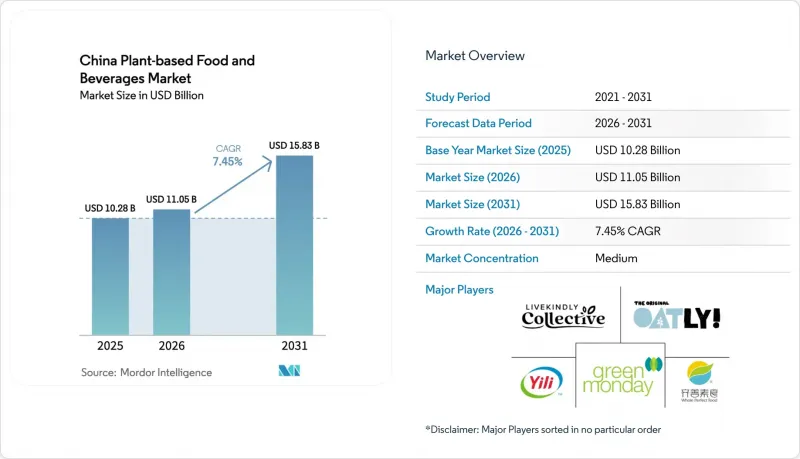
This report is Segmented by Type (Plant-Based Dairy, Meat Substitutes, Beverages, Other Food and Beverages), Source (Soy, Pea, Wheat, Rice, Oats, Other Sources), Distribution Channels (On-Trade, Off-Trade), and Geography. The Market Forecasts are Provided in Terms of Value (USD) and Volume (Units).
China Plant-based Food And Beverages Market Trends and Insights
Rising Health and Wellness Trends
Following the pandemic, health consciousness among Chinese consumers has surged, fueling a growing preference for functional foods that combine nutritional benefits with convenience. To align with this trend, the China Food and Drug Administration implemented updated labeling standards, GB 7718-2025 and GB 28050-2025, which mandate clearer and more detailed nutritional information . These regulations empower plant-based brands to emphasize their products' health advantages, such as zero cholesterol, higher fiber content, and reduced saturated fat levels when compared to animal-based products. This shift is particularly advantageous for the plant-based dairy alternatives market. China has the ability to play a significant role in advancing the global trend toward plant-based meat by boosting output and lowering costs. The country has an abundance of non-GMO soybeans locally and a large processing capacity for plant-based raw materials like soy and pea. According to ProVeg, 98% of Chinese consumers are likely to eat more plant-based foods when presented with scientific data on the benefits of such diets .
Innovation in Product Development
Chinese manufacturers leverage technological advances in high-moisture extrusion and fermentation processing to craft meat-like textures, addressing long-standing consumer concerns about plant-based alternatives. Research from Singapore's A*STAR highlights that multi-objective Bayesian optimization can fine-tune extrusion parameters, achieving chicken-breast-like hardness with just a 5-7% variance and a cutting force within 15% of targets. Jinan Xilang Machine, a domestic equipment manufacturer, offers production lines for textured vegetable protein, boasting capacities between 100-2,000 kg/hour, underscoring the infrastructure's readiness for scaled production. With China processing about 50% of the world's soy protein capacity, its fermentation capabilities not only reduce ingredient production costs but also position it competitively against imported alternatives.
Supply Chain and Production Challenges
Fragmented raw material sourcing and rising costs for animal-free ingredients hinder production scalability and reduce profit margins. Chinese manufacturers in the plant-based sector face challenges with unstable ingredient supplies. Specialized proteins and functional additives require longer lead times and are more expensive compared to traditional food ingredients. Production cost analysis shows that plant-based products often cost 2-4 times more than conventional alternatives. This cost disparity is notable, with 21% of trial consumers identifying price as the main reason for not repurchasing, according to the Food Engineering Journal. Freight expenses further exacerbate these issues, as specialized ingredients need temperature-controlled logistics, and smaller batch sizes drive up per-unit transportation costs. To address these challenges, companies are adopting continuous processing automation and regional manufacturing strategies. Many are also developing integrated ingredient-processing facilities to optimize formulations with lower-cost proteins and simplify supply chains.
Other drivers and restraints analyzed in the detailed report include:
- Dietary Shifts and Flexitarianism
- Increased Availability in Online Channels
- Flavor and Texture Gaps
For complete list of drivers and restraints, kindly check the Table Of Contents.
Segment Analysis
In 2025, plant-based dairy holds a dominant 61.62% market share, supported by a cultural preference for soy milk and rapid diversification across coffee shops and retail channels. This segment's leadership stems from consumer trust in established options like soy milk, which has facilitated the growth of oat, almond, and rice-based alternatives. Although meat substitutes currently account for a smaller market share, they exhibit the fastest growth, with an 8.66% CAGR projected from 2026 to 2031, driven by advancements in texture and flavor technologies. Meanwhile, plant-based beverages are leveraging China's growing cafe culture. Brands such as HEYTEA have achieved significant market presence by innovatively combining plant proteins with traditional tea formulations.
In addition, the food and beverage sector is experiencing growth in plant-based categories such as baking, snacks, and ready-to-eat meals, with companies like Zero Limits leading the way in animal-free bakery products. Regulatory developments also play a crucial role, as the China Food Safety Authority facilitates the approval of novel ingredients under the GB 2760-2024 food additive standards. However, extended approval timelines can delay product development. Furthermore, the Ministry of Agriculture and Rural Affairs influences category dynamics by providing subsidies to support domestic raw milk production, increasing competition and compelling plant-based dairy alternatives to establish clear value propositions beyond price.
Complete Report Scope:
- By Type
- Plant-based Dairy
- Yogurt
- Cheese
- Frozen Dessert and Ice Cream
- Other Dairy Products
- Meat Substitutes
- Tofu
- Tempeh
- Textured Vegetable Protein
- Other Meat Substitutes
- Beverages
- Milk
- Smoothies
- Tea
- Coffee
- Other Beverages
- Other Food and Beverages
- Plant-based Dairy
- By Source
- Soy
- Pea
- Wheat
- Rice
- Oats
- Other Sources
- By Distribution Channels
- On-Trade
- Off-Trade
- Supermarkets/Hypermarkets
- Convenience Stores
- Specialty Stores
- Online Channels
- Other Distribution Channels
List of Companies Covered in this Report:
- The LiveKindly Company Inc.
- Beyond Meat
- Yili Group
- China Mengniu Dairy Co. Ltd.
- Oatly Group AB
- Unilever PLC (The Vegetarian Butcher)
- Green Monday Group (OmniPork)
- Hero Protein
- Vitasoy International Hodings Ltd.
- Qishan Foods
- Zhenmeat
- Chengde Lulu
- Zhongyin (Zhejiang) Beverage Co., Ltd.
- Golden Spring Group
- Hainan Laizhi Industry Co., Ltd.
- Zhenxin Industry Co., Ltd.
- Elisha Beverage Co., Ltd.
- Sichuan Viee Beverage Food Co.
- Green Common (Chinese plant-based brand)
- Cargill Inc.
Additional Benefits:
- The market estimate (ME) sheet in Excel format
- 3 months of analyst support
TABLE OF CONTENTS
1 INTRODUCTION
- 1.1 Study Assumptions and Market Definition
- 1.2 Scope of the Study
2 RESEARCH METHODOLOGY
3 EXECUTIVE SUMMARY
4 MARKET LANDSCAPE
- 4.1 Market Overview
- 4.2 Market Drivers
- 4.2.1 Rising health and wellness trends
- 4.2.2 Innovation in product development
- 4.2.3 Dietary shifts and flexitarianism
- 4.2.4 Increased availability in online channels
- 4.2.5 Growing prevalence of lactose intolerance
- 4.2.6 Influence of western and global trends
- 4.3 Market Restraints
- 4.3.1 Supply chain and production challenges
- 4.3.2 Limited awareness beyond major cities
- 4.3.3 Regulatory and standardization complexities
- 4.3.4 Flavor and texture gaps
- 4.4 Supply Chain Analysis
- 4.5 Regulatory Outlook
- 4.6 Porter's Five Forces
- 4.6.1 Threat of New Entrants
- 4.6.2 Bargaining Power of Buyers/Consumers
- 4.6.3 Bargaining Power of Suppliers
- 4.6.4 Threat of Substitute Products
- 4.6.5 Intensity of Competitive Rivalry
5 MARKET SIZE AND GROWTH FORECAST
- 5.1 By Type
- 5.1.1 Plant-based Dairy
- 5.1.1.1 Yogurt
- 5.1.1.2 Cheese
- 5.1.1.3 Frozen Dessert and Ice Cream
- 5.1.1.4 Other Dairy Products
- 5.1.2 Meat Substitutes
- 5.1.2.1 Tofu
- 5.1.2.2 Tempeh
- 5.1.2.3 Textured Vegetable Protein
- 5.1.2.4 Other Meat Substitutes
- 5.1.3 Beverages
- 5.1.3.1 Milk
- 5.1.3.2 Smoothies
- 5.1.3.3 Tea
- 5.1.3.4 Coffee
- 5.1.3.5 Other Beverages
- 5.1.4 Other Food and Beverages
- 5.1.1 Plant-based Dairy
- 5.2 By Source
- 5.2.1 Soy
- 5.2.2 Pea
- 5.2.3 Wheat
- 5.2.4 Rice
- 5.2.5 Oats
- 5.2.6 Other Sources
- 5.3 By Distribution Channels
- 5.3.1 On-Trade
- 5.3.2 Off-Trade
- 5.3.2.1 Supermarkets/Hypermarkets
- 5.3.2.2 Convenience Stores
- 5.3.2.3 Specialty Stores
- 5.3.2.4 Online Channels
- 5.3.2.5 Other Distribution Channels
6 COMPETITIVE LANDSCAPE
- 6.1 Market Concentration
- 6.2 Strategic Moves
- 6.3 Market Ranking Analysis
- 6.4 Company Profiles (includes Global-level Overview, Market-level Overview, Core Segments, Financials (if available), Strategic Information, Market Rank/Share, Products and Services, Recent Developments)
- 6.4.1 The LiveKindly Company Inc.
- 6.4.2 Beyond Meat
- 6.4.3 Yili Group
- 6.4.4 China Mengniu Dairy Co. Ltd.
- 6.4.5 Oatly Group AB
- 6.4.6 Unilever PLC (The Vegetarian Butcher)
- 6.4.7 Green Monday Group (OmniPork)
- 6.4.8 Hero Protein
- 6.4.9 Vitasoy International Hodings Ltd.
- 6.4.10 Qishan Foods
- 6.4.11 Zhenmeat
- 6.4.12 Chengde Lulu
- 6.4.13 Zhongyin (Zhejiang) Beverage Co., Ltd.
- 6.4.14 Golden Spring Group
- 6.4.15 Hainan Laizhi Industry Co., Ltd.
- 6.4.16 Zhenxin Industry Co., Ltd.
- 6.4.17 Elisha Beverage Co., Ltd.
- 6.4.18 Sichuan Viee Beverage Food Co.
- 6.4.19 Green Common (Chinese plant-based brand)
- 6.4.20 Cargill Inc.
7 MARKET OPPORTUNITIES AND FUTURE OUTLOOK

