PUBLISHER: Mordor Intelligence | PRODUCT CODE: 2116880

PUBLISHER: Mordor Intelligence | PRODUCT CODE: 2116880
Online Action Games - Market Share Analysis, Industry Trends & Statistics, Growth Forecasts (2026 - 2031)
According to Mordor Intelligence, online action games market size in 2026 is estimated at USD 25.48 billion, growing from 2025 value of USD 23.42 billion with 2031 projections showing USD 38.84 billion, growing at 8.80% CAGR over 2026-2031.
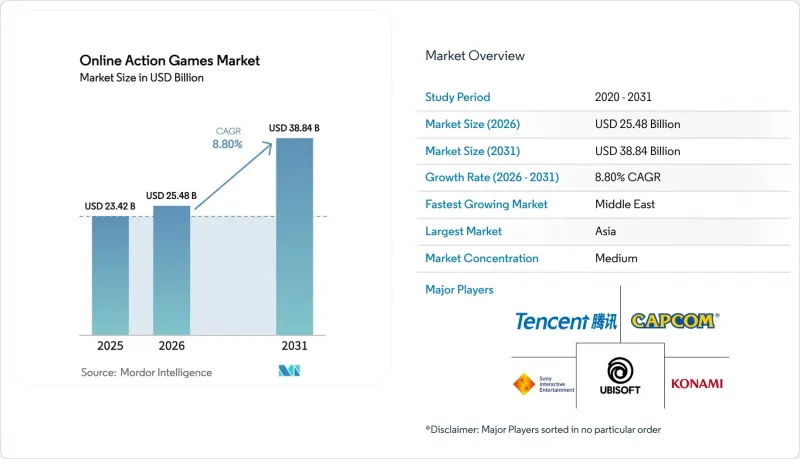
This report is Segmented by Revenue Model (Free Gaming Services, Paid Gaming Services and More), Platform (PCs, Consoles, Mobile Phones and More), Operating Systems (iOS, Android, Windows, and More), and Geography. The Market Forecasts are Provided in Terms of Value (USD).
Global Online Action Games Market Trends and Insights
5G-Enabled Low-Latency Mobile Action Gaming Adoption across APAC and MENA
Commercial 5G rollouts across India, Saudi Arabia and the United Arab Emirates have slashed median round-trip latency for multiplayer titles, enabling real-time hit detection and smoother competitive play. Network-slicing pilots in Riyadh and Mumbai allocate assured throughput tiers for game packets, translating into 20% higher session lengths compared with 4G cohorts. Publishers are responding by staging timed live-ops events optimized for sub-50 ms latency, accelerating regional revenue pick-up.
Cross-Platform Game Engines Reducing Porting Costs
Unreal Engine and Unity now ship multi-target build tools that reuse shaders and asset bundles across PC, console and mobile SKUs, trimming porting cycles by up to 30 days per platform. Independent studios can therefore reach addressable install bases exceeding 2 billion devices while maintaining a single QA pipeline. The move also improves time-to-market for downloadable content, reinforcing player retention.
Rising User-Acquisition Costs post-ATT on Mobile Ad Networks
Apple's App Tracking Transparency (ATT) framework has suppressed ID-level targeting, inflating average CPI (cost per install) for action genres by 25% year on year. Publishers divert spend toward influencer-led discovery channels, but conversion efficiency remains below pre-ATT baselines, compressing margins on free-to-play launches.
Other drivers and restraints analyzed in the detailed report include:
- Cloud-Streaming Partnerships Expanding Access in Emerging Markets
- Esports Prize-Pool Escalation in Shooter Sub-genre
- Violence-Related Content Regulations in China and South Korea
For complete list of drivers and restraints, kindly check the Table Of Contents.
Segment Analysis
Subscription offerings contribute 13.25% of 2025 spend, yet their growth trajectory at 12.35% CAGR exceeds that of ad-funded free services. Competitive publishers differentiate by bundling a rotating catalog of premium shooters, early access to DLC and platform-agnostic cloud saves. In turn, the online action games market size for subscription tiers is projected to reach USD 6.23 billion by 2031, capturing players averse to micro-transactions.
Diversified hybrids such as battle-pass models combine predictable recurring revenue with aspirational cosmetic unlocks. Premium passes priced at USD 9.99 per season achieve an attach rate above 35% in tier-1 countries, feeding into higher monthly active user retention. Conversely, advertising-supported experiences remain critical for emerging markets where average spend per paying user trails the global mean by over 45%.
Complete Report Scope:
- By Revenue Model
- Free Gaming Services
- Paid Gaming Services
- Subscription-Based Gaming Services
- Hybrid Battle-Pass Models
- In-Game Advertising-Supported Free Services
- By Platform
- PCs
- Consoles
- Mobile Phones
- Cloud Gaming Platforms
- XR/VR Devices
- By Operating System
- iOS
- Android
- Windows
- Other Operating Systems (macOS, Linux, ChromeOS)
- By Geography
- North America
- United States
- Canada
- Mexico
- South America
- Brazil
- Argentina
- Rest of SouthAmerica
- Europe
- Germany
- United Kingdom
- France
- Italy
- Spain
- Rest of Europe
- Asia-Pacific
- China
- Japan
- South Korea
- India
- Australia
- New Zealand
- Rest of Asia-Pacific
- Middle East and
- United Arab Emirates
- Saudi Arabia
- Rest of Middle East
- Africa
- South Africa
- Rest of Africa
- North America
Geography Analysis
Asia-Pacific generated 51.35% of global revenue in 2025, underpinned by mobile-first markets such as China, South Korea and India. Government-led fiber-to-home investment in South Korea pushes average downstream speeds beyond 200 Mbps, sustaining 240 Hz shooters and 4K streaming campaigns. However, the introduction of play-time caps in China tempers under-18 monetization velocity, shifting publisher focus toward adult whales and cross-border Southeast Asian growth.
North America follows as the second-largest territory, benefitting from console install-base density and robust esports infrastructure. Franchise tie-ins with Hollywood IP accelerate brand recognition, while league-based monetization-echoing traditional sports media rights-strengthens recurring revenue streams. Yet rising labor costs in California and Texas AAA studios encourage outsourcing to Montreal, Vancouver and Guadalajara to preserve project margins.
Europe's regulatory climate remains fragmented; tax incentives in France, the United Kingdom and Italy underpin the resurgence of AAA single-player action titles, enriching the wider ecosystem through asset reuse in multiplayer expansions. Eastern Europe, spearheaded by Poland and Romania, emerges as a cost-competitive hub for Unreal Engine programmers, attracting outsourcing contracts from Western publishers seeking to expedite concurrent PC-console releases.
- Tencent
- Sony Interactive Entertainment
- Activision Blizzard
- Nintendo EPD
- Electronic Arts
- Ubisoft
- Konami
- Capcom
- Rockstar Games
- Bethesda Game Studios
- FromSoftware
- NEXON
- NetEase
- Riot Games
- Square Enix
- PlatinumGames
- Guerrilla Games
- id Software
- Rocksteady Studios
- Krafton
- SIE Santa Monica Studio
- Garena
- Embracer Group
Additional Benefits:
- The market estimate (ME) sheet in Excel format
- 3 months of analyst support
TABLE OF CONTENTS
1 INTRODUCTION
- 1.1 Study Assumptions and Market Definition
- 1.2 Scope of the Study
2 RESEARCH METHODOLOGY
3 EXECUTIVE SUMMARY
4 MARKET LANDSCAPE
- 4.1 Market Overview
- 4.2 Market Drivers
- 4.2.1 5G-enabled Low-Latency Mobile Action Gaming Adoption across APAC and MENA
- 4.2.2 Cross-Platform Game Engines Reducing Porting Costs
- 4.2.3 Cloud-Streaming Partnerships Expanding Access in Emerging Markets
- 4.2.4 Esports Prize-Pool Escalation in Shooter Sub-genre
- 4.2.5 GenAI-Driven Live-Ops Personalization Boosting ARPU
- 4.2.6 European Tax Incentives Stimulating AAA Action Pipelines
- 4.3 Market Restraints
- 4.3.1 Rising User-Acquisition Costs post-ATT on Mobile Ad Networks
- 4.3.2 Violence-Related Content Regulations in China and South Korea
- 4.3.3 High Real-Time Multiplayer Infrastructure Costs for Indies
- 4.3.4 Escalating Cyber-Security Threats Impacting Competitive Play
- 4.4 Technological Outlook
- 4.5 Porter's Five Forces Analysis
- 4.5.1 Threat of New Entrants
- 4.5.2 Bargaining Power of Buyers/Consumers
- 4.5.3 Bargaining Power of Suppliers
- 4.5.4 Threat of Substitute Products
- 4.5.5 Intensity of Competitive Rivalry
5 MARKET SIZE AND GROWTH FORECASTS (VALUE)
- 5.1 By Revenue Model
- 5.1.1 Free Gaming Services
- 5.1.2 Paid Gaming Services
- 5.1.3 Subscription-Based Gaming Services
- 5.1.4 Hybrid Battle-Pass Models
- 5.1.5 In-Game Advertising-Supported Free Services
- 5.2 By Platform
- 5.2.1 PCs
- 5.2.2 Consoles
- 5.2.3 Mobile Phones
- 5.2.4 Cloud Gaming Platforms
- 5.2.5 XR/VR Devices
- 5.3 By Operating System
- 5.3.1 iOS
- 5.3.2 Android
- 5.3.3 Windows
- 5.3.4 Other Operating Systems (macOS, Linux, ChromeOS)
- 5.4 By Geography
- 5.4.1 North America
- 5.4.1.1 United States
- 5.4.1.2 Canada
- 5.4.1.3 Mexico
- 5.4.2 South America
- 5.4.2.1 Brazil
- 5.4.2.2 Argentina
- 5.4.2.3 Rest of SouthAmerica
- 5.4.3 Europe
- 5.4.3.1 Germany
- 5.4.3.2 United Kingdom
- 5.4.3.3 France
- 5.4.3.4 Italy
- 5.4.3.5 Spain
- 5.4.3.6 Rest of Europe
- 5.4.4 Asia-Pacific
- 5.4.4.1 China
- 5.4.4.2 Japan
- 5.4.4.3 South Korea
- 5.4.4.4 India
- 5.4.4.5 Australia
- 5.4.4.6 New Zealand
- 5.4.4.7 Rest of Asia-Pacific
- 5.4.5 Middle East and
- 5.4.5.1 United Arab Emirates
- 5.4.5.2 Saudi Arabia
- 5.4.5.3 Rest of Middle East
- 5.4.6 Africa
- 5.4.6.1 South Africa
- 5.4.6.2 Rest of Africa
- 5.4.1 North America
6 COMPETITIVE LANDSCAPE
- 6.1 Strategic Developments
- 6.2 Vendor Positioning Analysis
- 6.3 Company Profiles (includes Global level Overview, Market level overview, Core Segments, Financials as available, Strategic Information, Products and Services, and Recent Developments)
- 6.3.1 Tencent
- 6.3.2 Sony Interactive Entertainment
- 6.3.3 Activision Blizzard
- 6.3.4 Nintendo EPD
- 6.3.5 Electronic Arts
- 6.3.6 Ubisoft
- 6.3.7 Konami
- 6.3.8 Capcom
- 6.3.9 Rockstar Games
- 6.3.10 Bethesda Game Studios
- 6.3.11 FromSoftware
- 6.3.12 NEXON
- 6.3.13 NetEase
- 6.3.14 Riot Games
- 6.3.15 Square Enix
- 6.3.16 PlatinumGames
- 6.3.17 Guerrilla Games
- 6.3.18 id Software
- 6.3.19 Rocksteady Studios
- 6.3.20 Krafton
- 6.3.21 SIE Santa Monica Studio
- 6.3.22 Garena
- 6.3.23 Embracer Group
7 MARKET OPPORTUNITIES AND FUTURE OUTLOOK
- 7.1 White-Space and Unmet-Need Assessment

