PUBLISHER: Mordor Intelligence | PRODUCT CODE: 2116920

PUBLISHER: Mordor Intelligence | PRODUCT CODE: 2116920
Online Casual Games - Market Share Analysis, Industry Trends & Statistics, Growth Forecasts (2026 - 2031)
According to Mordor Intelligence, the online casual games market was valued at USD 22.68 billion in 2026 and is projected to reach USD 29.51 billion in 2031, translating into a 5.41% CAGR over the forecast period.
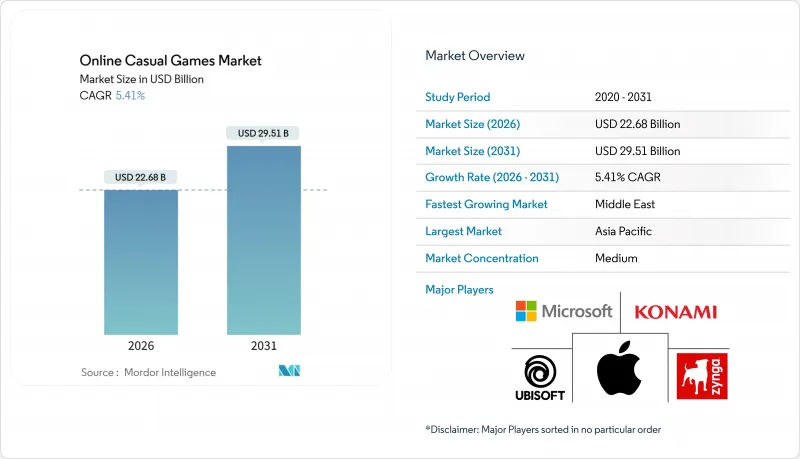
This report is Segmented by Monetization Model (Advertising, In-App Purchase, and Paid App), Platform (Smartphone, Tablet, and PC/Web), Age Group (Below 18 Years, 18-35 Years, 36-50 Years, and Above 50 Years), and Geography (North America, South America, Europe, Asia Pacific, Middle East, and Africa). The Market Forecasts are Provided in Terms of Value (USD).
Global Online Casual Games Market Trends and Insights
Growing 5G Smartphone Penetration Accelerating Mobile Gaming Adoption
Low-latency radio networks enable real-time multiplayer on handsets priced under USD 200, allowing publishers to port PC-quality assets without alienating budget buyers. Indonesia alone counts 155 million gamers who rely almost exclusively on mobile access, and sub-20-millisecond latency enables cloud-rendered experiences previously locked behind discrete GPUs. Tencent's Dungeon and Fighter Mobile demonstrated the commercial upside by surpassing CNY 10 billion (USD 1.4 billion) in its first two post-launch months. As edge nodes extend into tier-2 cities, the performance gap between premium and entry-level devices narrows, democratizing access to content and expanding the online casual games market.
Expansion of Reward-Based Advertising Networks Boosting Casual Titles Monetization
Opt-in video ads have matured into the highest-yield format for casual games, with click-through rates averaging 8.2% in Q4 2024 compared with 1.1% for static banners. Completion rates exceed 90% because users receive guaranteed in-game value, a tradeoff that resonates with 18-35-year-olds who typically budget USD 5-15 a month for virtual goods. Server-side bidding by Google AdMob and Unity Ads now auctions impressions in real time, lifting average revenue per daily active user by up to 25% as higher-yield networks compete for each view. European publishers are layering rewarded ads beneath optional USD 4.99 subscriptions, creating three-tier models that capture spend across income bands without eroding free-to-play reach.
ATT Privacy Changes Compressing Attribution Data for Mid-Tier Publishers
Apple's AdAttributionKit replaces device-level identifiers with aggregated cohorts, reducing post-install event visibility for advertisers by up to 60%. Casual titles with many purchasable SKUs lose the precision needed to bid aggressively for high-value users, prompting a 25-35% budget shift toward organic tactics such as influencer collaborations and in-app cross-promotion. Larger publishers mitigate the data gap by pooling events across multiple franchises, a scale benefit unavailable to single-game studios. The restraint weighs most heavily on puzzle and hyper-casual teams that rely on granular optimization to keep CPI below USD 1 in saturated Western markets.
Other drivers and restraints analyzed in the detailed report include:
- Cloud-Streaming Integration Lowering Hardware Barriers in Southeast Asia
- Cross-Platform Engines Slashing Development Costs for Indie Studios
- Rising Energy Costs Increasing Server Opex for Ad-Supported Web Casual Games
For complete list of drivers and restraints, kindly check the Table Of Contents.
Segment Analysis
Hybrid frameworks now sit at the vanguard of the online casual games market, expanding at a 5.89% CAGR through 2031. In-app purchases maintained a 38.19% share of 2025 revenue, sustained by franchises like Candy Crush Saga, yet their share is gradually ceding ground to approaches that combine micro-transactions, rewarded ads, and optional USD 4.99 monthly passes. Roblox's USD 919 million Q3 2024 revenue illustrates how layered models can monetize both free users and high spenders. Rewarded videos act as a safety valve, letting non-payers progress without hard locks and keeping retention high enough to convert a minority into payers. The online casual games market for subscription-driven word and puzzle titles is modest today, but is projected to expand as players seek ad-free convenience.
Hybrid design also buffers developers against privacy-related swings in user acquisition efficiency. When attribution visibility narrows, teams lean on engagement loops rather than precision targeting, a hedge that has gained salience since Apple's privacy changes. Small starter packs priced at USD 0.99 amplify initial conversion by reducing sticker shock, while battle passes introduce predictable revenue arcs over four-week cycles. Paid-only apps are relegated to niche board-game adaptations because free alternatives and rapid content inflation discourage upfront fees.
Complete Report Scope:
- By Monetization Model
- Advertising
- In-App Purchase
- Paid App
- By Platform
- Smartphone
- Tablet
- PC / Web
- By Age Group
- Below 18 Years
- 18-35 Years
- 36-50 Years
- Above 50 Years
- By Geography
- North America
- United States
- Canada
- Mexico
- South America
- Brazil
- Argentina
- Rest of South America
- Europe
- Germany
- United Kingdom
- France
- Italy
- Spain
- Rest of Europe
- Asia Pacific
- China
- Japan
- South Korea
- India
- Rest of Asia Pacific
- Middle East and Africa
- Middle East
- United Arab Emirates
- Saudi Arabia
- Turkey
- Rest of Middle East
- Africa
- South Africa
- Rest of Africa
- Middle East
- North America
Geography Analysis
Asia Pacific commanded 35.48% of spending in 2025, anchored by China's partial regulatory thaw that cleared NetEase to launch Marvel Rivals and helped Tencent post CNY 51.8 billion (USD 7.3 billion) in Q3 2024 gaming revenue. Southeast Asia's 1.93 billion Q1 2025 downloads and USD 625 million in receipts highlight the potential unlocked by inexpensive Android devices and carrier billing integrations. India's rural teledensity is 58.8%, compared with 125.3% in urban areas, so metropolitan gamers stream high-fidelity titles, while villagers gravitate toward lightweight downloadable games that cache assets locally. Japan and South Korea remain revenue-dense but slower-growing, the latter setting a template for alternative payment models after passing its in-app billing choice legislation in 2024.
The Middle East is on course for a 5.92% CAGR, powered by Saudi Arabia's USD 38 billion gaming investment program and its USD 4.9 billion Scopely acquisition. Vision 2030 targets USD 13.3 billion in gaming GDP contribution, supported by the Qiddiya Gaming District and Dubai's 10-year Gaming Visa. With 420 million Arabic speakers worldwide, the addressable pool for localized titles is vast, and AI-driven asset generation now compresses translation costs enough for mid-tier studios to pursue the opportunity. Africa's emerging markets lag due to smartphone affordability and fragmented payment rails, but mobile money services such as M-Pesa are widening the funnel in East Africa.
North America and Europe collectively delivered roughly 45% of 2025 revenue. The United States still leads on absolute spend, though growth tapers as CPI inflation meets Apple's privacy policy constraints. Canada and Mexico expand faster, with Mexico's 50 million gamers serving as a gateway into Spanish-speaking South America. Europe's Digital Markets Act is already shifting spend to web shops that bypass 30% platform fees, boosting average revenue per paying user by as much as 18% without raising prices. Germany and Belgium's loot-box prohibitions accelerate cosmetic-only monetization, forcing studios to maintain region-specific builds but also smoothing retention by removing perceived pay-to-win features.
- Tencent Holdings Ltd.
- Activision Blizzard Inc.
- King Digital Entertainment Plc
- Playrix Holding Ltd.
- Zynga Inc.
- Moon Active Ltd.
- Ubisoft Entertainment SA
- Microsoft Corporation
- Apple Inc.
- Konami Digital Entertainment
- Sega Corporation
- Sony Interactive Entertainment
- Nintendo Co., Ltd.
- Bandai Namco Entertainment Inc.
- Rovio Entertainment Corporation
- NetEase Games
- Supercell Oy
- Miniclip SA
- Roblox Corporation
- Scopely, Inc.
- Voodoo SAS
- Playtika Holding Corp.
Additional Benefits:
- The market estimate (ME) sheet in Excel format
- 3 months of analyst support
TABLE OF CONTENTS
1 INTRODUCTION
- 1.1 Study Assumptions and Market Definition
- 1.2 Scope of the Study
2 RESEARCH METHODOLOGY
3 EXECUTIVE SUMMARY
4 MARKET LANDSCAPE
- 4.1 Market Overview
- 4.2 Market Drivers
- 4.2.1 Growing 5G Smartphone Penetration Accelerating Mobile Gaming Adoption
- 4.2.2 Expansion of Reward-Based Advertising Networks Boosting Casual Titles Monetization
- 4.2.3 Cloud-Streaming Integration Lowering Hardware Barriers in Southeast Asia
- 4.2.4 Cross-Platform Engines (Unity, Unreal) Slashing Dev Costs for Indie Studios
- 4.2.5 Direct-to-Consumer Web Shops Reducing Platform Fees and Increasing ARPU in Europe
- 4.2.6 AI-Powered Creative Optimization Lowering CPI for Hyper-Casual Titles in MENA
- 4.3 Market Restraints
- 4.3.1 Stringent Loot-Box Regulations in Germany and Belgium
- 4.3.2 Latency Issues in Rural India Hindering Cloud-Casual Adoption
- 4.3.3 Rising Energy Costs Increasing Server Opex for Ad-Supported Web Casual Games
- 4.3.4 ATT Privacy Changes Compressing Attribution Data for Mid-Tier Publishers
- 4.4 Industry Value Chain Analysis
- 4.5 Impact of Macroeconomic Factors on the Market
- 4.6 Regulatory Outlook
- 4.7 Technological Outlook
- 4.8 Porter's Five Forces Analysis
- 4.8.1 Bargaining Power of Suppliers
- 4.8.2 Bargaining Power of Buyers
- 4.8.3 Threat of New Entrants
- 4.8.4 Threat of Substitute Products
- 4.8.5 Intensity of Competitive Rivalry
5 MARKET SIZE AND GROWTH FORECASTS (VALUE)
- 5.1 By Monetization Model
- 5.1.1 Advertising
- 5.1.2 In-App Purchase
- 5.1.3 Paid App
- 5.2 By Platform
- 5.2.1 Smartphone
- 5.2.2 Tablet
- 5.2.3 PC / Web
- 5.3 By Age Group
- 5.3.1 Below 18 Years
- 5.3.2 18-35 Years
- 5.3.3 36-50 Years
- 5.3.4 Above 50 Years
- 5.4 By Geography
- 5.4.1 North America
- 5.4.1.1 United States
- 5.4.1.2 Canada
- 5.4.1.3 Mexico
- 5.4.2 South America
- 5.4.2.1 Brazil
- 5.4.2.2 Argentina
- 5.4.2.3 Rest of South America
- 5.4.3 Europe
- 5.4.3.1 Germany
- 5.4.3.2 United Kingdom
- 5.4.3.3 France
- 5.4.3.4 Italy
- 5.4.3.5 Spain
- 5.4.3.6 Rest of Europe
- 5.4.4 Asia Pacific
- 5.4.4.1 China
- 5.4.4.2 Japan
- 5.4.4.3 South Korea
- 5.4.4.4 India
- 5.4.4.5 Rest of Asia Pacific
- 5.4.5 Middle East and Africa
- 5.4.5.1 Middle East
- 5.4.5.1.1 United Arab Emirates
- 5.4.5.1.2 Saudi Arabia
- 5.4.5.1.3 Turkey
- 5.4.5.1.4 Rest of Middle East
- 5.4.5.2 Africa
- 5.4.5.2.1 South Africa
- 5.4.5.2.2 Rest of Africa
- 5.4.5.1 Middle East
- 5.4.1 North America
6 COMPETITIVE LANDSCAPE
- 6.1 Market Concentration
- 6.2 Strategic Moves
- 6.3 Market Share Analysis
- 6.4 Company Profiles (includes Global level Overview, Market level overview, Core Segments, Financials as available, Strategic Information, Market Rank/Share for key companies, Products & Services, and Recent Developments)
- 6.4.1 Tencent Holdings Ltd.
- 6.4.2 Activision Blizzard Inc.
- 6.4.3 King Digital Entertainment Plc
- 6.4.4 Playrix Holding Ltd.
- 6.4.5 Zynga Inc.
- 6.4.6 Moon Active Ltd.
- 6.4.7 Ubisoft Entertainment SA
- 6.4.8 Microsoft Corporation
- 6.4.9 Apple Inc.
- 6.4.10 Konami Digital Entertainment
- 6.4.11 Sega Corporation
- 6.4.12 Sony Interactive Entertainment
- 6.4.13 Nintendo Co., Ltd.
- 6.4.14 Bandai Namco Entertainment Inc.
- 6.4.15 Rovio Entertainment Corporation
- 6.4.16 NetEase Games
- 6.4.17 Supercell Oy
- 6.4.18 Miniclip SA
- 6.4.19 Roblox Corporation
- 6.4.20 Scopely, Inc.
- 6.4.21 Voodoo SAS
- 6.4.22 Playtika Holding Corp.
7 MARKET OPPORTUNITIES AND FUTURE OUTLOOK
- 7.1 White-Space and Unmet-Need Assessment

