PUBLISHER: Mordor Intelligence | PRODUCT CODE: 2125374

PUBLISHER: Mordor Intelligence | PRODUCT CODE: 2125374
Online Strategy Games - Market Share Analysis, Industry Trends & Statistics, Growth Forecasts (2026 - 2031)
According to Mordor Intelligence, the online strategy games market size was valued at USD 21.44 billion in 2025 and estimated to grow from USD 23.45 billion in 2026 to reach USD 36.74 billion by 2031, at a CAGR of 9.39% during the forecast period (2026-2031).
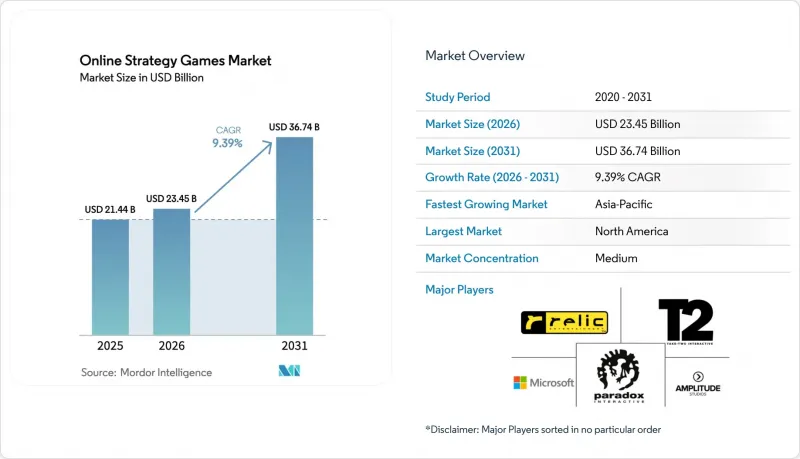
This report is Segmented by Genre (Real-Time Strategy, Turn-Based Strategy, and More), Platform (PC, Mobile, Console, Browser-Based, and More), Revenue Model (In-Game Purchases, Advertising-Supported, and More), Player Mode (Single-Player, Asynchronous Multiplayer, Real-Time Multiplayer, and MMO/4X, Esports-Focused), and Geography. The Market Forecasts are Provided in Terms of Value (USD).
Global Online Strategy Games Market Trends and Insights
Cloud-Native Distribution Lowering Entry Barriers
Cloud delivery removes hardware and retail constraints, enabling a flood of new titles and allowing smaller studios to reach global audiences without a physical footprint. Over 15,000 browser-based strategy games launched in H1 2025, a 4.9-fold increase versus H1 2023, demonstrating how low entry costs energize creative competition. Unity's 55% share of browser development underscores middleware's role in accelerating launch cycles. Platform providers such as Amazon GameLift Streams extend scalable back-end services, letting developers prioritize gameplay innovation over server maintenance. Regulatory fragmentation, however, means compliance requirements vary widely, demanding legal vigilance across jurisdictions.
5G Rollouts Enabling Low-Latency Mobile RTS
Commercial 5G deployments have cut end-to-end lag to 70-100 ms, while 5G-A test networks show 5-10 ms radio latency and 100 Mbps downlink potential. These parameters allow console-grade real-time strategy experiences on smartphones and tablets, especially in Asia-Pacific where mobile-first adoption dominates. Edge facilities shorten data paths, preserving frame-sync integrity for competitive play. The performance leap expands addressable demographics among users lacking high-end PCs, although operators must still manage variable indoor coverage and data tariffs that influence session length.
Rising User-Acquisition CPMs Post-IDFA Privacy Changes
Apple's identifier-for-advertisers deprecation raised CPMs and diluted targeting precision, complicating recoupment of long-tail lifetime values prevalent in strategy genres. Studios respond by reinforcing first-party data collection, via opt-in gameplay telemetry, and by adopting contextual ad placements anchored to genre affinity. Scale remains vital; without large user cohorts the statistical power of these alternative approaches diminishes, keeping acquisition costs elevated in the near term.
Other drivers and restraints analyzed in the detailed report include:
- Esports Monetization Expanding Real-Time Strategy Viewership
- Generative-AI Tools Cutting Content-Update Costs
- App-Store Policy Fees Squeezing Developer Margins
For complete list of drivers and restraints, kindly check the Table Of Contents.
Segment Analysis
Real-time strategy titles represented 58.10% of 2025 revenue, an outperformance anchored by evergreen franchises and spectator-friendly esports ecosystems. Auto-battler innovation, however, is pulling new demographics through accessible mechanics and shorter match loops, giving the sub-category a forecast 10.36% CAGR. Players migrate fluidly across genres, prompting developers to blend real-time decision loops with auto-resolved combat modules that conserve session time without sacrificing depth. Successful hybrids can tap both hardcore and casual cohorts, broadening lifetime value and diversifying competitive metas. The online strategy games market therefore witnesses experimental genre convergence as studios apply AI-driven procedural systems to prototype new archetypes rapidly, reinforcing pipeline agility while mitigating budget risk.
Second-order effects include a rising e-commerce aftermarket for cosmetic assets that transcend individual genres, reinforcing monetization through interoperable skins and avatars. RTS publishers, meanwhile, leverage cross-progression between PC and cloud platforms to anchor their installed bases. Auto-battler startups exploit lightweight mobile builds to reach emerging economies, using low-bandwidth footprints and regional language packs to accelerate adoption. Provided regulatory guardrails on loot boxes remain stable, both segments expect incremental spend-per-paying-user to hold above mid-single-digit USD levels through 2030.
Mobile captured 47.10% in 2025 on the back of high smartphone penetration and intuitive touch controls, confirming the device's position as the primary on-ramp to the online strategy games market. Yet cloud gaming's 10.21% projected CAGR indicates shifting infrastructure economics: low-powered devices gain access to high-fidelity titles without discrete GPUs. Operators combine adaptive bitrate streaming with instant-resume state management to remove patch downloads, shrinking churn associated with friction at first launch. Developers build control-scheme abstraction layers to support controller, keyboard-mouse, and gesture input concurrently, reinforcing cross-play viability.
Browser games, fueled by WebAssembly and WebGPU, collected more than 15,000 launches in H1 2025; they illustrate how zero-install access counters app-store fees while aiding global reach. PC and console remain staples for competitive ladders that mandate precision inputs, with multi-monitor data overlays giving high-skill players marginal advantages. The platform mix is therefore fluid: consumer loyalty fragments across devices, challenging publishers to optimize social graphs, leaderboards, and virtual-economy sync in near real-time.
Complete Report Scope:
- By Genre
- Real-Time Strategy (RTS)
- Turn-Based Strategy (TBS)
- 4X / Grand Strategy
- Tower-Defense and Auto-Battler
- By Platform
- PC
- Mobile
- Console
- Browser-based
- Cloud Gaming
- By Revenue Model
- In-Game Purchases
- Advertising-Supported
- Subscription / Battle-Pass
- Premium (Paid Download)
- Hybrid
- By Player Mode
- Single-Player
- Asynchronous Multiplayer
- Real-Time Multiplayer
- Massively Multiplayer Online (MMO/4X)
- Esports-Focused
- By Geography
- North America
- United States
- Canada
- Europe
- Germany
- United Kingdom
- France
- Netherlands
- Spain
- Italy
- Rest of Europe
- Asia-Pacific
- China
- Japan
- South Korea
- India
- Rest of Asia-Pacific
- South America
- Brazil
- Argentina
- Mexico
- Rest of South America
- Middle East and Africa
- Middle East
- United Arab Emirates
- Saudi Arabia
- Rest of Middle East
- Africa
- South Africa
- Nigeria
- Rest of Africa
- Middle East
- North America
Geography Analysis
North America's leadership in the online strategy games market stems from sophisticated payment rails that support diverse monetization, from premium purchases to recurring passes, while esports arenas in Los Angeles and Dallas act as broadcast hubs for global tournaments. Cloud-infrastructure ownership by U.S. hyperscalers grants developers direct access to scalable GPU clusters, accelerating iterative live-ops cycles. Regulatory focus on antitrust within digital storefronts signals possible commission relief but introduces legal uncertainty that may delay investment decisions.
Asia-Pacific's acceleration reflects a convergence of factors: China's regulatory stabilization after prior licensing freezes, the popularity of mobile-first strategy titles, and state-backed esports infrastructure expansion. Domestic studios refine cultural localization, enabling titles to resonate in Southeast Asia while preserving monetization hooks optimized for WeChat Pay and Alipay. Japanese publishers leverage strong character IP and cross-media partnerships to differentiate amidst rising domestic competition, whereas South Korean firms pioneer 5G-native cloud releases with integrated broadcast overlays.
European developers navigate GDPR restrictions by deploying on-device analytics and explicit consent flows. Established PC modding communities in Germany and Poland cultivate long-tail engagement for grand-strategy titles. Middle Eastern sovereign-wealth funds invest in esports venues, eyeing tourism spill-overs, while African telecom operators bundle low-cost data passes for mobile games. South America's dominant markets such as Brazil observe growing export potential for locally themed strategy content, although high import tariffs on gaming hardware constrain console adoption.
- Microsoft Corporation
- Tencent Holdings Ltd.
- NetEase Inc.
- Electronic Arts Inc.
- Activision Blizzard, Inc.
- Take-Two Interactive Software, Inc.
- Paradox Interactive AB (publ)
- Relic Entertainment Inc.
- Firaxis Games, Inc.
- Riot Games, Inc.
- SEGA Corporation
- Square Enix Holdings Co., Ltd.
- Supercell Oy
- Amplitude Studios SAS
- FunPlus International AG
- Lilith Games Co., Ltd.
- IGG Inc.
- KIXEYE Inc.
- Goodgame Studios GmbH
- Wargaming Group Limited
- Subset Games LLC
- Madruga Works Ltd.
- A Sharp LLC
Additional Benefits:
- The market estimate (ME) sheet in Excel format
- 3 months of analyst support
TABLE OF CONTENTS
1 INTRODUCTION
- 1.1 Study Assumptions and Market Definition
- 1.2 Scope of the Study
2 RESEARCH METHODOLOGY
3 EXECUTIVE SUMMARY
4 MARKET LANDSCAPE
- 4.1 Market Overview
- 4.2 Market Drivers
- 4.2.1 Cloud-native distribution lowering entry barriers
- 4.2.2 5G rollouts enabling low-latency mobile RTS
- 4.2.3 Esports monetization expanding real-time strategy viewership
- 4.2.4 Generative-AI tools cutting content-update costs
- 4.2.5 Cross-play engines broadening addressable base
- 4.2.6 Rising VC funding for mid-core mobile strategy titles
- 4.3 Market Restraints
- 4.3.1 Rising user-acquisition (UA) CPMs post-IDFA privacy changes
- 4.3.2 App-store policy fees squeezing developer margins
- 4.3.3 Cloud-gaming bandwidth throttling in emerging markets
- 4.3.4 Deep-fake and botting risks eroding competitive integrity
- 4.4 Industry Value Chain Analysis
- 4.5 Regulatory Landscape
- 4.6 Technological Outlook
- 4.7 Porter's Five Forces Analysis
- 4.7.1 Bargaining Power of Suppliers
- 4.7.2 Bargaining Power of Consumers
- 4.7.3 Threat of New Entrants
- 4.7.4 Intensity of Competitive Rivalry
- 4.7.5 Threat of Substitutes
5 MARKET SIZE AND GROWTH FORECASTS (VALUE)
- 5.1 By Genre
- 5.1.1 Real-Time Strategy (RTS)
- 5.1.2 Turn-Based Strategy (TBS)
- 5.1.3 4X / Grand Strategy
- 5.1.4 Tower-Defense and Auto-Battler
- 5.2 By Platform
- 5.2.1 PC
- 5.2.2 Mobile
- 5.2.3 Console
- 5.2.4 Browser-based
- 5.2.5 Cloud Gaming
- 5.3 By Revenue Model
- 5.3.1 In-Game Purchases
- 5.3.2 Advertising-Supported
- 5.3.3 Subscription / Battle-Pass
- 5.3.4 Premium (Paid Download)
- 5.3.5 Hybrid
- 5.4 By Player Mode
- 5.4.1 Single-Player
- 5.4.2 Asynchronous Multiplayer
- 5.4.3 Real-Time Multiplayer
- 5.4.4 Massively Multiplayer Online (MMO/4X)
- 5.4.5 Esports-Focused
- 5.5 By Geography
- 5.5.1 North America
- 5.5.1.1 United States
- 5.5.1.2 Canada
- 5.5.2 Europe
- 5.5.2.1 Germany
- 5.5.2.2 United Kingdom
- 5.5.2.3 France
- 5.5.2.4 Netherlands
- 5.5.2.5 Spain
- 5.5.2.6 Italy
- 5.5.2.7 Rest of Europe
- 5.5.3 Asia-Pacific
- 5.5.3.1 China
- 5.5.3.2 Japan
- 5.5.3.3 South Korea
- 5.5.3.4 India
- 5.5.3.5 Rest of Asia-Pacific
- 5.5.4 South America
- 5.5.4.1 Brazil
- 5.5.4.2 Argentina
- 5.5.4.3 Mexico
- 5.5.4.4 Rest of South America
- 5.5.5 Middle East and Africa
- 5.5.5.1 Middle East
- 5.5.5.1.1 United Arab Emirates
- 5.5.5.1.2 Saudi Arabia
- 5.5.5.1.3 Rest of Middle East
- 5.5.5.2 Africa
- 5.5.5.2.1 South Africa
- 5.5.5.2.2 Nigeria
- 5.5.5.2.3 Rest of Africa
- 5.5.5.1 Middle East
- 5.5.1 North America
6 COMPETITIVE LANDSCAPE
- 6.1 Market Concentration
- 6.2 Strategic Moves
- 6.3 Market Share Analysis
- 6.4 Company Profiles (includes Global level Overview, Market level overview, Core Segments, Financials as available, Strategic Information, Market Rank/Share for key companies, Products and Services, and Recent Developments)
- 6.4.1 Microsoft Corporation
- 6.4.2 Tencent Holdings Ltd.
- 6.4.3 NetEase Inc.
- 6.4.4 Electronic Arts Inc.
- 6.4.5 Activision Blizzard, Inc.
- 6.4.6 Take-Two Interactive Software, Inc.
- 6.4.7 Paradox Interactive AB (publ)
- 6.4.8 Relic Entertainment Inc.
- 6.4.9 Firaxis Games, Inc.
- 6.4.10 Riot Games, Inc.
- 6.4.11 SEGA Corporation
- 6.4.12 Square Enix Holdings Co., Ltd.
- 6.4.13 Supercell Oy
- 6.4.14 Amplitude Studios SAS
- 6.4.15 FunPlus International AG
- 6.4.16 Lilith Games Co., Ltd.
- 6.4.17 IGG Inc.
- 6.4.18 KIXEYE Inc.
- 6.4.19 Goodgame Studios GmbH
- 6.4.20 Wargaming Group Limited
- 6.4.21 Subset Games LLC
- 6.4.22 Madruga Works Ltd.
- 6.4.23 A Sharp LLC
7 MARKET OPPORTUNITIES AND FUTURE OUTLOOK
- 7.1 White-Space and Unmet-Need Assessment

