PUBLISHER: Mordor Intelligence | PRODUCT CODE: 2116959

PUBLISHER: Mordor Intelligence | PRODUCT CODE: 2116959
Philippines Cybersecurity - Market Share Analysis, Industry Trends & Statistics, Growth Forecasts (2026 - 2031)
According to Mordor Intelligence, the philippines cybersecurity market size in 2026 is estimated at USD 282.68 million, growing from 2025 value of USD 261.5 million with 2031 projections showing USD 417.12 million, growing at 8.10% CAGR over 2026-2031.
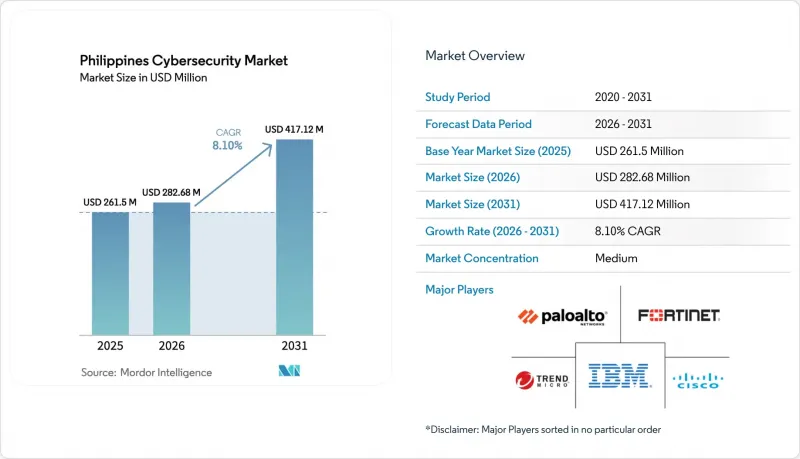
This report is Segmented by Offering (Solutions [Application Security, Cloud Security, and More], Services [Professional Services, and More]), Deployment Mode (Cloud, On-Premise), End-User Industry (BFSI, Healthcare, IT and Telecom, Industrial and Defense, Retail and E-Commerce, and More), End-User Enterprise Size (Large Enterprises, Smes). The Market Forecasts are Provided in Terms of Value (USD).
Philippines Cybersecurity Market Trends and Insights
National Cybersecurity Plan 2022-2028 funding boosts enterprise security procurement
The Philippine government's National Cybersecurity Plan 2023-2028 establishes workforce-development, policy, and critical-infrastructure milestones that accelerate private procurement cycles. Enterprises formerly hesitant to upgrade are now aligning projects with the plan's compliance checkpoints, redirecting capital from discretionary pilots to full production roll-outs. The clarity of mandated controls-rather than sheer budget volume-has become the primary catalyst for action, especially among government suppliers seeking contract eligibility. Early beneficiaries include domestic managed security service providers that deliver monitoring and incident response aligned to public-sector benchmarks. The plan's visibility also unlocks multilateral funding for cyber-capacity-building in rural jurisdictions.
Expansion of IT-BPM and BPO exports demanding compliance with global security frameworks
Global clients increasingly require SOC 2 and ISO 27001 attestation from Philippine outsourcing vendors, recasting cybersecurity as a revenue-gatekeeper instead of a back-office safeguard. Large BPOs have responded by embedding security operations centers into bid proposals and by allocating dedicated compliance squads to sustain audit readiness. Mid-tier providers follow suit to avoid losing high-value contracts, driving security investments beyond Manila into secondary hubs such as Cebu and Clark. This dynamic positions cybersecurity certifications as non-tariff trade barriers: without them, service providers struggle to penetrate regulated verticals like healthcare or financial services. Consequently, even cost-sensitive firms now budget for continuous monitoring and third-party risk management.
Shortage of GIAC/CISSP-certified talent inflating project lead-times
The Philippines has fewer than 300 GIAC or CISSP-certified cybersecurity professionals in active roles, compared with roughly 3,000 in Singapore, creating a sharp supply-demand gap that stalls complex implementation projects. Lengthy recruitment cycles push deployment timelines beyond planned windows, prompting some enterprises to shelve upgrades or down-scope feature sets to fit the available workforce. The scarcity also inflates salary premiums, raising total cost of ownership for on-premise solutions that require in-house administration. Domestic experts are frequently recruited by overseas employers offering higher pay, deepening the local deficit and eroding institutional knowledge. As a result, organizations pivot toward cloud security services and automation tools that reduce reliance on specialist talent while still meeting baseline compliance obligations.
Other drivers and restraints analyzed in the detailed report include:
- Rapid e-wallet and digital banking adoption accelerating threat-surface in BFSI
- 5G rollout and IoT pilots in smart cities raising critical-infrastructure protection spend
- Cyber-security budgets of Philippine SMEs remain below 2% of IT spend
For complete list of drivers and restraints, kindly check the Table Of Contents.
Segment Analysis
Solutions retained 50.65 % Philippines cybersecurity market share in 2025, but services are projected to outgrow them at a 9.45 % CAGR through 2031. Enterprises prefer external expertise to compensate for the country's pool of fewer than 300 certified specialists. Network and cloud security products remain foundational, while identity-and-access management gains board attention amid soaring account-takeover fraud. Professional services-especially consulting and advisory-see brisk demand as firms navigate overlapping mandates from the Department of Information and Communications Technology, the National Privacy Commission, and the central bank.
Managed security services record double-digit growth and absorb work once handled by in-house security operations centers. Integration projects often face delays because of limited engineering headcount, steering customers toward turnkey cloud-delivered platforms. Vendors differentiate by embedding automation, reducing reliance on scarce human analysts. The talent shortage therefore functions as both a restraint on do-it-yourself deployments and a growth lever for service revenue.
On-premise architectures led the market with 53.90 % share in 2025, yet cloud deployments are slated to expand at 10.95 % CAGR, the fastest among all modes. Banks, retailers, and government portals adopt cloud-native security to exploit elastic scaling and rapid patch cycles. This progression reframes cloud economics from cost minimization to risk mitigation: constantly updated controls trump capex savings. Hybrid blends appeal to conglomerates with legacy data centers, providing control over crown-jewel workloads while consuming SaaS analytics for broad visibility.
As nationwide talent shortages persist, many enterprises portray cloud security as a workaround that outsources labor-intensive maintenance to specialized providers. Compliance teams, once wary of offshore data residency, now leverage regionally hosted clouds that satisfy local sovereignty stipulations. Consequently, cloud adoption has matured into a strategic pillar, not a tactical stopgap.
Complete Report Scope:
- By Offering
- Solutions
- Application Security
- Cloud Security
- Data Security
- Identity and Access Management
- Infrastructure Protection
- Integrated Risk Management
- Network Security
- End-point Security
- Services
- Professional Services
- Managed Services
- Solutions
- By Deployment Mode
- Cloud
- On-Premise
- By End-user Industry
- BFSI
- Healthcare
- IT and Telecom
- Industrial and Defense
- Retail and E-commerce
- Energy and Utilities
- Manufacturing
- Others
- By End-user Enterprise Size
- Large Enterprises
- Small and Medium Enterprises (SMEs)
List of Companies Covered in this Report:
- Cisco Systems Inc.
- Fortinet Inc.
- Trend Micro Inc.
- Palo Alto Networks Inc.
- IBM Corporation
- Check Point Software Technologies Ltd.
- Kaspersky Lab
- Sophos Ltd.
- Dell Technologies Inc.
- Microsoft Corp. (Defender)
- Huawei Technologies Co. Ltd.
- RSA Security LLC
- Accenture PLC (MSSP)
- PLDT Enterprise (ePLDT Cybersecurity)
- Globe Telecom Inc. (Globe Business CyberSec)
- Dragonpay Corp. (Cyber-fraud solutions)
- MicroD International Inc. (MDI Novare)
- eSecure Networks Inc.
- Pointwest Technologies Corp.
- Netpoleon Philippines
Additional Benefits:
- The market estimate (ME) sheet in Excel format
- 3 months of analyst support
TABLE OF CONTENTS
1 INTRODUCTION
- 1.1 Market Definition and Study Assumptions
- 1.2 Scope of the Study
2 RESEARCH METHODOLOGY
3 EXECUTIVE SUMMARY
4 MARKET LANDSCAPE
- 4.1 Market Overview
- 4.2 Market Drivers
- 4.2.1 National Cybersecurity Plan 2022-2028 funding boosts enterprise security procurement
- 4.2.2 Expansion of IT-BPM and BPO exports demanding compliance with global security frameworks
- 4.2.3 Rapid e-wallet and digital banking adoption accelerating threat-surface in BFSI
- 4.2.4 5G rollout and IoT pilots in smart cities raising critical-infrastructure protection spend
- 4.2.5 Surge in ransomware attacks on healthcare and public agencies forcing incident-response investments
- 4.2.6 AI-led incident-response platforms
- 4.3 Market Restraints
- 4.3.1 Acute Shortage of Senior Security Architects Inflating Project Timelines and Costs
- 4.3.2 SME Budget Constraints Owing to Legacy CAPEX-heavy IT Footprints
- 4.3.3 Fragmented Cross-border Data-Sovereignty Rules Slowing Cloud Migrations
- 4.3.4 Low Multi-factor-Auth Adoption Outside BFSI Heightening Residual Risk
- 4.4 Value Chain Analysis
- 4.5 Evaluation of Critical Regulatory Framework
- 4.6 Impact Assessment of Key Stakeholders
- 4.7 Technological Outlook
- 4.8 Porter's Five Forces Analysis
- 4.8.1 Bargaining Power of Suppliers
- 4.8.2 Bargaining Power of Consumers
- 4.8.3 Threat of New Entrants
- 4.8.4 Threat of Substitutes
- 4.8.5 Intensity of Competitive Rivalry
- 4.9 Impact of Macro-economic Factors
5 MARKET SIZE AND GROWTH FORECASTS (VALUE)
- 5.1 By Offering
- 5.1.1 Solutions
- 5.1.1.1 Application Security
- 5.1.1.2 Cloud Security
- 5.1.1.3 Data Security
- 5.1.1.4 Identity and Access Management
- 5.1.1.5 Infrastructure Protection
- 5.1.1.6 Integrated Risk Management
- 5.1.1.7 Network Security
- 5.1.1.8 End-point Security
- 5.1.2 Services
- 5.1.2.1 Professional Services
- 5.1.2.2 Managed Services
- 5.1.1 Solutions
- 5.2 By Deployment Mode
- 5.2.1 Cloud
- 5.2.2 On-Premise
- 5.3 By End-user Industry
- 5.3.1 BFSI
- 5.3.2 Healthcare
- 5.3.3 IT and Telecom
- 5.3.4 Industrial and Defense
- 5.3.5 Retail and E-commerce
- 5.3.6 Energy and Utilities
- 5.3.7 Manufacturing
- 5.3.8 Others
- 5.4 By End-user Enterprise Size
- 5.4.1 Large Enterprises
- 5.4.2 Small and Medium Enterprises (SMEs)
6 COMPETITIVE LANDSCAPE
- 6.1 Market Concentration
- 6.2 Strategic Moves
- 6.3 Market Share Analysis
- 6.4 Company Profiles (includes Global level Overview, Market level overview, Core Segments, Financials as available, Strategic Information, Market Rank/Share for key companies, Products and Services, and Recent Developments)
- 6.4.1 Cisco Systems Inc.
- 6.4.2 Fortinet Inc.
- 6.4.3 Trend Micro Inc.
- 6.4.4 Palo Alto Networks Inc.
- 6.4.5 IBM Corporation
- 6.4.6 Check Point Software Technologies Ltd.
- 6.4.7 Kaspersky Lab
- 6.4.8 Sophos Ltd.
- 6.4.9 Dell Technologies Inc.
- 6.4.10 Microsoft Corp. (Defender)
- 6.4.11 Huawei Technologies Co. Ltd.
- 6.4.12 RSA Security LLC
- 6.4.13 Accenture PLC (MSSP)
- 6.4.14 PLDT Enterprise (ePLDT Cybersecurity)
- 6.4.15 Globe Telecom Inc. (Globe Business CyberSec)
- 6.4.16 Dragonpay Corp. (Cyber-fraud solutions)
- 6.4.17 MicroD International Inc. (MDI Novare)
- 6.4.18 eSecure Networks Inc.
- 6.4.19 Pointwest Technologies Corp.
- 6.4.20 Netpoleon Philippines
7 MARKET OPPORTUNITIES AND FUTURE TRENDS
- 7.1 White-space and Unmet-need Assessment

