PUBLISHER: Mordor Intelligence | PRODUCT CODE: 2117216

PUBLISHER: Mordor Intelligence | PRODUCT CODE: 2117216
Automotive TIC - Market Share Analysis, Industry Trends & Statistics, Growth Forecasts (2026 - 2031)
According to Mordor Intelligence, the automotive testing, inspection, and certification market size was valued at USD 20.31 billion in 2025 and estimated to grow from USD 21.28 billion in 2026 to reach USD 26.86 billion by 2031, at a CAGR of 4.78% during the forecast period (2026-2031).
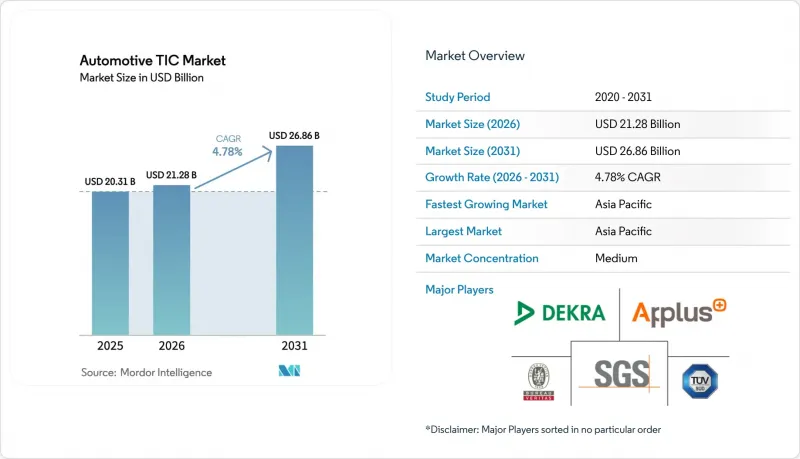
This report is Segmented by Service Type (Testing Services, Inspection Services, and Certification Services), Sourcing Type (In-House and Outsourced), and Geography (North America, South America, Europe, Asia-Pacific, and Middle East and Africa). The Market Forecasts are Provided in Terms of Value (USD).
Global Automotive TIC Market Trends and Insights
Stricter UNECE and ISO Safety Mandates
UNECE R155 and R156, mandatory for new vehicle types since July 2024, require demonstrable cybersecurity management throughout a vehicle's lifespan. SGS enlarged its portfolio to include ISO/SAE 21434 training and Common-Criteria evaluations across Germany, the Netherlands, and Singapore, enabling OEMs to meet these continuous-compliance expectations. ISO 24089 revisions published in 2024 added tougher automated-driving validation, forcing manufacturers to test sensor fusion, decision algorithms, and human-machine-interface (HMI) performance under a single audit umbrella. Semiconductor suppliers responded quickly; multiple chipmakers achieved ISO 26262 ASIL-D in 2024, proving functional-safety standards now permeate the full supply chain. As a result, providers that can deliver integrated hardware, software, and cybersecurity assessments are winning multi-year contracts tied to model-series refresh cycles.
Growing Outsourcing of Periodic Technical Inspection (PTI)
Governments increasingly delegate PTI activities to specialized firms to access advanced test benches and data analytics platforms without public-sector capital outlay. DEKRA secured 61% of inspection lines in Guadalajara, Mexico, showing how scale and reputation sway public tenders.New PTI scopes now cover brake-particle emissions, battery health, and even cybersecurity checks. Fragmented inspection intervals-some EU nations mandate 12-month cycles while others stretch to 48 months-create opportunities for providers adept at tailoring services to divergent rules. Digital inspection portals enabling real-time data transfer to regulators give large TIC firms an edge, reinforcing the outsourcing trajectory.
High Cost and Time-to-Market of Homologation
Divergent U.S. CARB, Euro 7, and Chinese GB standards force OEMs to run parallel validation cycles for identical subsystems. TUV NORD reports that multiplying rules for pollutant limits, battery durability, and driver-assist functions inflate homologation budgets and add months to launch schedules. Stellantis faced investigations over Opel models that triggered retesting and retrofit campaigns, highlighting reputational exposure when rules are misinterpreted.Small suppliers feel the pinch most; certification fees can exceed 10% of annual revenue for niche component makers. The push toward multi-energy platforms intensifies the burden because each propulsion type must satisfy distinct test matrices without cross-credit among regulators.
Other drivers and restraints analyzed in the detailed report include:
- Electrification Driving Battery and E-Powertrain Testing
- Connected-Car Cyber-Security Compliance
- Fragmented Country-Level PTI Regulations
For complete list of drivers and restraints, kindly check the Table Of Contents.
Segment Analysis
Testing held a 60.85% share of the automotive testing, inspection, and certification market in 2025, reflecting its indispensability for validating hardware durability, EMI resilience, and safety-critical software. Continued demand for full-vehicle crash tests, battery thermal-runaway chambers, and vehicle-in-the-loop (VIL) simulations anchors the segment's scale advantage. Certification, though smaller, is growing fastest at 5.12% CAGR because UNECE R155/R156 obligate OEMs to prove cybersecurity and software-update competence before any new model is registered. Each mandatory certificate unlocks downstream testing contracts for periodic audits and OTA re-approvals.
Digital-twin adoption is reshaping revenue composition. dSPACE's AURELION platform enables Mercedes-Benz to perform sensor-realistic driving scenario validation that regulators accept as equivalent to road miles. Such simulation reduces physical-prototype counts, but it does not diminish testing volume; instead, it shifts spend to high-performance computing clusters and data-validation services. Providers pairing track facilities with certified simulation suites secure multi-phase bookings covering concept, design, and homologation. The automotive testing, inspection, and certification market size tied to software-driven validation is set to widen as developers ask regulators to credit virtual kilometers toward compliance targets.
Complete Report Scope:
- By Service Type
- Testing Services
- Inspection Services
- Certification Services
- By Sourcing Type
- In-house
- Outsourced
- By Geography
- North America
- United States
- Canada
- Mexico
- South America
- Brazil
- Argentina
- Rest of South America
- Europe
- Germany
- United Kingdom
- France
- Italy
- Spain
- Rest of Europe
- Asia-Pacific
- China
- Japan
- India
- South Korea
- South-East Asia
- Rest of Asia-Pacific
- Middle East and Africa
- Middle East
- Saudi Arabia
- United Arab Emirates
- Turkey
- Rest of Middle East
- Africa
- South Africa
- Nigeria
- Rest of Africa
- Middle East
- North America
Geography Analysis
Asia-Pacific's 48.12% share in 2025 and 5.26% CAGR through 2031 confirm the region as the gravitational center of the automotive testing, inspection, and certification market. China's mandate for enhanced tyre and lighting standards, couples with the world's highest electric-vehicle adoption, is funneling battery-pack and EMC validation work to domestic TIC zones. India's NATRAX alliance with TUV SUD has cut lead times for ADAS and electromagnetic-compatibility tests, supporting the country's surge in compact SUV exports. Japan's advanced autonomous-drive pilots and South Korea's prominence in automotive semiconductors add layers of software and memory-device certification volume. Yet regulatory harmonization remains modest; labs must hold discrete accreditations for GB, AIS, and J-type standards, reinforcing multiyear project bookings for globally connected providers.
Europe sustains significant weight thanks to rule-making leadership. Euro 7 emissions ceilings and circular-economy directives keep demand robust for powertrain durability, battery recycling, and end-of-life dismantling audits. The region houses dense networks of TUV, SGS, and Bureau Veritas facilities that possess deep regulators' trust. Eastern European nations attract new lab investments as cost-effective alternatives to legacy Western European sites, while Brexit complications channel additional certification runs to continental labs. Continued refinement of UNECE and ISO standards ensures steady revenue even as light-vehicle sales stagnate.
North America concentrates on autonomous-vehicle and cybersecurity validations. DEKRA's USD 22.8 million Michigan expansion in 2024 added climatic chambers and 5G test bays to serve a pipeline of vehicle-software overhauls. U.S. federal and California CARB rules seldom align perfectly, so manufacturers rely on TIC firms to separate and manage dual-path programs. Mexico's rising role as a manufacturing hub generates cross-border testing demand, especially for NAFTA-compliant emissions and safety certifications. South America and the Middle East, and Africa show emerging, if uneven, promise. Brazil's PROCONVE L7 and L8 standards increase local powertrain testing needs, while Gulf countries invest in inspection centers tied to growing passenger-car fleets. Infrastructure gaps and technician shortages temper growth but also create first-mover advantages for global providers that partner with local governments.
- SGS SA
- Bureau Veritas SA
- DEKRA SE
- TUV SUD AG
- TUV Rheinland AG
- TUV Nord Group
- Intertek Group plc
- Applus Services S.A.
- UL Solutions Inc.
- ALS Limited
- Lloyd's Register Group Ltd.
- Kiwa N.V.
- Element Materials Technology Group
- Eurofins Scientific SE
- DNV AS
- RINA S.p.A.
- SOCOTEC Group SA
- Keysight Technologies Inc.
- CSA Group
- MISTRAS Group, Inc.
- MAHLE Powertrain Ltd.
- SAI Global Assurance
- NATRAX
- Cotecna Inspection SA
Additional Benefits:
- The market estimate (ME) sheet in Excel format
- 3 months of analyst support
TABLE OF CONTENTS
1 INTRODUCTION
- 1.1 Study Assumptions and Market Definition
- 1.2 Scope of the Study
2 RESEARCH METHODOLOGY
3 EXECUTIVE SUMMARY
4 MARKET LANDSCAPE
- 4.1 Market Overview
- 4.2 Market Drivers
- 4.2.1 Stricter UNECE and ISO Safety Mandates
- 4.2.2 Growing Outsourcing of Periodic Technical Inspection (PTI)
- 4.2.3 Electrification Driving Battery and E-Powertrain Testing
- 4.2.4 Connected-Car Cyber-Security Compliance
- 4.2.5 OTA Software-Update Validation Needs
- 4.2.6 Circular-Economy End-of-Life Certification
- 4.3 Market Restraints
- 4.3.1 High Cost and Time-to-Market of Homologation
- 4.3.2 Fragmented Country-Level PTI Regulations
- 4.3.3 Shortage of EV-Qualified Test Engineers
- 4.3.4 Ethical-AI Audit Gaps for Autonomous Systems
- 4.4 Industry Value Chain Analysis
- 4.5 Impact of Macroeconomic Factors
- 4.6 Regulatory Landscape
- 4.7 Technological Outlook
- 4.8 Porter's Five Forces Analysis
- 4.8.1 Threat of New Entrants
- 4.8.2 Bargaining Power of Suppliers
- 4.8.3 Bargaining Power of Buyers
- 4.8.4 Threat of Substitutes
- 4.8.5 Competitive Rivalry
5 MARKET SIZE AND GROWTH FORECASTS (VALUE)
- 5.1 By Service Type
- 5.1.1 Testing Services
- 5.1.2 Inspection Services
- 5.1.3 Certification Services
- 5.2 By Sourcing Type
- 5.2.1 In-house
- 5.2.2 Outsourced
- 5.3 By Geography
- 5.3.1 North America
- 5.3.1.1 United States
- 5.3.1.2 Canada
- 5.3.1.3 Mexico
- 5.3.2 South America
- 5.3.2.1 Brazil
- 5.3.2.2 Argentina
- 5.3.2.3 Rest of South America
- 5.3.3 Europe
- 5.3.3.1 Germany
- 5.3.3.2 United Kingdom
- 5.3.3.3 France
- 5.3.3.4 Italy
- 5.3.3.5 Spain
- 5.3.3.6 Rest of Europe
- 5.3.4 Asia-Pacific
- 5.3.4.1 China
- 5.3.4.2 Japan
- 5.3.4.3 India
- 5.3.4.4 South Korea
- 5.3.4.5 South-East Asia
- 5.3.4.6 Rest of Asia-Pacific
- 5.3.5 Middle East and Africa
- 5.3.5.1 Middle East
- 5.3.5.1.1 Saudi Arabia
- 5.3.5.1.2 United Arab Emirates
- 5.3.5.1.3 Turkey
- 5.3.5.1.4 Rest of Middle East
- 5.3.5.2 Africa
- 5.3.5.2.1 South Africa
- 5.3.5.2.2 Nigeria
- 5.3.5.2.3 Rest of Africa
- 5.3.5.1 Middle East
- 5.3.1 North America
6 COMPETITIVE LANDSCAPE
- 6.1 Market Concentration
- 6.2 Strategic Moves
- 6.3 Market Share Analysis
- 6.4 Company Profiles (includes Global level Overview, Market level overview, Core Segments, Financials as available, Strategic Information, Market Rank/Share for key companies, Products and Services, and Recent Developments)
- 6.4.1 SGS SA
- 6.4.2 Bureau Veritas SA
- 6.4.3 DEKRA SE
- 6.4.4 TUV SUD AG
- 6.4.5 TUV Rheinland AG
- 6.4.6 TUV Nord Group
- 6.4.7 Intertek Group plc
- 6.4.8 Applus Services S.A.
- 6.4.9 UL Solutions Inc.
- 6.4.10 ALS Limited
- 6.4.11 Lloyd's Register Group Ltd.
- 6.4.12 Kiwa N.V.
- 6.4.13 Element Materials Technology Group
- 6.4.14 Eurofins Scientific SE
- 6.4.15 DNV AS
- 6.4.16 RINA S.p.A.
- 6.4.17 SOCOTEC Group SA
- 6.4.18 Keysight Technologies Inc.
- 6.4.19 CSA Group
- 6.4.20 MISTRAS Group, Inc.
- 6.4.21 MAHLE Powertrain Ltd.
- 6.4.22 SAI Global Assurance
- 6.4.23 NATRAX
- 6.4.24 Cotecna Inspection SA
7 MARKET OPPORTUNITIES AND FUTURE OUTLOOK
- 7.1 White-space and Unmet-Need Assessment

