PUBLISHER: Mordor Intelligence | PRODUCT CODE: 2117366

PUBLISHER: Mordor Intelligence | PRODUCT CODE: 2117366
United States Heavy-Duty Truck - Market Share Analysis, Industry Trends & Statistics, Growth Forecasts (2026 - 2031)
According to Mordor Intelligence, the United States heavy-duty truck market size was valued at USD 51.56 billion in 2025 and is estimated to grow from USD 55.09 billion in 2026 to reach USD 76.73 billion by 2031, at a CAGR of 6.85% during the forecast period (2026-2031).
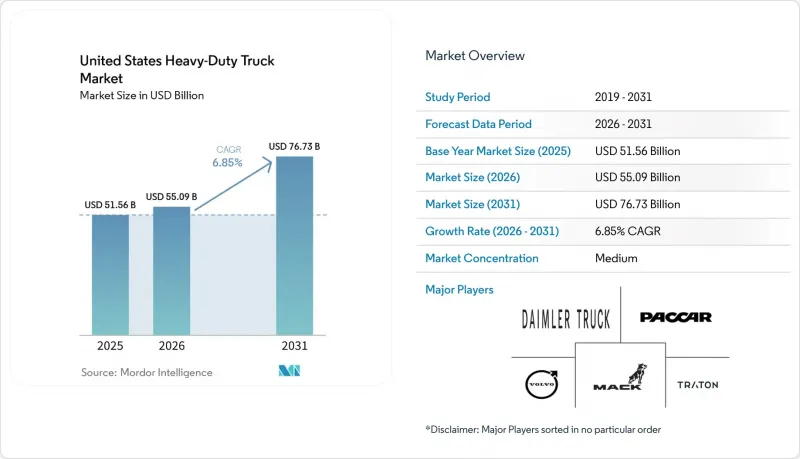
This report is Segmented by Gross Vehicle Weight Rating (Class 7, Class 8a, and More), Propulsion (Internal-Combustion Engine (ICE) and Electric), Axle Type (4x'2, 6x2, 6x4, and More), Truck Type (Rigid, Articulated, and Others), and Application (Construction and Mining, Freight and Logistics, and More). The Market Forecasts are Provided in Terms of Value (USD) and Volume (Units).
United States Heavy-Duty Truck Market Trends and Insights
Infrastructure Investment and IIJA Stimulus
Congress allocated significant funding for roads and bridges, as well as for zero-emission truck infrastructure. This funding is accelerating the replacement of weight-restricted spans and enabling higher-capacity configurations on rehabilitated corridors. Port authorities in Los Angeles, Savannah, and Houston matched these funds with local bonds, creating early demand clusters for battery-electric drayage tractors. Updated bridge-formula guidance now allows lighter tandems to carry increased payloads. This change is prompting fleets to downspec axles to save on fuel. State DOTs are accelerating pavement programs to obligate infrastructure dollars before deadlines, leading to a surge in concrete-mixer and dump-truck orders. However, Buy America rules have lengthened lead times for U.S.-assembled cabs and drivelines, causing some deliveries to shift to later timeframes.
E-Commerce-Driven Freight Tonnage Growth
Parcel and less-than-truckload tonnage grew, driven by retailers' efforts to position inventory closer to customers to uphold two-day delivery commitments. Amazon, with a large fleet of tractors, is transitioning a portion of its diesel linehaul to battery-electric Class 8 units. This move is pressuring competing carriers to experiment with similar zero-emission technologies. Both UPS and FedEx are leveraging telematics to minimize empty miles, thereby prolonging the lifespan of their current trucks and moderating the immediate need for replacements. Meanwhile, port drayage is experiencing a distinct surge. This is largely due to the California Advanced Clean Fleets mandate, which aims to accelerate significant adoption of zero-emission vehicles. This regulation is driving up orders for battery-electric and hydrogen trucks, even as congestion levels ease. Looking ahead, e-commerce is expected to create a substantial number of additional truck-driver roles. This anticipated shortfall is spurring heightened interest in autonomous and platooning technologies to maintain service standards.
Fleet Over-Capacity and High Inventory Levels
Lingering freight recession conditions have stretched to more than two years, pushing spot-rate indices below operating cost for many small carriers. Elevated used-truck volumes weigh on residual values, weakening equity available for trade-ins and delaying new-truck purchase decisions. The imbalance is particularly sharp in dry-van and refrigerated lanes where e-commerce volatility led to over-ordering in recent times. OEMs have responded by flexing build-rates and offering selective incentive programs targeted at large contract carriers. Although capacity discipline is gradually improving, near-term appetite for incremental equipment remains restrained until freight indices recover to profitable thresholds.
Other drivers and restraints analyzed in the detailed report include:
- Pre-Buying Ahead of EPA 2027 Standards
- Critical-Minerals Boom Increasing Heavy-Haul Demand
- Elevated Interest Rates Raising Financing Costs
For complete list of drivers and restraints, kindly check the Table Of Contents.
Segment Analysis
Class 8a tractors spanning 33,001-54,000 lb gross vehicle weight captured 47.17% of 2025 registrations, anchoring the United States heavy-duty truck market share because they balance payload capacity with interstate bridge-formula compliance. Trucks exceeding 80,000 lb are expanding at a 9.45% CAGR as lithium and rare-earth mining projects in Nevada, North Carolina, and Utah demand 8X6 and 8X8 drivetrains to haul battery-grade concentrate on unpaved haul roads. Class 8b units (54,001-80,000 lb) still serve long-haul freight but are ceding momentum to lighter 6X2 tandems that lower fuel burn on flat corridors. IIJA bridge-rehabilitation funds will permit higher axle weights on select corridors by 2028, letting fleets spec lighter frames without sacrificing legal payload.
Super-heavy growth remains hemmed in by fragmented oversize-overweight permits that force costly transloading at state borders and add 15-20% to logistics expense. Oshkosh and Mack have launched a reinforced chassis that withstands 120,000-lb gross weights, carving share from legacy vocational brands. Class 7 trucks (26,001-33,000 lb) benefit from predictable municipal routes, so battery-electric adoption is fastest in this class, where overnight depot charging eliminates range anxiety. The upshot is a bifurcated trajectory: while Class 8a volumes secure baseline scale for the United States heavy-duty truck market size, super-heavy rigs will set the pace for incremental revenue as the critical minerals cycle matures.
Diesel engines retained 91.12% of 2025 volume, underscoring their refueling speed, nationwide service network, and high energy density, while battery-electric units climbed 7.87% per year as the Tesla Semi began series production, coinciding with the activation of California's Advanced Clean Fleets rule. Battery-electric tractors now represent a small portion of the U.S. heavy-duty truck market, primarily in drayage and regional distribution, where daily mileage is typically limited. While hydrogen fuel-cell trucks hold a minimal market share, they've gained traction following DOE hub grants and Hyundai's deployment of XCIENT units in Northern California. Cummins' X15N natural-gas engine provides a diesel-free route to compliance for refuse and regional-haul carriers, especially those with existing CNG stations.
Due to the pre-buy wave, diesel assembly lines will remain busy for the near term. However, with cost premiums expected, late adopters are likely to pivot towards alternative fuels, especially once warranty data proves reliable. Hydrogen becomes increasingly appealing on routes where battery weight reduces payload, and grid connections can't keep up with charger demand. Hybrid and plug-in hybrid systems, currently holding a niche market share, face challenges: their added complexity diminishes payload without delivering equivalent fuel savings. Looking ahead, while diesel's market share will gradually decline, it's unlikely to plummet. This is due to varying total-cost-of-ownership calculations based on duty cycles, allowing fleets to maintain a diverse propulsion portfolio well into the future.
Complete Report Scope:
- By Gross Vehicle Weight Rating (GVWR)
- Class 7 (26,001 to 33,000 lb)
- Class 8a (33,001 to 54,000 lb)
- Class 8b (54,001 to 80,000 lb)
- Others (Over 80,000 lb)
- By Propulsion
- Internal-Combustion Engine (ICE)
- Diesel
- Natural Gas (CNG/LNG)
- Electric
- Battery-Electric (BEV)
- Hybrid and Plug-in Hybrid (HEV and PHEV)
- Fuel-Cell Electric (FCEV)
- Internal-Combustion Engine (ICE)
- By Axle Type
- 4x'2
- 6x2
- 6x4
- 6x6
- 8x6
- 8x8
- Others
- By Truck Type
- Rigid
- Articulated
- Others
- By Application
- Construction and Mining
- Freight and Logistics
- Long Haul
- Other
List of Companies Covered in this Report:
- Daimler Truck
- PACCAR Inc.
- Volvo Group
- Mack Trucks
- Traton Group
- Hino Motors
- Oshkosh Corporation
- Autocar
- Nikola Corporation
- Tesla Inc.
- Lion Electric
- BYD Motors
- Cummins Inc.
- Hyundai Motor (XCIENT)
- Isuzu Commercial Truck
- Volvo Autonomous Solutions
- Einride
Additional Benefits:
- The market estimate (ME) sheet in Excel format
- 3 months of analyst support
TABLE OF CONTENTS
1 Introduction
- 1.1 Study Assumptions and Market Definition
- 1.2 Scope of the Study
2 Research Methodology
3 Executive Summary
4 Market Landscape
- 4.1 Market Overview
- 4.2 Market Drivers
- 4.2.1 Infrastructure Investment and IIJA Stimulus
- 4.2.2 E-Commerce-Driven Freight Tonnage Growth
- 4.2.3 Pre-Buying Ahead of EPA 2027 Standards
- 4.2.4 Critical-Minerals Boom Increasing Heavy-Haul Demand
- 4.2.5 Hydrogen-Hub Funding Accelerating Early FCEV Uptake
- 4.2.6 Autonomous-Ready Drayage Demand at Ports
- 4.3 Market Restraints
- 4.3.1 Fleet Over-Capacity and High Inventory Levels
- 4.3.2 Elevated Interest Rates Raising Financing Costs
- 4.3.3 Utility-Grid Interconnection Delays for Megawatt Charging
- 4.3.4 Interstate Permit Fragmentation Above 80 K Lb GVW
- 4.4 Value / Supply-Chain Analysis
- 4.5 Regulatory Landscape
- 4.6 Technological Outlook
- 4.7 Porter's Five Forces Analysis
- 4.7.1 Bargaining Power of Suppliers
- 4.7.2 Bargaining Power of Buyers
- 4.7.3 Threat of New Entrants
- 4.7.4 Threat of Substitutes
- 4.7.5 Intensity of Competitive Rivalry
5 Market Size and Growth Forecasts (Value, Volume)
- 5.1 By Gross Vehicle Weight Rating (GVWR)
- 5.1.1 Class 7 (26,001 to 33,000 lb)
- 5.1.2 Class 8a (33,001 to 54,000 lb)
- 5.1.3 Class 8b (54,001 to 80,000 lb)
- 5.1.4 Others (Over 80,000 lb)
- 5.2 By Propulsion
- 5.2.1 Internal-Combustion Engine (ICE)
- 5.2.1.1 Diesel
- 5.2.1.2 Natural Gas (CNG/LNG)
- 5.2.2 Electric
- 5.2.2.1 Battery-Electric (BEV)
- 5.2.2.2 Hybrid and Plug-in Hybrid (HEV and PHEV)
- 5.2.2.3 Fuel-Cell Electric (FCEV)
- 5.2.1 Internal-Combustion Engine (ICE)
- 5.3 By Axle Type
- 5.3.1 4x'2
- 5.3.2 6x2
- 5.3.3 6x4
- 5.3.4 6x6
- 5.3.5 8x6
- 5.3.6 8x8
- 5.3.7 Others
- 5.4 By Truck Type
- 5.4.1 Rigid
- 5.4.2 Articulated
- 5.4.3 Others
- 5.5 By Application
- 5.5.1 Construction and Mining
- 5.5.2 Freight and Logistics
- 5.5.3 Long Haul
- 5.5.4 Other
6 Competitive Landscape
- 6.1 Market Concentration
- 6.2 Strategic Moves
- 6.3 Market Share Analysis
- 6.4 Company Profiles (Includes Global Level Overview, Market Level Overview, Core Segments, Financials as Available, Strategic Information, Market Rank/Share for Key Companies, Products and Services, SWOT Analysis, and Recent Developments)
- 6.4.1 Daimler Truck
- 6.4.2 PACCAR Inc.
- 6.4.3 Volvo Group
- 6.4.4 Mack Trucks
- 6.4.5 Traton Group
- 6.4.6 Hino Motors
- 6.4.7 Oshkosh Corporation
- 6.4.8 Autocar
- 6.4.9 Nikola Corporation
- 6.4.10 Tesla Inc.
- 6.4.11 Lion Electric
- 6.4.12 BYD Motors
- 6.4.13 Cummins Inc.
- 6.4.14 Hyundai Motor (XCIENT)
- 6.4.15 Isuzu Commercial Truck
- 6.4.16 Volvo Autonomous Solutions
- 6.4.17 Einride
7 Market Opportunities and Future Outlook
- 7.1 White-space and Unmet-Need Assessment

