PUBLISHER: Mordor Intelligence | PRODUCT CODE: 2117400

PUBLISHER: Mordor Intelligence | PRODUCT CODE: 2117400
Connected Helmet - Market Share Analysis, Industry Trends & Statistics, Growth Forecasts (2026 - 2031)
According to Mordor Intelligence, the connected helmet market size was valued at USD 0.94 billion in 2025 and is estimated at USD 1.11 billion in 2026, and is projected to reach USD 2.57 billion by 2031, growing at a CAGR of 18.26% over 2026-2031.
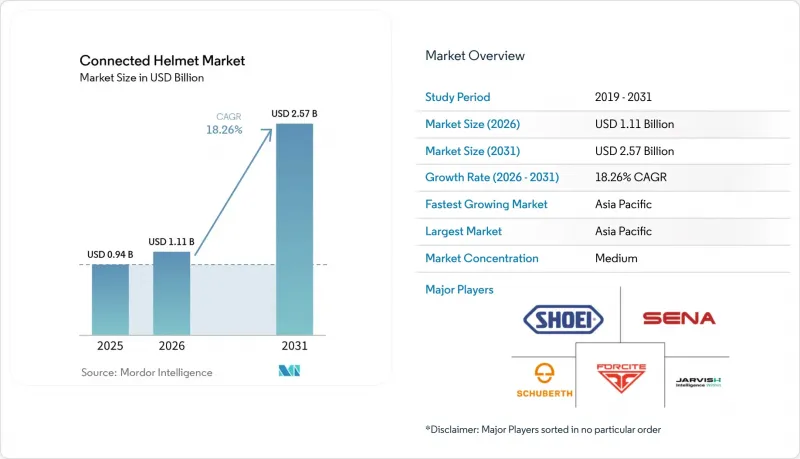
This report is Segmented by Product Type (Full-Face, Modular/Flip-up, and More), End-User (Rider (Individual), Passenger, and More), Distribution Channel (Offline (Specialty, Superstores) and Online (E-Commerce)), Connectivity Technology (Bluetooth-Only, Cellular/4G-LTE, and More), and Geography (North America, South America, and More). The Market Forecasts are Provided in Terms of Value (USD).
Global Connected Helmet Market Trends and Insights
Rapid 5G Rollout Enabling Low-latency V2X
A Valeo prototype demonstrated sub-millisecond V2X latency, showing that helmet-mounted antennas can meet ETSI TS 124 486 performance standards even without a direct line-of-sight to a base station. South Korea's extensive urban 5G SA coverage enabled a stable mesh network for a group of riders at highway speeds, a capability beyond the reach of Bluetooth technology. In China, C-V2X modules became mandatory for all new connected vehicles, with municipal subsidies now extending to two-wheeler fleets, driving demand across multiple cities. However, infrastructure coverage remains a critical factor for success; delays in rural areas of Africa and Latin America may concentrate growth opportunities within a limited period.
Mandatory E-call and Crash-notification Mandates
EN 16072 obliges automatic crash alert systems on powered two-wheelers sold in the EU, shifting connected helmets from optional accessories to regulatory requirements . In Japan, a fleet pilot reduced emergency response times and decreased severe injury hospitalizations within a short period. In India, a proposed regulation requiring two helmets per new motorcycle could significantly expand the addressable market for connected helmets, provided state-level enforcement is effective. However, implementation challenges in North America may limit the initial impact there.
High ASP versus Conventional Helmets
Sena's Specter was introduced at a premium price point, while uncertified modular alternatives are significantly more affordable. This price gap often causes riders to delay purchases until subsidies are available. Shoei's pricing reflects a focus on luxury rather than catering to the mass-market safety segment. In India, Studds' SMK connected helmet line is priced notably higher than entry-level helmets. This price difference continues to limit market penetration, even in the world's largest two-wheeler market.
Other drivers and restraints analyzed in the detailed report include:
- Integration of AR-HUDs for Real-time Navigation
- Growing Adoption of Motorcycle ADAS Platforms
- Limited Battery Life and Thermal Management
For complete list of drivers and restraints, kindly check the Table Of Contents.
Segment Analysis
Full-face units held 47.21% of the connected helmet market share in 2025. They remain the benchmark for safety and the reference platform for new connectivity layouts. The connected helmet market size for HUD-Integrated/AR designs is projected to expand at 19.22% CAGR as regulatory rules continue to favor maximum cranial coverage. AR-HUD models, though accounting for only a small share of volumes, are expected to grow significantly, driven by wafer-thin waveguides that now meet energy-absorption standards.
Moderate growth is observed in modular shells, which are increasingly favored by touring commuters. These helmets now feature factory-installed mesh radios, such as the Sena Specter. In contrast, open-face and half helmets remain primarily influenced by price and space limitations, resulting in modest adoption of connectivity features. Off-road helmet variants incorporate dust-proof modules that connect to adventure bike navigation consoles. This segment maintains a stable niche among rally and trail riders.
Individual riders comprised 68.32% of 2025 turnover, but price sensitivity caps premium uptake. Delivery fleets are scaling fastest, targeting an 18.98% CAGR, driven by evidence that a USD 500 helmet can cut insurance and downtime costs by multiples across a two-year refresh window.
Subsidy models invert buyer maths: insurers gift hardware to harvest data, and fleets absorb higher ASP in exchange for lower liability. Passenger helmets stay a small slice, as pillion mandates remain spotty. Fleet volume, however, seeds secondary demand when used helmets enter the private resale channel at discounted prices, nudging late adopters into the ecosystem.
Complete Report Scope:
- By Product Type
- Full-Face
- Modular/Flip-up
- Open-Face/Half
- Off-road/Adventure
- HUD-Integrated/AR
- By End-user
- Rider (Individual)
- Passenger
- Commercial Fleet and Delivery
- By Distribution Channel
- Offline (Specialty, Superstores)
- Online (E-commerce)
- By Connectivity Technology
- Bluetooth-Only
- Cellular/4G-LTE
- 5G and C-V2X
- By Geography
- North America
- United States
- Canada
- Rest of North America
- South America
- Brazil
- Argentina
- Colombia
- Rest of South America
- Europe
- Germany
- France
- Italy
- Spain
- United Kingdom
- Rest of Europe
- Asia-Pacific
- China
- India
- Japan
- South Korea
- Rest of Asia-Pacific
- Middle East and Africa
- Saudi Arabia
- United Arab Emirates
- South Africa
- Rest of Middle East and Africa
- North America
Geography Analysis
Asia-Pacific accounted for 47.26% of 2025 global revenue and is projected to maintain a 19.65% CAGR through 2031. China introduced a significant number of 4G helmets to delivery fleets across various cities, greatly reducing accidents in certain areas, with provincial subsidies supporting the initiative. If implemented, India's proposed twin-helmet regulation could significantly expand annual market opportunities. Meanwhile, 5G trials in major Japanese cities have improved emergency response times. South Korea's advanced 5G network sets the benchmark for open-road latency in helmet V2X technology.
Europe accounted for a significant share of sales, with regulations mandating cellular crash notifications in the near future. Germany, France, Italy, Spain, and the United Kingdom collectively account for a substantial portion of the regional volume. Capital inflows, such as recent equity investments, indicate a shift toward technology-integrated product launches.
North America accounted for a notable share of revenue, driven by the touring and recreational segments, which prioritize long-range communication systems. However, the lack of a federal e-call policy means adoption largely depends on insurer incentives. In South America, motorcycle-taxi riders are early adopters of telematics, while the Middle East's climate conditions are fostering research and development in cooling solutions. In Africa, the primary focus is on theft tracking rather than crash data, creating a niche market for GPS-focused units.
- Shoei Co. Ltd.
- Sena Technologies
- Schuberth GmbH
- Forcite Helmet Systems (GoPro, Inc.)
- Jarvish Inc.
- Dainese SpA
- HJC Europe S.A.R.L.
- LIVALL Tech Co. Ltd.
- CrossHelmet
- Bell Sports Inc.
- Studds Accessories Ltd.
- TORC Helmets
Additional Benefits:
- The market estimate (ME) sheet in Excel format
- 3 months of analyst support
TABLE OF CONTENTS
1 Introduction
- 1.1 Study Assumptions and Market Definition
- 1.2 Scope of the Study
2 Research Methodology
3 Executive Summary
4 Market Landscape
- 4.1 Market Overview
- 4.2 Market Drivers
- 4.2.1 Rapid 5G Rollout Enabling Low-Latency V2X
- 4.2.2 Mandatory E-Call and Crash-Notification Mandates
- 4.2.3 Integration of AR-HUDs for Real-Time Navigation
- 4.2.4 Growing Adoption of Motorcycle ADAS Platforms
- 4.2.5 Ride-Sharing and Delivery-Fleet Safety Programmes
- 4.2.6 Insur-Tech Telematics-Linked Premium Discounts
- 4.3 Market Restraints
- 4.3.1 High ASP Versus Conventional Helmets
- 4.3.2 Limited Battery Life and Thermal Management
- 4.3.3 Lack of Interoperability Standards
- 4.3.4 Data-Privacy and Cyber-Security Concerns
- 4.4 Value / Supply-Chain Analysis
- 4.5 Regulatory Landscape
- 4.6 Technological Outlook
- 4.7 Porter's Five Forces
- 4.7.1 Bargaining Power of Suppliers
- 4.7.2 Bargaining Power of Buyers
- 4.7.3 Threat of New Entrants
- 4.7.4 Threat of Substitutes
- 4.7.5 Competitive Rivalry
5 Market Size and Growth Forecasts (Value, USD)
- 5.1 By Product Type
- 5.1.1 Full-Face
- 5.1.2 Modular/Flip-up
- 5.1.3 Open-Face/Half
- 5.1.4 Off-road/Adventure
- 5.1.5 HUD-Integrated/AR
- 5.2 By End-user
- 5.2.1 Rider (Individual)
- 5.2.2 Passenger
- 5.2.3 Commercial Fleet and Delivery
- 5.3 By Distribution Channel
- 5.3.1 Offline (Specialty, Superstores)
- 5.3.2 Online (E-commerce)
- 5.4 By Connectivity Technology
- 5.4.1 Bluetooth-Only
- 5.4.2 Cellular/4G-LTE
- 5.4.3 5G and C-V2X
- 5.5 By Geography
- 5.5.1 North America
- 5.5.1.1 United States
- 5.5.1.2 Canada
- 5.5.1.3 Rest of North America
- 5.5.2 South America
- 5.5.2.1 Brazil
- 5.5.2.2 Argentina
- 5.5.2.3 Colombia
- 5.5.2.4 Rest of South America
- 5.5.3 Europe
- 5.5.3.1 Germany
- 5.5.3.2 France
- 5.5.3.3 Italy
- 5.5.3.4 Spain
- 5.5.3.5 United Kingdom
- 5.5.3.6 Rest of Europe
- 5.5.4 Asia-Pacific
- 5.5.4.1 China
- 5.5.4.2 India
- 5.5.4.3 Japan
- 5.5.4.4 South Korea
- 5.5.4.5 Rest of Asia-Pacific
- 5.5.5 Middle East and Africa
- 5.5.5.1 Saudi Arabia
- 5.5.5.2 United Arab Emirates
- 5.5.5.3 South Africa
- 5.5.5.4 Rest of Middle East and Africa
- 5.5.1 North America
6 Competitive Landscape
- 6.1 Market Concentration
- 6.2 Strategic Moves
- 6.3 Market Share Analysis
- 6.4 Company Profiles (includes Global Level Overview, Market Level Overview, Core Segments, Financials as Available, Strategic Information, Market Rank/Share for Key Companies, Products and Services, SWOT Analysis, and Recent Developments)
- 6.4.1 Shoei Co. Ltd.
- 6.4.2 Sena Technologies
- 6.4.3 Schuberth GmbH
- 6.4.4 Forcite Helmet Systems (GoPro, Inc.)
- 6.4.5 Jarvish Inc.
- 6.4.6 Dainese SpA
- 6.4.7 HJC Europe S.A.R.L.
- 6.4.8 LIVALL Tech Co. Ltd.
- 6.4.9 CrossHelmet
- 6.4.10 Bell Sports Inc.
- 6.4.11 Studds Accessories Ltd.
- 6.4.12 TORC Helmets
7 Market Opportunities & Future Outlook
- 7.1 White-space & Unmet-Need Assessment

