PUBLISHER: Mordor Intelligence | PRODUCT CODE: 2154281

PUBLISHER: Mordor Intelligence | PRODUCT CODE: 2154281
Japan Magnet Free Electric Axle System - Market Share Analysis, Industry Trends & Statistics, Growth Forecasts (2026 - 2031)
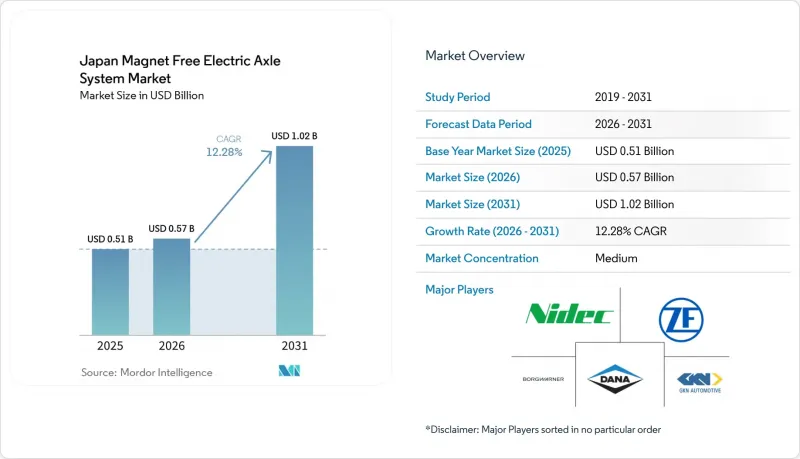
According to Mordor Intelligence, the Japan magnet free electric axle system market size was valued at USD 0.51 billion in 2025, and is projected to grow from USD 0.57 billion in 2026 to USD 1.02 billion by 2031, registering a 12.28% CAGR between 2026 and 2031.
Japan Magnet Free Electric Axle System Market Trends and Insights
OEM Shift to Rare-Earth Risk Mitigation After 2023 Nd Price Spike
In 2024, neodymium spot prices increased significantly due to China's export licensing rules introduced in 2023. This development pressured OEM margins and prompted Japanese suppliers to accelerate the adoption of non-magnet architectures. Both BluE Nexus and Nidec have announced plans to launch magnet-free platforms starting in 2027. Schaeffler's contactless-excited e-axle projects 8-12% cost savings above 150 kW, illustrating why OEMs are doubling down on alternative topologies .
Government Incentives for 100% xEV Sales by 2035
The April 2026 subsidy revision raised battery-electric caps to JPY 1.3 million, boosting purchase affordability in metropolitan prefectures . Simultaneously, fuel-cell incentives were trimmed, realigning policy toward plug-in architectures. Higher grants, coupled with increased subsidies for fast chargers, strengthened program certainty for suppliers in the Japan Magnet Free Electric Axle System market.
Slow Charging-Station Roll-Out Outside Tokai and Kanto Corridors
While Tokyo and Aichi benefit from a well-established network of fast chargers, rural areas continue to face significant infrastructure gaps. This disparity has created challenges for the adoption of Battery Electric Vehicles (BEVs), which in turn affects the demand for e-axle shipments. Although the Ministry of Land, Infrastructure, Transport and Tourism (MLIT) has increased subsidies for fast chargers in fiscal 2025, the economic feasibility of installing private chargers remains a barrier in regions such as Hokkaido, Shikoku, and Kyushu. The lack of sufficient charging infrastructure in these areas underscores the need for further policy and industry efforts to bridge the gap.
Other drivers and restraints analyzed in the detailed report include:
- Integration Synergies with SiC Inverters in 800 V Platforms
- Corporate-Average Fuel-Economy (CAFE) Tightening from 2028
- Higher Upfront Cost Premium Versus PM E-Axles Until Economies of Scale Achieved (Pre-2027)
For complete list of drivers and restraints, kindly check the Table Of Contents.
Segment Analysis
Switched reluctance motors (SRM) captured 41.25% of the Japan Magnet Free Electric Axle System market share in 2025, yet externally excited synchronous motors (EESM) are forecast for the quickest 13.55% CAGR as price parity with PM motors emerges above 120 kW. Below that threshold, the Japan Magnet Free Electric Axle System market size premium persists until SiC supply expansion drives inverter cost declines. Torque-dense 220-350 kW iBEE modules from Valeo-MAHLE are scheduled for 2027 series production, bringing premium-segment magnet-free options. Induction motors, although magnet-free, lag in power density and remain niche for high-power SUVs.
Integrating SRM with asymmetric converters significantly increases per-unit production costs. Over the years, advancements in EESM technology, particularly its contactless rotor excitation, have completely removed the dependency on magnets. This innovation has enabled field-weakening capabilities, expanded the constant-power speed range, and contributed to noticeable improvements in hybrid vehicle fuel efficiency.
Fully electric drives accounted for 64.11% of the Japan magnet-free electric axle system market in 2025 and are expected to register a CAGR of 16.74% during the forecast period. Policy developments, including the incentive increase implemented in April 2026, and the growing availability of urban fast-charging infrastructure, support this growth. These factors are accelerating the adoption of fully electric vehicles, positioning them as a preferred option for consumers seeking sustainable and efficient transportation. The expanding charging network is particularly important in reducing range anxiety and further encouraging the transition to electric mobility.
Hybrid and plug-in hybrid variants continue to maintain their appeal, especially among cost-conscious buyers. These variants benefit from shared e-axle modules, which help manufacturers optimize development costs. Additionally, the use of EESM technology, with its adjustable excitation, offers a broader load profile than PM motors. This feature enables plug-in hybrid electric vehicles to meet evolving regulatory standards, such as the new CAFE thresholds, without increasing dependency on rare-earth materials. Such advancements highlight the ongoing innovation in the hybrid and plug-in hybrid segment, ensuring their relevance in the evolving automotive landscape.
Complete Report Scope:
- By Motor Type
- Externally Excited Synchronous Motors (EESM)
- Induction Motors
- Switched Reluctance Motors
- By Drive Type
- Fully Electric Drive
- Hybrid Drive
- Plug-in Hybrid Drive
- By E-Axle Configuration
- Single E-Axle
- Dual E-Axle
- Integrated E-Axle
- By Vehicle Type
- Passenger Cars
- Hatchbacks
- Sedans
- Sport Utility Vehicles (SUVs)
- Multi-Purpose Vehicles (MPVs)
- Commercial Vehicles
- Light Commercial Vehicles
- Medium and Heavy Commercial Vehicles
- Buses and Coaches
- Passenger Cars
List of Companies Covered in this Report:
- Nidec Corporation
- Schaeffler AG
- ZF Friedrichshafen AG
- GKN Automotive
- Mitsubishi Electric Corporation
- Dana Inc.
- BorgWarner Inc.
- Toyota Motor Corporation
- Continental AG
- Mahle GmbH
- Valeo SA
Additional Benefits:
- The market estimate (ME) sheet in Excel format
- 3 months of analyst support
TABLE OF CONTENTS
1 Introduction
- 1.1 Study Assumptions & Market Definition
- 1.2 Scope of the Study
2 Research Methodology
3 Executive Summary
4 Market Landscape
- 4.1 Market Overview
- 4.2 Market Drivers
- 4.2.1 OEM Shift to Rare-Earth Risk Mitigation After 2023 Nd Price Spike
- 4.2.2 Government Incentives for 100% xEV Sales by 2035
- 4.2.3 Integration Synergies with SiC Inverters in 800 V Platforms
- 4.2.4 Corporate-Average Fuel-Economy (CAFE) Tightening from 2028
- 4.2.5 Green Innovation Fund-Backed Ramp-Up of Domestic SiC Module Capacity Enabling Cost-Competitive Magnet-Free E-Axles
- 4.2.6 Weight-Saving Benefits vs. Dual-Motor E-Drive Architectures
- 4.3 Market Restraints
- 4.3.1 Slow Charging-Station Roll-Out Outside Tokai and Kanto Corridors
- 4.3.2 Higher Upfront Cost Premium Versus PM E-Axles Until Economies of Scale Achieved (Pre-2027)
- 4.3.3 Lack of Local Tier-2 Supply Chain for Switched-Reluctance Power Electronics
- 4.3.4 Higher NVH Levels Versus PM E-Motors
- 4.4 Value / Supply-Chain Analysis
- 4.5 Regulatory Landscape
- 4.6 Technological Outlook
- 4.7 Porter's Five Forces Analysis
- 4.7.1 Threat of New Entrants
- 4.7.2 Bargaining Power of Suppliers
- 4.7.3 Bargaining Power of Buyers
- 4.7.4 Threat of Substitutes
- 4.7.5 Competitive Rivalry
5 Market Size & Growth Forecasts (Value, USD)
- 5.1 By Motor Type
- 5.1.1 Externally Excited Synchronous Motors (EESM)
- 5.1.2 Induction Motors
- 5.1.3 Switched Reluctance Motors
- 5.2 By Drive Type
- 5.2.1 Fully Electric Drive
- 5.2.2 Hybrid Drive
- 5.2.3 Plug-in Hybrid Drive
- 5.3 By E-Axle Configuration
- 5.3.1 Single E-Axle
- 5.3.2 Dual E-Axle
- 5.3.3 Integrated E-Axle
- 5.4 By Vehicle Type
- 5.4.1 Passenger Cars
- 5.4.1.1 Hatchbacks
- 5.4.1.2 Sedans
- 5.4.1.3 Sport Utility Vehicles (SUVs)
- 5.4.1.4 Multi-Purpose Vehicles (MPVs)
- 5.4.2 Commercial Vehicles
- 5.4.2.1 Light Commercial Vehicles
- 5.4.2.2 Medium and Heavy Commercial Vehicles
- 5.4.2.3 Buses and Coaches
- 5.4.1 Passenger Cars
6 Competitive Landscape
- 6.1 Market Concentration
- 6.2 Strategic Moves
- 6.3 Market Share Analysis
- 6.4 Company Profiles (Includes Global Level Overview, Market Level Overview, Core Segments, Financials as Available, Strategic Information, Market Rank/Share for Key Companies, Products and Services, SWOT Analysis, and Recent Developments)
- 6.4.1 Nidec Corporation
- 6.4.2 Schaeffler AG
- 6.4.3 ZF Friedrichshafen AG
- 6.4.4 GKN Automotive
- 6.4.5 Mitsubishi Electric Corporation
- 6.4.6 Dana Inc.
- 6.4.7 BorgWarner Inc.
- 6.4.8 Toyota Motor Corporation
- 6.4.9 Continental AG
- 6.4.10 Mahle GmbH
- 6.4.11 Valeo SA
7 Market Opportunities & Future Outlook
- 7.1 White-space & Unmet-Need Assessment

