PUBLISHER: Mordor Intelligence | PRODUCT CODE: 2117471

PUBLISHER: Mordor Intelligence | PRODUCT CODE: 2117471
Pharma and Medical Device Sterile Packaging Services - Market Share Analysis, Industry Trends & Statistics, Growth Forecasts (2025 - 2030)
According to Mordor Intelligence, the pharma and Medical Device Sterile Packaging Services market size reached USD 9.28 billion in 2025 and is projected to climb to USD 14.51 billion by 2030, advancing at a 9.35% CAGR.
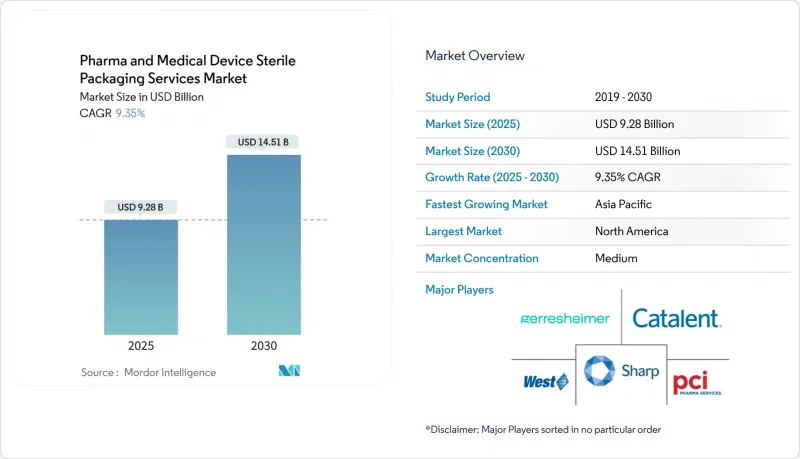
This report is Segmented by Service Type (Primary Packaging, Secondary Packaging, Clean-Room Contract Packaging, and More), Packaging Format (Pouches and Bags, Trays and Clamshells, and More), Sterilization Method (Ethylene Oxide, and More), End-Use Industry (Pharmaceutical Companies, and More), and Geography. The Market Forecasts are Provided in Terms of Value (USD).
Global Pharma and Medical Device Sterile Packaging Services Market Trends and Insights
Rapid Growth of Biologics and Cell-Gene Therapies
Explosive biologics pipelines and regulatory momentum behind advanced therapy medicinal products are reshaping the requirements for sterile packaging. Cell and gene therapies often ship at temperatures below -80 °C, compelling providers to validate cryogenic vials, bags, and overwraps that guard sterility throughout ultra-cold chains. Personalized doses require mini-batch fills, serialized labels, and chain-of-identity safeguards integrated into packaging workflows. Single-use, gamma-compatible polymer assemblies help producers cut cross-contamination risk during small runs. The Pharma and Medical Device Sterile Packaging Services Market, therefore, channels capital toward high-integrity stoppers, dual-chamber syringes, and tamper-evident formats. North America and Europe dominate early demand, but funding for local biologics plants in the Asia-Pacific is accelerating capability transfer.
Expansion of Contract Packaging Outsourcing Among Mid-Tier Pharma
Rising biologic complexity and multi-jurisdictional labeling rules are pushing mid-sized drug makers to outsource pharmaceutical contract packaging and sterile packaging operations to CDMOs. Maintaining GMP-compliant cleanrooms, conducting environmental monitoring, and providing ready-to-use components can strain internal budgets, making fee-for-service models more attractive. Recent acquisitions, including Novo Holdings' USD 16.5 billion Catalent deal, show how investors prize end-to-end packaging depth. CDMOs respond with modular fill-finish suites, online vision inspection, and site-wide serialization, enabling sponsors to launch regionally tailored packs more quickly. The Pharma and Medical Device Sterile Packaging Services Market thus benefits from predictable outsourcing pipelines as innovators focus capital on R&D rather than plant upkeep.
Limited EtO Capacity and Environmental Scrutiny
Only 88 EtO facilities operate in the United States, and utilization exceeds 90%. The Environmental Protection Agency's 2024 rule mandating 90% emission reductions forces multimillion-dollar upgrades, threatening shutdowns where retrofits prove uneconomic. Approximately 56% of critical medical devices still rely on EtO, leaving little room for error if even a handful of plants go offline. Packaging firms hedge by validating electron-beam and X-ray methods, but face multi-year material compatibility studies. Until proven alternatives scale, EtO bottlenecks can delay launches and inflate lead times across the Pharma and Medical Device Sterile Packaging Services Market.
Other drivers and restraints analyzed in the detailed report include:
- Stricter Global Sterility and Serialization Mandates
- Automation and Industry 4.0 Boosting Clean-Room Productivity
- High Validation and Compliance Costs for SMEs
For complete list of drivers and restraints, kindly check the Table Of Contents.
Segment Analysis
Primary packaging captured 46.78% of the Pharma and Medical Device Sterile Packaging Services market share in 2024, reflecting drug makers' priority on container closure integrity at the dose level. Integrated suppliers deliver ready-to-fill syringes, nested vials, and barrier-coated stoppers that pass Annex 1 visual quality thresholds. Sponsors rely on validated media fill runs and helium leak tests to secure global batch release, locking in long-term contracts that stabilize revenue streams. Clean-room contract packaging is poised to lead the field with an 11.86% CAGR as biologic pipelines expand and personalized therapies require agile batch sizes. CDMOs that combine fill-finish, sterile assembly, and post-sterilization labeling within modular isolators shorten technology transfer timelines for mid-tier companies.
Digital twins widen the productivity gap by simulating airflow, equipment cycles, and dwell times before physical validation. Service suites bundle lyophilization, visual inspection, and serialization, offering a one-stop path to global launch. Validation and testing add incremental revenue because sponsors outsource particulate count studies and accelerated aging on Tyvek overwraps. Secondary packaging remains vital for tamper-evidence and aggregation codes, albeit at lower gross margins, given the commoditization of carton erecting. The Pharma and Medical Device Sterile Packaging Services Market thus gravitates toward integrated partners that can deliver cradle-to-gate compliance.
Pouches and bags commanded a 38.41% share in 2024, anchored by Tyvek-based overwraps that withstand EtO cycles while ensuring microbial barrier. They remain go-to choices for surgical kits, drug-device combinations, and bulk catheter sets. Blister and strip packs are projected to post the fastest 10.95% CAGR to 2030 as oral oncology and highly potent tablets migrate to unit-dose regimens that aid adherence. Tight pocket tolerances guard dose integrity, and integrated QR codes promote traceability.
Rigid trays support procedure-ready bundles, but they face substitution from form-fill-seal rolls where transportation weight savings are a concern. Bottles still house bulk liquids and suspensions, yet are migrating toward recyclable cyclic olefin copolymer resins to fulfill sustainability pledges. Wraps and rolls serve niche autoclave applications where porous, medical-grade paper is sufficient. Innovations such as Tyvek with Renewable Attribution underscore the stakeholder push for verified, lower-carbon footprints. Material science, therefore, remains central as the Pharma and Medical Device Sterile Packaging Services Market meets eco standards without compromising sterility.
Complete Report Scope:
- By Service Type
- Primary Packaging
- Secondary Packaging
- Clean-room Contract Packaging
- Sterilization
- Validation and Testing Services
- By Packaging Format
- Pouches and Bags
- Trays and Clamshells
- Blister and Strip Packs
- Bottles and Containers
- Wraps and Rolls
- By Sterilization Method
- Ethylene Oxide (EtO)
- Gamma Irradiation
- Electron-Beam
- Steam and Autoclave
- Hydrogen Peroxide Vapor
- By End-use Industry
- Pharmaceutical Companies
- Biotechnology Companies
- CDMOs/CMOs/CROs
- Hospitals and Specialty Clinics
- Other End-use Industries
- By Geography
- North America
- United States
- Canada
- Mexico
- South America
- Brazil
- Argentina
- Chile
- Rest of South America
- Europe
- United Kingdom
- Germany
- France
- Italy
- Spain
- Russia
- Rest of Europe
- Asia-Pacific
- China
- India
- Japan
- South Korea
- Australia
- Rest of Asia-Pacific
- Middle East and Africa
- Middle East
- Saudi Arabia
- United Arab Emirates
- Turkey
- Rest of Middle East
- Africa
- South Africa
- Nigeria
- Rest of Africa
- Middle East
- North America
Geography Analysis
North America accounted for 37.56% of global revenue in 2024, driven by the United States' leadership in biologics R&D and stringent FDA oversight of container closure integrity. EtO utilization levels surpass 90%, and impending emission controls heighten the urgency for alternative capacity. Serialization deadlines under the Drug Supply Chain Security Act sustain demand for data-rich labeling and aggregation. Canada and Mexico contribute incremental growth through the production of generic injectables and the near-shoring of packaging runs.
Asia-Pacific is forecast to register an 11.31% CAGR, reflecting aggressive capacity additions and updated national GMP codes. China's 2025 sterile medicine rules elevate cleanroom standards, while India's revised Schedule M pushes local fillers to upgrade HVAC and monitoring. Southeast Asian members, including Malaysia, now require foreign GMP inspection certificates, which raises entry thresholds but harmonizes quality. Regional wage advantages attract multinational production; yet, sponsors still rely on Western CDMOs for first-in-human studies. Progressive harmonization with ICH guidelines is expected to sustain double-digit gains for the Pharma and Medical Device Sterile Packaging Services Market in the region.
Europe maintains steady momentum as the EU Falsified Medicines Directive standardizes serialization and tamper evidence. Germany and the United Kingdom innovate in sustainable materials, exemplified by the rollout of Tyvek with Renewable Attribution. PFAS restrictions shape resin choices, and the forthcoming Packaging and Packaging Waste Regulation tightens recycled-content mandates. Brexit continues to alter logistics flows, though mutual recognition of GMP inspections reduces friction. EtO emission rules mirror U.S. trends, prompting investments in X-ray and hydrogen peroxide lines, particularly in Ireland and Belgium. Together, these factors keep the continent a mature yet technologically progressive node within the Pharma and Medical Device Sterile Packaging Services Market.
- Catalent Pharma Solutions, Inc.
- West Pharmaceutical Services, Inc.
- Gerresheimer AG
- Packaging Coordinators, Inc.
- Sharp Services, LLC
- SCHOTT Pharma AG & Co. KGaA
- Vetter Pharma International GmbH
- Baxter BioPharma Solutions
- Syntegon Technology GmbH
- Jubilant HollisterStier LLC
- Curia Global, Inc.
- Grand River Aseptic Manufacturing, Inc.
- WuXi STA Pharmaceutical Co., Ltd.
- Samsung Biologics Co., Ltd.
- Ajinomoto Bio-Pharma Services
- Thermo Fisher Scientific Inc.
- Nipro PharmaPackaging International NV
- Unicep Packaging LLC
- Sanner GmbH
Additional Benefits:
- The market estimate (ME) sheet in Excel format
- 3 months of analyst support
TABLE OF CONTENTS
1 INTRODUCTION
- 1.1 Study Assumptions and Market Definition
- 1.2 Scope of the Study
2 RESEARCH METHODOLOGY
3 EXECUTIVE SUMMARY
4 MARKET LANDSCAPE
- 4.1 Market Overview
- 4.2 Market Drivers
- 4.2.1 Rapid Growth of Biologics and Cell-Gene Therapies
- 4.2.2 Expansion Of Contract Packaging Outsourcing Among Mid-Tier Pharma
- 4.2.3 Stricter Global Sterility and Serialization Mandates
- 4.2.4 Mini-Batch, Personalized-Medicine Demand for Flexible Sterile Fills
- 4.2.5 Automation And Industry 4.0 Boosting Clean-Room Productivity
- 4.2.6 Shift to Eco-Friendly Sterile Barrier Materials
- 4.3 Market Restraints
- 4.3.1 Limited Eto Capacity and Environmental Scrutiny
- 4.3.2 High Validation and Compliance Costs for SMEs
- 4.3.3 Volatile Polymer and Tyvek Input Prices
- 4.3.4 Supply-Chain Fragility for Gamma Irradiators
- 4.4 Industry Value Chain Analysis
- 4.5 Regulatory Landscape
- 4.6 Technological Outlook
- 4.7 Impact of Macroeconomic Factors
- 4.8 Porter's Five Forces Analysis
- 4.8.1 Threat of New Entrants
- 4.8.2 Bargaining Power of Suppliers
- 4.8.3 Bargaining Power of Buyers
- 4.8.4 Threat of Substitutes
- 4.8.5 Industry Rivalry
5 MARKET SIZE AND GROWTH FORECASTS (VALUE)
- 5.1 By Service Type
- 5.1.1 Primary Packaging
- 5.1.2 Secondary Packaging
- 5.1.3 Clean-room Contract Packaging
- 5.1.4 Sterilization
- 5.1.5 Validation and Testing Services
- 5.2 By Packaging Format
- 5.2.1 Pouches and Bags
- 5.2.2 Trays and Clamshells
- 5.2.3 Blister and Strip Packs
- 5.2.4 Bottles and Containers
- 5.2.5 Wraps and Rolls
- 5.3 By Sterilization Method
- 5.3.1 Ethylene Oxide (EtO)
- 5.3.2 Gamma Irradiation
- 5.3.3 Electron-Beam
- 5.3.4 Steam and Autoclave
- 5.3.5 Hydrogen Peroxide Vapor
- 5.4 By End-use Industry
- 5.4.1 Pharmaceutical Companies
- 5.4.2 Biotechnology Companies
- 5.4.3 CDMOs/CMOs/CROs
- 5.4.4 Hospitals and Specialty Clinics
- 5.4.5 Other End-use Industries
- 5.5 By Geography
- 5.5.1 North America
- 5.5.1.1 United States
- 5.5.1.2 Canada
- 5.5.1.3 Mexico
- 5.5.2 South America
- 5.5.2.1 Brazil
- 5.5.2.2 Argentina
- 5.5.2.3 Chile
- 5.5.2.4 Rest of South America
- 5.5.3 Europe
- 5.5.3.1 United Kingdom
- 5.5.3.2 Germany
- 5.5.3.3 France
- 5.5.3.4 Italy
- 5.5.3.5 Spain
- 5.5.3.6 Russia
- 5.5.3.7 Rest of Europe
- 5.5.4 Asia-Pacific
- 5.5.4.1 China
- 5.5.4.2 India
- 5.5.4.3 Japan
- 5.5.4.4 South Korea
- 5.5.4.5 Australia
- 5.5.4.6 Rest of Asia-Pacific
- 5.5.5 Middle East and Africa
- 5.5.5.1 Middle East
- 5.5.5.1.1 Saudi Arabia
- 5.5.5.1.2 United Arab Emirates
- 5.5.5.1.3 Turkey
- 5.5.5.1.4 Rest of Middle East
- 5.5.5.2 Africa
- 5.5.5.2.1 South Africa
- 5.5.5.2.2 Nigeria
- 5.5.5.2.3 Rest of Africa
- 5.5.5.1 Middle East
- 5.5.1 North America
6 COMPETITIVE LANDSCAPE
- 6.1 Market Concentration
- 6.2 Strategic Moves
- 6.3 Market Share Analysis
- 6.4 Company Profiles (includes Global level Overview, Market level overview, Core Segments, Financials as available, Strategic Information, Market Rank/Share for key companies, Products and Services, and Recent Developments)
- 6.4.1 Catalent Pharma Solutions, Inc.
- 6.4.2 West Pharmaceutical Services, Inc.
- 6.4.3 Gerresheimer AG
- 6.4.4 Packaging Coordinators, Inc.
- 6.4.5 Sharp Services, LLC
- 6.4.6 SCHOTT Pharma AG & Co. KGaA
- 6.4.7 Vetter Pharma International GmbH
- 6.4.8 Baxter BioPharma Solutions
- 6.4.9 Syntegon Technology GmbH
- 6.4.10 Jubilant HollisterStier LLC
- 6.4.11 Curia Global, Inc.
- 6.4.12 Grand River Aseptic Manufacturing, Inc.
- 6.4.13 WuXi STA Pharmaceutical Co., Ltd.
- 6.4.14 Samsung Biologics Co., Ltd.
- 6.4.15 Ajinomoto Bio-Pharma Services
- 6.4.16 Thermo Fisher Scientific Inc.
- 6.4.17 Nipro PharmaPackaging International NV
- 6.4.18 Unicep Packaging LLC
- 6.4.19 Sanner GmbH
7 MARKET OPPORTUNITIES AND FUTURE OUTLOOK
- 7.1 White-space and Unmet-need Assessment

