PUBLISHER: Mordor Intelligence | PRODUCT CODE: 2121861

PUBLISHER: Mordor Intelligence | PRODUCT CODE: 2121861
Contract Packaging - Market Share Analysis, Industry Trends & Statistics, Growth Forecasts (2026 - 2031)
According to Mordor Intelligence, contract packaging market size in 2026 is estimated at USD 86.16 billion, growing from 2025 value of USD 79.69 billion with 2031 projections showing USD 127.28 billion, growing at 8.12% CAGR over 2026-2031.
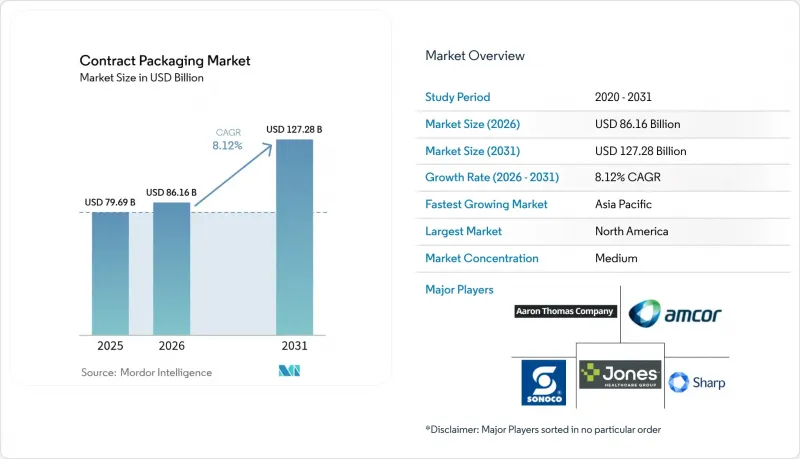
This report is Segmented by Material Type (Plastics, Paper and Paperboard, and More), Packaging Type (Primary, Secondary, and Tertiary), Service Type (Formulation and Blending, Filling and Assembly, and More), End-User Industry (Food, Beverage, Pharmaceutical, and More), and Geography (North America, South America, and More). The Market Forecasts are Provided in Terms of Value (USD).
Global Contract Packaging Market Trends and Insights
Outsourcing to Gain Competitive Advantage
Pharmaceutical manufacturers increasingly direct capital toward drug discovery while relying on pharmaceutical contract packaging providers for highly regulated packaging tasks. FDA guidance on combination products released in 2024 intensified validation, container-closure integrity, and documentation demands, encouraging biologics producers to outsource to specialists such as Catalent, which invested EUR 23 million (USD 27.13 million) in an automated clinical-supply line in Germany. European Medicines Agency rules for advanced therapy medicinal products heighten the complexity further, prompting contract packagers to shoulder compliance risk and technology refresh, shortening launch timelines for sponsors and freeing them from costly facility upgrades.
Explosive SKU Proliferation from E-commerce
Direct-to-consumer channels require shorter runs, frequent artwork variations, and protective designs tuned for parcel networks rather than palletized retail. Flexible manufacturing cells and digital job tickets allow contract packagers to execute more changeovers per shift without inflating set-up costs. Food brands exploit this agility for seasonal flavors and limited editions, while the same lines accommodate eco-friendly substrates that align with online retailers' emissions goals. Modern workflow software captures traceability data and routes it into enterprise resource planning systems, meeting audit requirements and reducing recall risk.
Stringent Cross-border Regulatory Compliance
Divergent FDA and European rules compel providers to duplicate validation protocols, label formats, and audit trails. PPWR design standards occasionally clash with U.S. food-contact thresholds, obliging dual inventory or reformulation. Smaller firms struggle to fund the necessary quality teams, enterprise resource planning modules, and serialization infrastructure, limiting their participation in global bids.
Other drivers and restraints analyzed in the detailed report include:
- Pharma Outsourcing for Novel Biologics Packaging
- Automation and Robotics Lowering Per-unit Cost
- Competition from In-house Packaging Lines
For complete list of drivers and restraints, kindly check the Table Of Contents.
Segment Analysis
Plastics retained 54.78% of revenue in 2025 thanks to entrenched supply chains, but recycled-content quotas and brand commitments accelerate a 9.12% CAGR for bio-based and composite materials. The shift calls for extrusion upgrades, compatibilizer know-how, and barrier coatings that preserve shelf life without multilayer laminates. Contract packaging market size allocations to plant-based polymers will expand as PPWR deadlines near, giving providers with formulary expertise a pricing premium.
Technical complexity widens competitive gaps. Providers with on-site laboratories conduct migration, seal-strength, and shelf-life tests swiftly, shortening approval cycles. Patent filings for biodegradable solutions rose 34% in 2024, underscoring rapid innovation and signaling that material leadership will be pivotal for margin defense.
Primary packaging accounted for 56.89% of 2025 revenue and is set for a 8.96% CAGR owing to stringent contact-surface validations required by the FDA and EMA. The contract packaging market share premium arises from container-closure integrity, extractables, and leachables testing, which smaller in-house teams often cannot execute economically.
Secondary packs face margin compression as corrugate and carton converting capacities rise globally, yet remain critical for tamper evidence, brand messaging, and serialization. Tertiary packs evolve with automation; robotic palletizers and warehouse robots drive ergonomic redesigns that improve cube utilization.
Complete Report Scope:
- By Material Type
- Plastics
- Paper and Paperboard
- Metal
- Glass
- Bio-based and Composites
- By Packaging Type
- Primary
- Secondary
- Tertiary
- By Service Type
- Formulation and Blending
- Filling and Assembly
- Packaging and Labeling
- Fulfillment and Logistics
- Other Service Types
- By End-User Industry
- Food
- Beverage
- Pharmaceutical
- Cosmetics and Personal Care
- Industrial
- Other End-user Industries
- By Geography
- North America
- United States
- Canada
- Mexico
- South America
- Brazil
- Argentina
- Chile
- Rest of South America
- Europe
- United Kingdom
- Germany
- France
- Spain
- Italy
- Rest of Europe
- Asia-Pacific
- China
- India
- Japan
- Australia
- South Korea
- Vietnam
- Rest of Asia-Pacific
- Middle East and Africa
- Middle East
- Saudi Arabia
- United Arab Emirates
- Turkey
- Rest of Middle East
- Africa
- South Africa
- Nigeria
- Egypt
- Rest of Africa
- Middle East
- North America
Geography Analysis
North America contributed 38.55% of 2025 sales, underpinned by mature pharmaceutical outsourcing and advanced automation adoption. The contract packaging market size in Asia-Pacific is accelerating at 11.03% CAGR, propelled by China's 8.7% packaging output growth and pro-manufacturing policies. India's vaccine output surge and Japan's reform of medical device approvals further lift regional demand.
Europe's growth centers on PPWR compliance, spurring investment in recyclable substrates and digital traceability infrastructure. South America and the Middle East and Africa represent long-horizon opportunities contingent on logistics upgrades and regulatory harmonization.
- Amcor plc
- Sonoco Products Company
- Aaron Thomas Company, Inc.
- Jones Healthcare Group Inc.
- Sharp Packaging Services LLC
- Pharma Tech Industries Inc.
- Reed-Lane Inc.
- Multipack Solutions LLC
- UNICEP Packaging LLC
- Stamar Packaging Inc.
- Budelpack Poortvliet BV
- Complete Co-Packing Services Ltd.
- Catalent Inc.
- PCI Pharma Services
- CCL Industries Inc.
- Smurfit WestRock
- Green Packaging Asia Ltd.
- Nulogy Corporation
- Graphic Packaging Holding Co.
- AptarGroup Inc.
- DHL Supply Chain (Co-Packing Division)
Additional Benefits:
- The market estimate (ME) sheet in Excel format
- 3 months of analyst support
TABLE OF CONTENTS
1 INTRODUCTION
- 1.1 Study Assumptions and Market Definition
- 1.2 Scope of the Study
2 RESEARCH METHODOLOGY
3 EXECUTIVE SUMMARY
4 MARKET LANDSCAPE
- 4.1 Market Overview
- 4.2 Market Drivers
- 4.2.1 Outsourcing to gain competitive advantage
- 4.2.2 Explosive SKU proliferation from e-commerce
- 4.2.3 Pharma outsourcing for novel biologics packaging
- 4.2.4 Automation and robotics lowering per-unit cost
- 4.2.5 Sustainability-led substrate shifts
- 4.2.6 Near-shoring to mitigate geopolitical risk
- 4.3 Market Restraints
- 4.3.1 Stringent cross-border regulatory compliance
- 4.3.2 Competition from in-house packaging lines
- 4.3.3 Volatile resin and energy prices
- 4.3.4 Mismatch between recycled-content goals and supply
- 4.4 Industry Value Chain Analysis
- 4.5 Regulatory Landscape
- 4.6 Technological Outlook
- 4.7 Porter's Five Forces Analysis
- 4.7.1 Bargaining Power of Suppliers
- 4.7.2 Bargaining Power of Buyers
- 4.7.3 Threat of New Entrants
- 4.7.4 Threat of Substitute Products
- 4.7.5 Intensity of Competitive Rivalry
- 4.8 The Impact of Macroeconomic Factors on the Market
5 MARKET SIZE AND GROWTH FORECASTS (Value)
- 5.1 By Material Type
- 5.1.1 Plastics
- 5.1.2 Paper and Paperboard
- 5.1.3 Metal
- 5.1.4 Glass
- 5.1.5 Bio-based and Composites
- 5.2 By Packaging Type
- 5.2.1 Primary
- 5.2.2 Secondary
- 5.2.3 Tertiary
- 5.3 By Service Type
- 5.3.1 Formulation and Blending
- 5.3.2 Filling and Assembly
- 5.3.3 Packaging and Labeling
- 5.3.4 Fulfillment and Logistics
- 5.3.5 Other Service Types
- 5.4 By End-User Industry
- 5.4.1 Food
- 5.4.2 Beverage
- 5.4.3 Pharmaceutical
- 5.4.4 Cosmetics and Personal Care
- 5.4.5 Industrial
- 5.4.6 Other End-user Industries
- 5.5 By Geography
- 5.5.1 North America
- 5.5.1.1 United States
- 5.5.1.2 Canada
- 5.5.1.3 Mexico
- 5.5.2 South America
- 5.5.2.1 Brazil
- 5.5.2.2 Argentina
- 5.5.2.3 Chile
- 5.5.2.4 Rest of South America
- 5.5.3 Europe
- 5.5.3.1 United Kingdom
- 5.5.3.2 Germany
- 5.5.3.3 France
- 5.5.3.4 Spain
- 5.5.3.5 Italy
- 5.5.3.6 Rest of Europe
- 5.5.4 Asia-Pacific
- 5.5.4.1 China
- 5.5.4.2 India
- 5.5.4.3 Japan
- 5.5.4.4 Australia
- 5.5.4.5 South Korea
- 5.5.4.6 Vietnam
- 5.5.4.7 Rest of Asia-Pacific
- 5.5.5 Middle East and Africa
- 5.5.5.1 Middle East
- 5.5.5.1.1 Saudi Arabia
- 5.5.5.1.2 United Arab Emirates
- 5.5.5.1.3 Turkey
- 5.5.5.1.4 Rest of Middle East
- 5.5.5.2 Africa
- 5.5.5.2.1 South Africa
- 5.5.5.2.2 Nigeria
- 5.5.5.2.3 Egypt
- 5.5.5.2.4 Rest of Africa
- 5.5.5.1 Middle East
- 5.5.1 North America
6 COMPETITIVE LANDSCAPE
- 6.1 Market Concentration
- 6.2 Strategic Moves
- 6.3 Market Share Analysis
- 6.4 Company Profiles (includes Global Level Overview, Market Level Overview, Core Segments, Financials as available, Strategic Information, Market Rank/Share, Products and Services, and Recent Developments)
- 6.4.1 Amcor plc
- 6.4.2 Sonoco Products Company
- 6.4.3 Aaron Thomas Company, Inc.
- 6.4.4 Jones Healthcare Group Inc.
- 6.4.5 Sharp Packaging Services LLC
- 6.4.6 Pharma Tech Industries Inc.
- 6.4.7 Reed-Lane Inc.
- 6.4.8 Multipack Solutions LLC
- 6.4.9 UNICEP Packaging LLC
- 6.4.10 Stamar Packaging Inc.
- 6.4.11 Budelpack Poortvliet BV
- 6.4.12 Complete Co-Packing Services Ltd.
- 6.4.13 Catalent Inc.
- 6.4.14 PCI Pharma Services
- 6.4.15 CCL Industries Inc.
- 6.4.16 Smurfit WestRock
- 6.4.17 Green Packaging Asia Ltd.
- 6.4.18 Nulogy Corporation
- 6.4.19 Graphic Packaging Holding Co.
- 6.4.20 AptarGroup Inc.
- 6.4.21 DHL Supply Chain (Co-Packing Division)
7 MARKET OPPORTUNITIES AND FUTURE OUTLOOK
- 7.1 White-space and Unmet-need Assessment

