PUBLISHER: Mordor Intelligence | PRODUCT CODE: 2118039

PUBLISHER: Mordor Intelligence | PRODUCT CODE: 2118039
AI-Powered Sleep Technologies - Market Share Analysis, Industry Trends & Statistics, Growth Forecasts (2026 - 2031)
According to Mordor Intelligence, the AI-powered sleep technologies market is expected to grow from USD 5.92 billion in 2025 to USD 6.91 billion in 2026 and is forecasted to reach USD 17.46 billion by 2031 at 20.35% CAGR over 2026-2031.
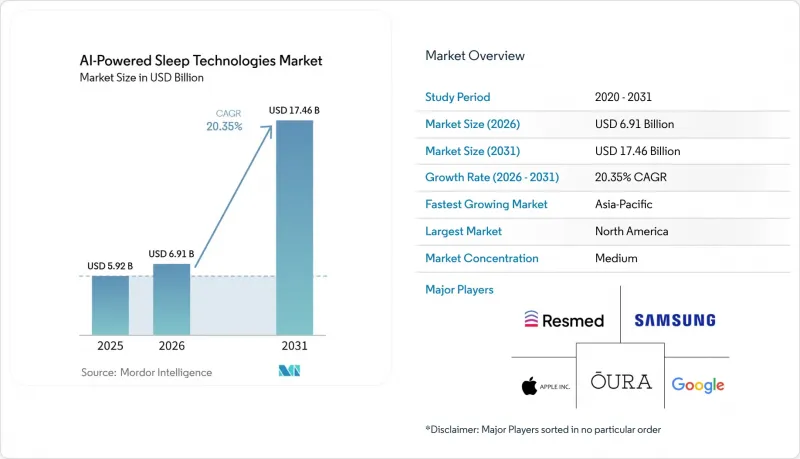
This report is Segmented by Product Type (AI-Enabled Sleep Trackers, and More), Technology (Machine Learning and Sensor Fusion, and More), Application (Sleep Monitoring and Scoring, and More), End-User (Home Care Settings, Hospitals, and More), and Geography (North America, Europe, Asia-Pacific, Middle East and Africa, South America). The Market Forecasts are Provided in Terms of Value (USD).
Global AI-Powered Sleep Technologies Market Trends and Insights
Rising Demand for Personalized Sleep Optimization
The AI-powered sleep technologies market is gaining from a clear shift in user expectations toward individualized guidance rather than static score reporting. Users increasingly want recommendations that reflect their physiology, daily behavior, and multi-week sleep patterns instead of generic sleep hygiene prompts. Devices and platforms that combine sleep staging, heart rate variability, skin temperature, and recovery signals are making that personalization more practical in daily use. Eight Sleep stated that its Autopilot platform makes millions of nightly biometric adjustments per user, and the company is extending that model with an AI Sleep Agent designed to simulate and optimize recovery outcomes. In the AI-powered sleep technologies market, this moves competitive value toward platforms that can maintain longer user engagement through adaptive coaching and measurable outcomes.
Shift From Passive Monitoring to Closed-Loop Sleep Intervention
The AI-powered sleep technologies market is no longer centered only on collecting overnight data and presenting it the next morning. Closed-loop systems are starting to detect physiological changes during sleep and respond with direct environmental or therapeutic adjustments. This matters because intervention creates a more durable value proposition than passive monitoring alone, especially when the system can respond during the sleep window instead of after it. Eight Sleep linked its real-time biometric analysis to automated temperature changes and expanded its roadmap toward AI-led sleep apnea and menopausal sleep applications. As a result, the AI-powered sleep technologies market is steadily shifting from sensor ownership toward intervention quality and algorithm responsiveness.
Consumer Trust Gaps Around Algorithmic Sleep Scoring
The AI-powered sleep technologies market still faces a trust problem because many scoring systems remain proprietary and difficult for clinicians to interpret. A 2025 study in Scientific Reports found that clinical adoption remains limited when clinicians cannot adequately assess algorithmic bias and decision opacity. Those concerns become more serious when scoring quality may vary across skin tone, BMI, and comorbidity subgroups. A 2026 review in Sleep and Breathing outlined an explainable AI framework for sleep-disordered breathing diagnostics, but also noted that the trade-off between interpretability and accuracy remains unresolved at the clinical scale. Until clinicians gain clearer visibility into how algorithms reach outputs, the AI-powered sleep technologies market will keep facing slower uptake in higher-acuity care settings.
Other drivers and restraints analyzed in the detailed report include:
- Growth of At-Home Sleep Diagnostics and Remote Monitoring
- Sleep Data Interoperability with Digital Health Ecosystems
- Fragmented Clinical Validation Standards Across Device Classes
For complete list of drivers and restraints, kindly check the Table Of Contents.
Segment Analysis
AI-enabled sleep trackers held 42.83% of the AI-powered sleep technologies market share in 2025, while sleep apps and digital sleep platforms are projected to grow at 20.63% through 2031. The leading position of trackers reflects the maturity of wrist-worn wearables, rings, and under-mattress sensing formats that already fit into daily routines with limited friction. These devices remain the main front door into the AI-powered sleep technologies market because they combine broad reach, recurring data capture, and a clear consumer wellness use case.
Software-led products are gaining ground because the economics of digital delivery are more attractive than hardware-only expansion. A 2025 meta-analysis in npj Digital Medicine confirmed the efficacy of fully automated digital cognitive behavioral therapy for insomnia, which supports wider institutional confidence in app-based care. That evidence helps explain why the AI-powered sleep technologies market is gradually shifting toward products that can monetize long-term engagement through subscriptions, clinical programs, and data-enabled coaching.
Machine learning and sensor fusion held 38.57% of revenue in 2025, while AI-guided behavioral therapy is expected to grow at 21.84% through 2031. Sensor fusion remains central to the AI-powered sleep technologies market because mainstream sleep devices still rely on photoplethysmography, accelerometry, and related multi-signal processing to convert raw physiological inputs into usable overnight profiles. That technical base is now well established across wearables and home monitoring tools, which helps explain its current revenue leadership.
Radar, audio, and thermal approaches fit well with that goal because they can monitor without adding a device to the body. Cloud and edge AI integration supports all of these modalities by balancing lower-latency processing with continuous model updates across larger data sets. In the AI-powered sleep technologies market, that creates a broader technology race where value depends less on any single sensor and more on how effectively signals are combined, interpreted, and translated into action.
Complete Report Scope:
- By Product Type
- AI-Enabled Sleep Trackers
- AI-Integrated Sleep Environment Devices
- AI-Driven Sleep Therapeutics and Interventions
- Sleep Apps and Digital Sleep Platforms
- By Technology
- Machine Learning and Sensor Fusion
- Radar, Audio, and Thermal Sensing
- AI-Guided Behavioral Therapy
- Cloud and Edge AI Integration
- By Application
- Sleep Monitoring and Scoring
- Sleep Apnea and Snoring Detection
- Sleep Optimization and Coaching
- Digital Sleep Therapy
- By End-User
- Home Care Settings
- Hospitals
- Sleep Clinics and Centers
- Corporate Wellness and Research Programs
- By Geography
- North America
- United States
- Canada
- Mexico
- Europe
- Germany
- United Kingdom
- France
- Italy
- Spain
- Rest of Europe
- Asia-Pacific
- China
- Japan
- India
- Australia
- South Korea
- Rest of Asia-Pacific
- Middle East and Africa
- GCC
- South Africa
- Rest of Middle East and Africa
- South America
- Brazil
- Argentina
- Rest of South America
- North America
Geography Analysis
North America held 41.28% of the AI-powered sleep technologies market share in 2025. The region leads because it combines a high burden of diagnosed and undiagnosed sleep disorders with strong clinical infrastructure and a more active regulatory path for AI-enabled sleep tools. Respiratory Medicine estimated 83.7 million U.S. adults had obstructive sleep apnea in 2024, which gives the region a very large screening and management base.
Europe remains important to the AI-powered sleep technologies market because adoption is increasingly tied to clinical validation and data governance. The region has strong provider infrastructure, but products that want a clinical role face a higher burden around evidence quality, interoperability, and privacy-ready data handling. The technical path is improving, as Frontiers in Digital Health documented GDPR-compliant HL7 FHIR integration of Garmin wearable sleep data into a standardized repository, which supports more practical clinical use of consumer-generated information. This means the European AI-powered sleep technologies market is likely to favor companies that can translate consumer-grade monitoring into compliant clinical workflows.
Asia-Pacific is projected to be the fastest-growing region in the AI-powered sleep technologies market, with a projected CAGR of 23.86% through 2031. China is supporting the category through policy direction, as national planning and healthy living initiatives now give sleep health a clearer place inside broader prevention and brain science priorities. These signals matter because they strengthen both consumer demand and institutional acceptance across the region. Middle East and Africa, especially the GCC, and parts of South America, remain earlier-stage opportunities where premium products are entering through global wearable ecosystems first. In those markets, the AI-powered sleep technologies market is likely to expand more gradually until pricing, reimbursement, and care infrastructure become more supportive.
- Apollo Neuroscience, Inc.
- Apple
- Awake Labs Inc.
- Compumedics
- Eight Sleep, Inc.
- Emfit Ltd.
- Fitbit, LLC
- Garmin
- Google LLC
- Huawei Technologies
- Masimo
- Oura Health Oy
- Philips N.V.
- Resmed
- Samsung Group
- Sleep Number Corporation
- SleepScore Labs, Inc.
- Somnox B.V.
- Withings
- Xiaomi Corporation
Additional Benefits:
- The market estimate (ME) sheet in Excel format
- 3 months of analyst support
TABLE OF CONTENTS
1 Introduction
- 1.1 Study Assumptions and Market Definition
- 1.2 Scope of the Study
2 Research Methodology
3 Executive Summary
4 Market Landscape
- 4.1 Market Overview
- 4.2 Market Drivers
- 4.2.1 Rising Demand for Personalized Sleep Optimization
- 4.2.2 Shift From Passive Monitoring to Closed-Loop Sleep Intervention
- 4.2.3 Growth of At-Home Sleep Diagnostics and Remote Monitoring
- 4.2.4 Sleep Data Interoperability with Digital Health Ecosystems
- 4.2.5 Reimbursement Pathways for AI-Assisted Sleep Screening
- 4.2.6 Increasing Prevalence of Sleep Disorders and Associated Chronic Diseases
- 4.3 Market Restraints
- 4.3.1 Consumer Trust Gaps Around Algorithmic Sleep Scoring
- 4.3.2 Fragmented Clinical Validation Standards Across Device Classes
- 4.3.3 Data Privacy Constraints for Overnight Biometric Monitoring
- 4.3.4 High Cost of Advanced AI-Enabled Sleep Monitoring Devices and Platforms
- 4.4 Supply/Value Chain Analysis
- 4.5 Regulatory Landscape
- 4.6 Technological Outlook
- 4.7 Porter's Five Forces Analysis
- 4.7.1 Threat of New Entrants
- 4.7.2 Bargaining Power of Suppliers
- 4.7.3 Bargaining Power of Buyers
- 4.7.4 Threat of Substitutes
- 4.7.5 Competitive Rivalry
5 Market Size & Growth Forecasts (Value, USD)
- 5.1 By Product Type
- 5.1.1 AI-Enabled Sleep Trackers
- 5.1.2 AI-Integrated Sleep Environment Devices
- 5.1.3 AI-Driven Sleep Therapeutics and Interventions
- 5.1.4 Sleep Apps and Digital Sleep Platforms
- 5.2 By Technology
- 5.2.1 Machine Learning and Sensor Fusion
- 5.2.2 Radar, Audio, and Thermal Sensing
- 5.2.3 AI-Guided Behavioral Therapy
- 5.2.4 Cloud and Edge AI Integration
- 5.3 By Application
- 5.3.1 Sleep Monitoring and Scoring
- 5.3.2 Sleep Apnea and Snoring Detection
- 5.3.3 Sleep Optimization and Coaching
- 5.3.4 Digital Sleep Therapy
- 5.4 By End-User
- 5.4.1 Home Care Settings
- 5.4.2 Hospitals
- 5.4.3 Sleep Clinics and Centers
- 5.4.4 Corporate Wellness and Research Programs
- 5.5 By Geography
- 5.5.1 North America
- 5.5.1.1 United States
- 5.5.1.2 Canada
- 5.5.1.3 Mexico
- 5.5.2 Europe
- 5.5.2.1 Germany
- 5.5.2.2 United Kingdom
- 5.5.2.3 France
- 5.5.2.4 Italy
- 5.5.2.5 Spain
- 5.5.2.6 Rest of Europe
- 5.5.3 Asia-Pacific
- 5.5.3.1 China
- 5.5.3.2 Japan
- 5.5.3.3 India
- 5.5.3.4 Australia
- 5.5.3.5 South Korea
- 5.5.3.6 Rest of Asia-Pacific
- 5.5.4 Middle East and Africa
- 5.5.4.1 GCC
- 5.5.4.2 South Africa
- 5.5.4.3 Rest of Middle East and Africa
- 5.5.5 South America
- 5.5.5.1 Brazil
- 5.5.5.2 Argentina
- 5.5.5.3 Rest of South America
- 5.5.1 North America
6 Competitive Landscape
- 6.1 Market Concentration
- 6.2 Market Share Analysis
- 6.3 Company Profiles (includes Global level Overview, Market level overview, Core Segments, Financials as available, Strategic Information, Market Rank/Share for key companies, Products & Services, Recent Developments)
- 6.3.1 Apollo Neuroscience, Inc.
- 6.3.2 Apple Inc.
- 6.3.3 Awake Labs Inc.
- 6.3.4 Compumedics Limited
- 6.3.5 Eight Sleep, Inc.
- 6.3.6 Emfit Ltd.
- 6.3.7 Fitbit, LLC
- 6.3.8 Garmin Ltd.
- 6.3.9 Google LLC
- 6.3.10 Huawei Technologies Co., Ltd.
- 6.3.11 Masimo Corporation
- 6.3.12 Oura Health Oy
- 6.3.13 Philips N.V.
- 6.3.14 ResMed Inc.
- 6.3.15 Samsung Electronics Co., Ltd.
- 6.3.16 Sleep Number Corporation
- 6.3.17 SleepScore Labs, Inc.
- 6.3.18 Somnox B.V.
- 6.3.19 Withings
- 6.3.20 Xiaomi Corporation
7 Market Opportunities & Future Outlook
- 7.1 White-space & Unmet-need Assessment

