PUBLISHER: Mordor Intelligence | PRODUCT CODE: 2100609

PUBLISHER: Mordor Intelligence | PRODUCT CODE: 2100609
AI Software In Legal Industry - Market Share Analysis, Industry Trends & Statistics, Growth Forecasts (2026 - 2031)
According to Mordor Intelligence, the AI software market size in legal industry market size in 2026 is estimated at USD 2.67 billion, growing from 2025 value of USD 2.42 billion with 2031 projections showing USD 4.42 billion, growing at 10.53% CAGR over 2026-2031.
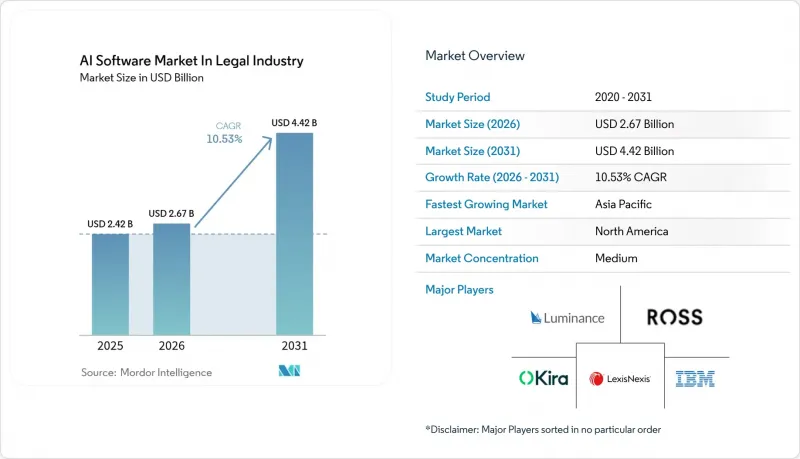
This report is Segmented by Component (Solutions and Services), Deployment (On-Premises and Cloud), Application (Legal Research, Contract Review and Management, and More), End-User (Law Firms, Corporate Legal Departments, and More), and Geography. The Market Forecasts are Provided in Terms of Value (USD).
Insights and Trends of AI Software Market In Legal Industry
Growing Demand for Automation Amid Rising Litigation Volume
Litigation teams now sift through unprecedented data, prompting e-discovery suites that remove up to 85% of documents from review and cut cycle times by half.Automation also shortens drafting; systems condense hours of brief preparation into minutes, slicing costs by 80%. Courts embracing AI-friendly rules, such as New South Wales' procedural update, further legitimize these tools, pushing global legal departments to scale automation without proportional headcount increases.
Increasing Adoption of AI-Assisted Legal-Research Tools
Generative engines pull live case law across jurisdictions, returning vetted precedents in minutes. Law schools now embed AI coursework, exemplified by Singapore Management University's blended curriculum, producing graduates fluent in AI-enhanced research. This generational shift accelerates firm-wide adoption and embeds research automation into everyday practice.
Data-Privacy and Confidentiality Concerns
Formal Opinion 512 obliges U.S. attorneys to vet vendor safeguards before exposing privileged data. Parallel EU mandates restrict cross-border data flows, and recent litigation compels AI vendors to preserve user logs, raising conflicts with confidentiality rules. Firms respond with bespoke policies and localized deployments to balance AI benefit with privilege obligations.
Other drivers and restraints analyzed in the detailed report include:
- Rapid Expansion of Contract-Lifecycle-Management Platforms
- Cost-Reduction Pressure and Legal-Talent Scarcity
- Limited AI Explainability Reducing Lawyer Trust
For complete list of drivers and restraints, kindly check the Table Of Contents.
Segment Analysis
Solutions represented 66.30% of AI software market share in 2025 as organizations favored unified suites bundling research, drafting, and analytics. The AI software market in legal industry relies on these broad platforms to satisfy confidentiality demands while simplifying vendor management. Strong traction from providers such as Harvey, which reached USD 100 million in recurring revenue within three years, validates this preference. Services, however, post the segment's 12.32% CAGR because successful rollouts demand training, change management, and governance consulting. Constant model tuning and ethical audits reinforce the notion that technology adoption is a long-term transformation rather than a one-time license expenditure.
A growing share of budgets now funds integration specialists who embed AI outputs into matter-management, billing, and knowledge-management systems. The AI software market in legal industry therefore balances plug-and-play ambition with the reality of bespoke workflows and jurisdictional constraints. Over the forecast, vendors offering outcome-based services-such as performance guarantees tied to document-review speed-are expected to outpace pure license sellers, extending the service growth trajectory.
Cloud configurations captured 73.20% of the AI software market size in 2025, expanding at a 12.10% CAGR as firms prioritize collaboration and mobility. Bedrock partnerships between providers and hyperscale cloud vendors furnish encryption, regional data residency, and scalable GPUs, mitigating earlier security apprehensions. On-premise deployments persist where statutes or client contracts mandate local hosting, yet integration demands often render them costlier. Consequently, even highly regulated practices now pilot private-cloud variants that mirror on-prem controls while permitting distributed access.
The AI software market in legal industry benefits from cloud's subscription economics, lowering entry barriers for midsize firms and accelerating time-to-value. In parallel, multi-cloud strategies gain favor to avoid proprietary-model lock-in and to balance sovereign data requirements with best-in-class functionality. Vendors offering containerized architectures capable of running behind firm firewalls are poised to capture risk-averse adopters seeking incremental transition paths.
Complete Report Scope:
- By Component
- Solutions
- Services
- By Deployment
- On-premises
- Cloud
- By Application
- Legal Research
- Contract Review and Management
- E-billing
- E-discovery
- Compliance
- Case Prediction
- Other Applications
- By End-User
- Law Firms
- Corporate Legal Departments
- Alternative Legal-Service Providers (ALSPs)
- Other End-Users
- By Geography
- North America
- South America
- Europe
- Asia Pacific
- Middle East and Africa
Geography Analysis
North America's USD-denominated opportunity remains the largest, propelled by capital inflows and a supportive professional framework. The region's firms were first to embed large language models within legacy research platforms, and continued guidance from the American Bar Association facilitates experimentation while safeguarding privilege. Venture funding and blockbuster acquisitions confirm a maturing yet still growth-oriented ecosystem. As a result, the AI software market in legal industry will see new service tiers, including premium context-specific models targeting niche practice areas.
Asia Pacific's growth narrative centers on policy incentives that lower technological barriers. Singapore's regulatory sandbox encourages pilots without full-term licensing exposure, while Japanese corporates use AI to manage complex multilingual contracts, driving cross-border compliance demand. Rapid economic digitization in Southeast Asia further boosts software uptake as regional firms leapfrog legacy systems.
Europe's methodical approach blends opportunity with oversight. The EU AI Act enforces risk categorization and documentation, nudging buyers toward vendors with embedded audit trails. Academic-industry collaboration, such as Oxford's AI for English Law program accessing 400,000 cases, fuels algorithmic sophistication. Eastern European firms are emerging adopters, attracted by cross-European litigation funding that prioritizes analytics-backed case evaluation.
- Thomson Reuters Corporation
- RELX PLC (LexisNexis Legal and Professional)
- OpenText Corporation
- International Business Machines Corporation
- CS Disco, Inc.
- Luminance Technologies Ltd.
- Kira Systems Inc.
- iManage, LLC
- Veritone, Inc.
- Everlaw, Inc.
- LawGeex Ltd.
- ContractPodAi Group Ltd.
- Litify, Inc.
- Relativity ODA, LLC
- Brainspace Corporation (A Reveal Company)
- Neota Logic Inc.
- Smokeball Inc.
- Casetext, Inc.
- ROSS Intelligence, Inc.
- Text IQ, Inc.
- Klarity Inc.
- Ravel Law, Inc.
Additional Benefits:
- The market estimate (ME) sheet in Excel format
- 3 months of analyst support
TABLE OF CONTENTS
1 INTRODUCTION
- 1.1 Study Assumptions and Market Definition
- 1.2 Scope of the Study
2 RESEARCH METHODOLOGY
3 EXECUTIVE SUMMARY
4 MARKET LANDSCAPE
- 4.1 Market Overview
- 4.2 Market Drivers
- 4.2.1 Growing demand for automation amid rising litigation volume
- 4.2.2 Increasing adoption of AI-assisted legal-research tools
- 4.2.3 Rapid expansion of contract-lifecycle-management (CLM) platforms
- 4.2.4 Cost-reduction pressure and legal-talent scarcity
- 4.2.5 Generative-AI breakthroughs for drafting and summarization
- 4.2.6 Open-justice data policies enabling AI training
- 4.3 Market Restraints
- 4.3.1 Data-privacy and confidentiality concerns
- 4.3.2 Limited AI explainability reducing lawyer trust
- 4.3.3 Proprietary-model vendor lock-in risk
- 4.3.4 AI-bias litigation and ethics compliance burden
- 4.4 Regulatory Landscape
- 4.5 Technological Outlook
- 4.6 Porter's Five Forces Analysis
- 4.6.1 Bargaining Power of Suppliers
- 4.6.2 Bargaining Power of Buyers
- 4.6.3 Threat of New Entrants
- 4.6.4 Threat of Substitutes
- 4.6.5 Intensity of Competitive Rivalry
- 4.7 Assessment of COVID-19 Impact
5 MARKET SIZE AND GROWTH FORECASTS (VALUE)
- 5.1 By Component
- 5.1.1 Solutions
- 5.1.2 Services
- 5.2 By Deployment
- 5.2.1 On-premises
- 5.2.2 Cloud
- 5.3 By Application
- 5.3.1 Legal Research
- 5.3.2 Contract Review and Management
- 5.3.3 E-billing
- 5.3.4 E-discovery
- 5.3.5 Compliance
- 5.3.6 Case Prediction
- 5.3.7 Other Applications
- 5.4 By End-User
- 5.4.1 Law Firms
- 5.4.2 Corporate Legal Departments
- 5.4.3 Alternative Legal-Service Providers (ALSPs)
- 5.4.4 Other End-Users
- 5.5 By Geography
- 5.5.1 North America
- 5.5.2 South America
- 5.5.3 Europe
- 5.5.4 Asia Pacific
- 5.5.5 Middle East and Africa
6 COMPETITIVE LANDSCAPE
- 6.1 Market Concentration
- 6.2 Strategic Moves
- 6.3 Market Share Analysis
- 6.4 Company Profiles (includes Global level Overview, Market level overview, Core Segments, Financials as available, Strategic Information, Market Rank/Share for key companies, Products and Services, and Recent Developments)
- 6.4.1 Thomson Reuters Corporation
- 6.4.2 RELX PLC (LexisNexis Legal and Professional)
- 6.4.3 OpenText Corporation
- 6.4.4 International Business Machines Corporation
- 6.4.5 CS Disco, Inc.
- 6.4.6 Luminance Technologies Ltd.
- 6.4.7 Kira Systems Inc.
- 6.4.8 iManage, LLC
- 6.4.9 Veritone, Inc.
- 6.4.10 Everlaw, Inc.
- 6.4.11 LawGeex Ltd.
- 6.4.12 ContractPodAi Group Ltd.
- 6.4.13 Litify, Inc.
- 6.4.14 Relativity ODA, LLC
- 6.4.15 Brainspace Corporation (A Reveal Company)
- 6.4.16 Neota Logic Inc.
- 6.4.17 Smokeball Inc.
- 6.4.18 Casetext, Inc.
- 6.4.19 ROSS Intelligence, Inc.
- 6.4.20 Text IQ, Inc.
- 6.4.21 Klarity Inc.
- 6.4.22 Ravel Law, Inc.
7 MARKET OPPORTUNITIES AND FUTURE OUTLOOK
- 7.1 White-space and Unmet-Need Assessment

