PUBLISHER: Mordor Intelligence | PRODUCT CODE: 2118063

PUBLISHER: Mordor Intelligence | PRODUCT CODE: 2118063
Phosphorus Enriched Organic Manure - Market Share Analysis, Industry Trends & Statistics, Growth Forecasts (2026 - 2031)
According to Mordor Intelligence, the phosphorus enriched organic manure market size is projected to expand from USD 2.35 billion in 2025 and USD 2.56 billion in 2026 to USD 4.00 billion by 2031, registering a CAGR of 11.2% between 2026 to 2031.
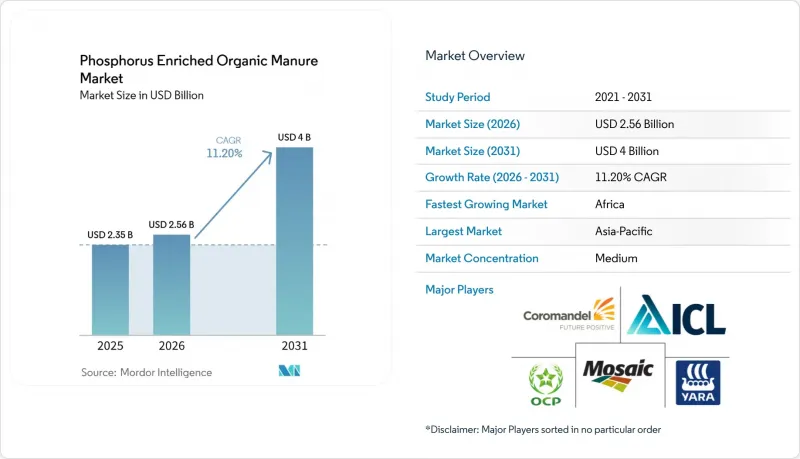
This report is Segmented by Form (Granular, Powder, and Liquid), by Source (Animal Manure-Derived, Plant-Based Compost, and More), by Application (Soil Amendment, and More), by Crop Type (Cereals and Grains, and More), by Distribution Channel (Direct Sales, and More), and by Geography (North America, South America, and More). The Market Forecasts are Provided in Terms of Value (USD).
Global Phosphorus Enriched Organic Manure Market Trends and Insights
Rising Adoption of Sustainable Agriculture Practices
Regenerative protocols that prioritize soil organic matter are placing phosphorus enriched manure at the center of mainstream crop nutrition. The Research Institute of Organic Agriculture reported 98.9 million hectares under certified organic management in 2024, an acreage that bans synthetic superphosphate. India's Promotion of Alternative Nutrients for Agriculture Management Remunerating Rewards scheme, launched in 2023, reimburses states that shift growers toward organic inputs, thereby shrinking the price gap at the village level. China's Fourteenth Five-Year Plan compels provinces to process 80% of livestock manure by 2025, subsidizing half the cost of composting and pelletizing equipment. Because organic certification audits last three years, growers who begin conversion from multi-season demand pipelines are largely insulated from spot pricing. These structural factors lock in offtake agreements, stabilizing cash flows for processors in the phosphorus enriched organic manure market.
Government Subsidies and Supportive Policies for Organic Fertilizers
Direct fiscal programs are compressing historical price premiums over synthetic phosphates. In December 2024, the United States Department of Agriculture (USDA) awarded USD 116 million to 41 manure-to-fertilizer projects, cutting payback periods from eight to below five years. Kenya's 2024 National Organic Agriculture Policy halved certification timelines to six months, enabling local processors to challenge imported blends. South Africa's 2024 Fertilizer Act amendments mandate phosphorus labeling, expose low-analysis compost, and favor compliant suppliers. Brazil's 2024 National Organic Agriculture Plan offers low-interest loans for plants that process sugarcane bagasse and poultry litter, abundant residues in Sao Paulo and Parana. These measures collectively expand the addressable customer base in the phosphorus enriched organic manure market.
Higher Cost Versus Conventional Chemical Fertilizers
Organic manure typically costs 1.5 to 2.5 times as much per kilogram of available phosphorus as diammonium phosphate, a spread that pinches smallholder margins. Fertilizer can account for 40% of production costs in parts of Sub-Saharan Africa, forcing growers to prioritize immediate yield response over soil health. The International Fertilizer Development Center blends local rock phosphate with compost under its Soil Values program to reduce delivered cost, yet benefits accrue only after two or three seasons. India's cooperative credit schemes relieve some pressure but carry default risks that cap loan volumes. Until processors scale up, the premium will continue to weigh on uptake in the phosphorus enriched organic manure market.
Other drivers and restraints analyzed in the detailed report include:
- Declining Phosphate Rock Reserves are Driving Phosphorus Recycling
- Integration of Manure Processing with Livestock Waste-to-Energy Projects
- Limited Shelf Life and Storage Challenges
For complete list of drivers and restraints, kindly check the Table Of Contents.
Segment Analysis
Granular products commanded 43% of 2025 of phosphorus enriched organic manure market share in 2025, the largest slice of the phosphorus enriched organic manure market, because ambient-storage warehouses in India and China cannot handle temperature-sensitive liquids. These solids integrate with farmers' existing broadcast spreaders, avoiding new capital outlays. Powdered inputs fill seed-coating niches but face dust and lower nutrient-density penalties. Granular supply also benefits from lower freight costs per unit of phosphorus than high-water liquid blends. As smartphone advisories spread the use of variable-rate techniques, interest in uniform pellet sizing is rising.
Liquid formulations will post the fastest 13.4% CAGR over 2026-2031 as fertigation systems penetrate high-value horticulture. Drip lines deliver dissolved phosphorus directly to root zones, improving use efficiency by 30% in calcareous soils. European Union living labs showed that liquids provide 15% quicker uptake in lettuce and spinach cultivation. Coromandel International's 2024 launch of Gromor Super Phosphate illustrates how hybrid slurry-granule formats bridge the transition from solids to liquids. These dynamics steadily diversify the phosphorus enriched organic manure market.
Animal manure-derived accounted for 48% of phosphorus enriched organic manure market size in 2025, delivering the largest volume share in the phosphorus enriched organic manure market, thanks to ready feedstock from confined livestock systems. Dairy, swine, and poultry operations already capture waste in pits, lowering collection costs. Nutrient content is predictable, supporting standardized labeling that retailers demand. Municipal biosolids add incremental tonnage where industrial contamination risks are managed. This feedstock abundance underpins current price leadership.
Plant-based compost will be the fastest-growing source category, with a 14.1% CAGR through 2026-2031, as cities divert green waste from landfills. Microbial inoculants that solubilize phosphorus double the extractable levels without rock additions, thereby increasing nutrient density. International Fertilizer Development Center pilots in Ethiopia demonstrate that coffee husk compost can offset imports of diammonium phosphate. ICL Group's Polysulphate mineral secured organic status in 2025, offering a manure-free alternative for growers wary of pathogens. Diversified sourcing enhances resilience in the phosphorus enriched organic manure market.
Complete Report Scope:
- By Form
- Granular
- Powder
- Liquid
- By Source
- Animal Manure-derived
- Plant-based Compost
- Municipal Waste-derived
- By Application
- Soil Amendment
- Foliar Treatment
- Seed Coating
- By Crop Type
- Cereals and Grains
- Fruits and Vegetables
- Oilseeds and Pulses
- By Distribution Channel
- Direct Sales
- Retail and Online
- By Geography
- North America
- United States
- Canada
- Rest of North America
- South America
- Brazil
- Argentina
- Rest of South America
- Europe
- Germany
- France
- United Kingdom
- Russia
- Rest of Europe
- Asia-Pacific
- China
- India
- Japan
- Australia
- Rest of Asia-Pacific
- Middle East
- Saudi Arabia
- United Arab Emirates
- Rest of Middle East
- Africa
- South Africa
- Kenya
- Rest of Africa
- North America
Geography Analysis
Asia-Pacific captured 42% of 2025 revenue in the market. India's 2024 rewards scheme reimburses states that substitute synthetics, reducing the delivered cost to cooperatives. China's directive to recycle a significant portion of livestock manure by 2025 supports the establishment of new pellet plants through substantial capital subsidies. Coromandel International's specialty nutrients sales rose in 2025 across rice and sugarcane belts. Japan and South Korea enforce phosphorus recovery rules, anchoring steady demand for struvite.
Africa will record the fastest CAGR of 13.0% through 2026-2031. Kenya's 2024 organic policy slashed certification time to six months, unlocking local processing capacity. South Africa's 2024 label rules expose substandard compost, boosting the share of compliant suppliers. OCP Group funded blending hubs in Kenya, Ethiopia, and Nigeria in 2024 to pair Moroccan rock with local residues. The International Fertilizer Development Center's Soil Values program covers two million Sahelian farmers, expanding the footprint of the phosphorus enriched organic manure market.
North America and Europe are projected to experience significant CAGRs in the phosphorus-enriched organic manure market. According to the United States Department of Agriculture (USDA), 2024 grants are projected to reduce manure processing payback periods to less than five years, thereby accelerating capacity additions. These grants are likely to encourage farmers and producers to adopt advanced manure processing technologies, further boosting market growth. In 2026, the European Union is set to lift application ceilings for processed manure, which is anticipated to increase market volume. This regulatory change is anticipated to provide greater flexibility for farmers in utilizing processed manure, enhancing its adoption across the region. Additionally, consultations in the United Kingdom aim to streamline registrations by 2027, which could simplify compliance processes and support market expansion.
- Coromandel International Limited
- ICL Group Ltd.
- OCP Group
- Yara International ASA
- The Mosaic Company
- Fertoz Limited
- Perfect Blend, LLC
- Sustane Natural Fertilizer, Inc.
- AgroLiquid
- Midwestern BioAg, Inc.
- Rovensa Group
- Lallemand Plant Care
- Italpollina S.p.A
- Symborg S.L.
- Rizobacter Argentina S.A.
Additional Benefits:
- The market estimate (ME) sheet in Excel format
- 3 months of analyst support
TABLE OF CONTENTS
1 Introduction
- 1.1 Study Assumptions and Market Definition
- 1.2 Scope of the Study
2 Research Methodology
3 Executive Summary
4 Market Landscape
- 4.1 Market Overview
- 4.2 Market Drivers
- 4.2.1 Rising adoption of sustainable agriculture practices
- 4.2.2 Government subsidies and supportive policies for organic fertilizers
- 4.2.3 Declining phosphate rock reserves driving phosphorus recycling
- 4.2.4 Integration of manure processing with livestock waste-to-energy projects
- 4.2.5 Emergence of biochar-blended phosphorus-enriched pellets
- 4.2.6 Blockchain-based traceability boosting premium pricing
- 4.3 Market Restraints
- 4.3.1 Higher cost versus conventional chemical fertilizers
- 4.3.2 Limited shelf life and storage challenges
- 4.3.3 Heavy-metal contamination risks from some waste streams
- 4.3.4 Lack of global standards for nutrient-content labeling
- 4.4 Regulatory Landscape
- 4.5 Technological Outlook
- 4.6 Porter's Five Forces Analysis
- 4.6.1 Bargaining Power of Suppliers
- 4.6.2 Bargaining Power of Buyers
- 4.6.3 Threat of New Entrants
- 4.6.4 Threat of Substitutes
- 4.6.5 Intensity of Competitive Rivalry
5 Market Size and Growth Forecasts (Value)
- 5.1 By Form
- 5.1.1 Granular
- 5.1.2 Powder
- 5.1.3 Liquid
- 5.2 By Source
- 5.2.1 Animal Manure-derived
- 5.2.2 Plant-based Compost
- 5.2.3 Municipal Waste-derived
- 5.3 By Application
- 5.3.1 Soil Amendment
- 5.3.2 Foliar Treatment
- 5.3.3 Seed Coating
- 5.4 By Crop Type
- 5.4.1 Cereals and Grains
- 5.4.2 Fruits and Vegetables
- 5.4.3 Oilseeds and Pulses
- 5.5 By Distribution Channel
- 5.5.1 Direct Sales
- 5.5.2 Retail and Online
- 5.6 By Geography
- 5.6.1 North America
- 5.6.1.1 United States
- 5.6.1.2 Canada
- 5.6.1.3 Rest of North America
- 5.6.2 South America
- 5.6.2.1 Brazil
- 5.6.2.2 Argentina
- 5.6.2.3 Rest of South America
- 5.6.3 Europe
- 5.6.3.1 Germany
- 5.6.3.2 France
- 5.6.3.3 United Kingdom
- 5.6.3.4 Russia
- 5.6.3.5 Rest of Europe
- 5.6.4 Asia-Pacific
- 5.6.4.1 China
- 5.6.4.2 India
- 5.6.4.3 Japan
- 5.6.4.4 Australia
- 5.6.4.5 Rest of Asia-Pacific
- 5.6.5 Middle East
- 5.6.5.1 Saudi Arabia
- 5.6.5.2 United Arab Emirates
- 5.6.5.3 Rest of Middle East
- 5.6.6 Africa
- 5.6.6.1 South Africa
- 5.6.6.2 Kenya
- 5.6.6.3 Rest of Africa
- 5.6.1 North America
6 Competitive Landscape
- 6.1 Market Concentration
- 6.2 Strategic Moves
- 6.3 Market Share Analysis
- 6.4 Company Profiles (Includes Global Level Overview, Market Level Overview, Core Segments, Financials as Available, Strategic Information, Market Rank/Share for Key Companies, Products and Services, And Recent Developments)
- 6.4.1 Coromandel International Limited
- 6.4.2 ICL Group Ltd.
- 6.4.3 OCP Group
- 6.4.4 Yara International ASA
- 6.4.5 The Mosaic Company
- 6.4.6 Fertoz Limited
- 6.4.7 Perfect Blend, LLC
- 6.4.8 Sustane Natural Fertilizer, Inc.
- 6.4.9 AgroLiquid
- 6.4.10 Midwestern BioAg, Inc.
- 6.4.11 Rovensa Group
- 6.4.12 Lallemand Plant Care
- 6.4.13 Italpollina S.p.A
- 6.4.14 Symborg S.L.
- 6.4.15 Rizobacter Argentina S.A.
7 Market Opportunities and Future Outlook

