PUBLISHER: Mordor Intelligence | PRODUCT CODE: 2122249

PUBLISHER: Mordor Intelligence | PRODUCT CODE: 2122249
GCC Organic Fertilizer - Market Share Analysis, Industry Trends & Statistics, Growth Forecasts (2026 - 2031)
According to Mordor Intelligence, the GCC organic fertilizer market size was valued at USD 120 million in 2025 and is projected to grow from USD 131 million in 2026 to USD 203.5 million by 2031, growing at a CAGR of 9.2% during the forecast period (2026-2031).
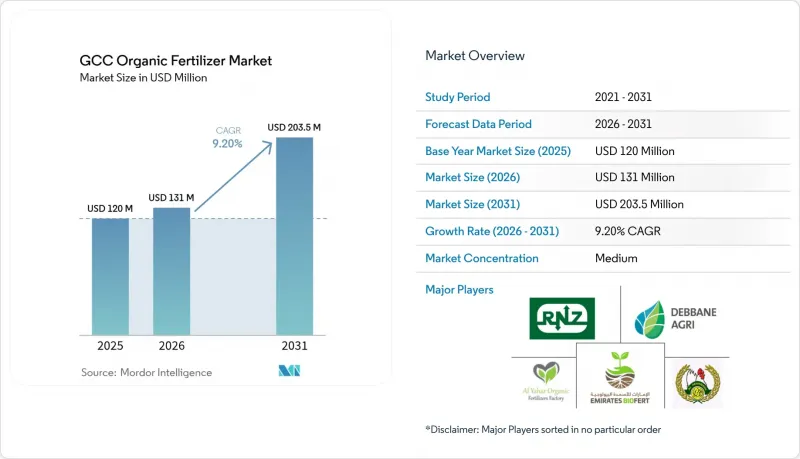
This report is Segmented by Source Type (Plant-Based, Animal-Based, and Mineral-Based), by Form (Solid and Liquid), by Crop Type (Cereals and Grains, Fruits and Vegetables, Ornamentals and Turf, and Others), and by Geography (Saudi Arabia, United Arab Emirates, Qatar, Oman, Bahrain, and Kuwait). The Market Forecasts are Provided in Terms of Value (USD).
GCC Organic Fertilizer Market Trends and Insights
Government Subsidies for Sustainable Agriculture
Targeted fiscal programs narrow the price gap between organics and synthetics, converting hesitant growers. Saudi Arabia's Agricultural Development Fund (ADF) is providing substantial funding to modernize agriculture, with approximately USD 220 million for high-tech greenhouses between 2021 and 2025. The United Arab Emirates's Farmer Support Program, in the same year, established traceability compliance under the National Food Security Strategy to promote local farming using modern techniques, including sustainable practices. Oman followed up with projects such as rebates for smallholder date orchard growers. These incentives collectively trimmed the organic price premium from 50% to roughly 20% and embedded GSO standards as a qualification hurdle, effectively crowding out sub-scale suppliers lacking certification. By lowering adoption risk and enforcing quality floors, subsidies are forecast to keep demand elastic even if commodity fertilizer prices moderate post-2026.
Expanding Organic Food Retail Channels
Retail visibility is translating consumer willingness to pay into upstream fertilizer pull-through. Spinneys UAE, the premium retailer, reported strong growth in 2025, driven by a 12.4% increase in gross selling area to 906,000 sq ft across 13 new stores in the United Arab Emirates and Saudi Arabia. As part of its 2030 sustainability strategy, Spinneys aimed to have 20% of its fresh produce be organic by 2025. In the same period, Carrefour focused on strengthening its private-label "Carrefour BIO" range, with over 20% of all items in-store exclusive to its private brands in some formats. The company is expanding its organic, locally sourced, sustainable produce, supported by partnerships with local farms to enhance food security. E-commerce platforms such as Kibsons and NRTC Fresh expand access for expatriates, a demographic that over-indexes in health-label purchases. With shelf positioning and direct-to-consumer models assuring stable price premiums for certified produce, growers gain confidence to shift acreage and secure organic inputs on multiyear contracts, reinforcing a virtuous demand loop for the GCC organic fertilizer market.
Limited Domestic Organic Waste Collection Systems
Feedstock scarcity caps production scalability. Fewer than 30% of households separate waste, with Abu Dhabi leading at 42% while Kuwait lags at 18% in 2025. Tadweer diverted 185,000 metric tons in 2025, just 22% of total organics. Riyadh's 2024 brown-bin pilot hit 28% uptake, yet nationwide expansion faces behavioral hurdles. The feedstock deficit compels imports of date pits from Tunisia and poultry manure from India, adding USD 40-60 per metric ton in logistics costs. Bahrain landfills organic waste or ships waste to the United Arab Emirates, while Kuwait awaits a 50,000 metric ton per year Salmi composting plant, not due until 2028. Uncertain supply throttles producers' capex appetites, limiting the pace at which the GCC organic fertilizer market can satisfy latent demand.
Other drivers and restraints analyzed in the detailed report include:
- Rising Soil Degradation Concerns
- Growing Hotel and Resort Landscaping Demand
- Price Premium Over Synthetic Fertilizers
For complete list of drivers and restraints, kindly check the Table Of Contents.
Segment Analysis
Plant-based inputs accounted for 45% of the GCC organic fertilizer market share in 2025, as the GCC organic fertilizer market leveraged a large volume of annual date-palm waste. Compost derived from pits and fronds has a C: N ratio of 25-35:1, ideal for sandy soils. Animal-based products are driven by higher nitrogen (2.5-3.5% N), but regulatory scrutiny on antibiotic residues is tightening. Mineral-based organics expand at a 12.4% CAGR through 2031, appealing to high-tech farms craving consistent nutrient delivery and lower salinity. uTerra's Soil Elixir aligns to a 15-10-10 NPK profile, reflecting a new precision ethos. Amid rising compliance costs, mineral blends could erode plant-based share, yet the need to build soil carbon ensures plant residues remain foundational to the GCC organic fertilizer market.
The segment's strategic pivot toward traceability underscores maturation. Al-Akhawain's blockchain ledger enables buyers to verify the origin of the fruit at the farm level. Emirates Bio Fertilizer adopted a 60:30:10 recipe, reducing nitrogen variability to below 15% and boosting credibility among greenhouse operators. Animal-based suppliers face antibiotic limits; a 2025 ADAFSA ( Abu Dhabi Agriculture and Food Safety Authority) audit flagged 18% non-compliance. Mineral-based players monetize desalination-brine feedstocks, narrowing price gaps. The interplay of soil-building benefits and precision requirements will maintain a balanced demand mix, supporting multi-source strategies across the GCC organic fertilizers industry.
Complete Report Scope:
- By Source Type
- Plant-based
- Animal-based
- Mineral-based
- By Form
- Solid (Granular and Powder)
- Liquid
- By Crop Type
- Cereals and Grains
- Fruits and Vegetables
- Ornamental and Turf
- Other Crops
- By Geography
- Saudi Arabia
- United Arab Emirates
- Oman
- Qatar
- Kuwait
- Bahrain
List of Companies Covered in this Report:
- RNZ Agrotech Industries Ltd. (RNZ Group)
- Emirates Bio Fertilizer Factory (EBFF)
- Al-Akhawain (Al-Akhawain Holding)
- Al Yahar Organic Fertilizers Factory
- uTerra Middle East Agro Industries LLC.(UniPax Investment Group)
- Debbane Agri (Debbane Saikali Group)
- Desert Oasis Fertilizers Packaging LLC (Desert Group)
- Union Chemicals Co. LLC
- Sikri Farms Innovation Private Limited
- Tadweer Food Recycling Company
- Dhofar Organics LLC
- Oman Agri-Fertilizer Co. LLC
- Dafe Afate Alborz Behsam Company
Additional Benefits:
- The market estimate (ME) sheet in Excel format
- 3 months of analyst support
TABLE OF CONTENTS
1 Introduction
- 1.1 Study Assumptions and Market Definition
- 1.2 Scope of the Study
2 Research Methodology
3 Executive Summary
4 Market Landscape
- 4.1 Market Overview
- 4.2 Market Drivers
- 4.2.1 Government subsidies for sustainable agriculture
- 4.2.2 Expanding organic food retail channels
- 4.2.3 Rising soil degradation concerns
- 4.2.4 Growing hotel and resort landscaping demand
- 4.2.5 Desalination brine reuse projects
- 4.2.6 Carbon-credit linked farming pilots
- 4.3 Market Restraints
- 4.3.1 Limited domestic organic waste collection systems
- 4.3.2 Price premium over synthetic fertilizers
- 4.3.3 Inconsistent nutrient content across batches
- 4.3.4 Water-salinity amplification risk
- 4.4 Regulatory Landscape
- 4.5 Technological Outlook
- 4.6 Porter's Five Forces Analysis
- 4.6.1 Threat of New Entrants
- 4.6.2 Bargaining Power of Suppliers
- 4.6.3 Bargaining Power of Buyers
- 4.6.4 Threat of Substitutes
- 4.6.5 Intensity of Competitive Rivalry
5 Market Size and Growth Forecasts (Value)
- 5.1 By Source Type
- 5.1.1 Plant-based
- 5.1.2 Animal-based
- 5.1.3 Mineral-based
- 5.2 By Form
- 5.2.1 Solid (Granular and Powder)
- 5.2.2 Liquid
- 5.3 By Crop Type
- 5.3.1 Cereals and Grains
- 5.3.2 Fruits and Vegetables
- 5.3.3 Ornamental and Turf
- 5.3.4 Other Crops
- 5.4 By Geography
- 5.4.1 Saudi Arabia
- 5.4.2 United Arab Emirates
- 5.4.3 Oman
- 5.4.4 Qatar
- 5.4.5 Kuwait
- 5.4.6 Bahrain
6 Competitive Landscape
- 6.1 Market Concentration
- 6.2 Strategic Moves
- 6.3 Market Share Analysis
- 6.4 Company Profiles (Includes Global level Overview, Market level overview, Core Segments, Financials as available, Strategic Information, Market Rank/Share for Key Companies, Products and Services, and Recent Developments)
- 6.4.1 RNZ Agrotech Industries Ltd. (RNZ Group)
- 6.4.2 Emirates Bio Fertilizer Factory (EBFF)
- 6.4.3 Al-Akhawain (Al-Akhawain Holding)
- 6.4.4 Al Yahar Organic Fertilizers Factory
- 6.4.5 uTerra Middle East Agro Industries LLC.(UniPax Investment Group)
- 6.4.6 Debbane Agri (Debbane Saikali Group)
- 6.4.7 Desert Oasis Fertilizers Packaging LLC (Desert Group)
- 6.4.8 Union Chemicals Co. LLC
- 6.4.9 Sikri Farms Innovation Private Limited
- 6.4.10 Tadweer Food Recycling Company
- 6.4.11 Dhofar Organics LLC
- 6.4.12 Oman Agri-Fertilizer Co. LLC
- 6.4.13 Dafe Afate Alborz Behsam Company
7 Market Opportunities and Future Outlook

