PUBLISHER: Mordor Intelligence | PRODUCT CODE: 2118141

PUBLISHER: Mordor Intelligence | PRODUCT CODE: 2118141
Europe Prefabricated Bathroom Modules - Market Share Analysis, Industry Trends & Statistics, Growth Forecasts (2026 - 2031)
According to Mordor Intelligence, the Europe prefabricated bathroom modules market size is projected to expand from USD 0.69 billion in 2025 and USD 0.73 billion in 2026 to USD 1.03 billion by 2031, registering a CAGR of 7.13% between 2026 to 2031.
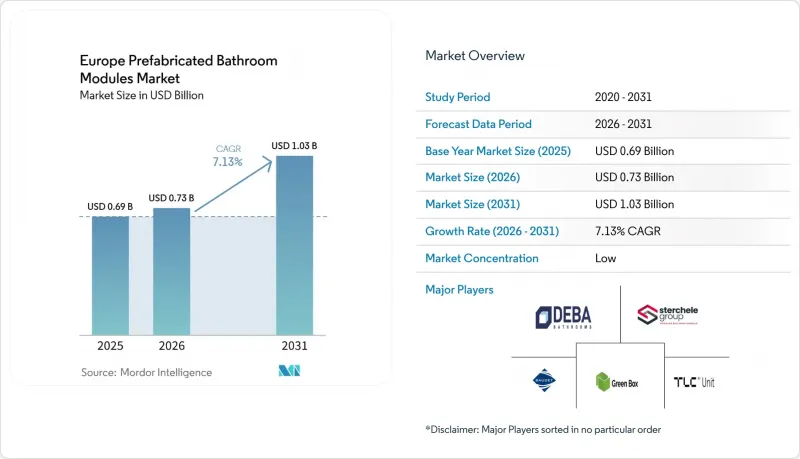
This report is Segmented by Product Type (Steel Framed Modules, Concrete Modules, Hybrid Modules, and More), Installation Type (New Build, and More), End User (Hospitality, Healthcare, Residential, Commercial Offices, and Others), and Geography (United Kingdom, Germany, France, Italy, Spain, and Rest of Europe). The Market Forecasts are Provided in Terms of Value (USD).
Europe Prefabricated Bathroom Modules Market Trends and Insights
Hospitality and Mixed-Use Construction Drives Bathroom Module Demand
Hospitality construction is a strong demand driver for prefabricated bathroom modules because hotel developers value faster room delivery, consistent finishes, and tighter control over interior fit-out risk. Europe's hotel construction pipeline stands at 1,731 projects with 255,354 rooms in Q1 2026, providing bathroom pod suppliers with a large, active base of projects where specification decisions are already underway. Within this pipeline, 792 projects covering 119,106 rooms are under construction, which supports near-term procurement demand for factory-built bathroom solutions. The early planning stage has reached 604 projects with 86,128 rooms, indicating a longer runway for modular bathroom adoption over the next few years. The United Kingdom leads with 268 pipeline projects, followed by Germany with 144 and France with 125, which aligns closely with the countries where bathroom pod specification is already more established. Upscale and upper-upscale hotels are expanding the fastest, and these formats favor prefabricated bathrooms because they need uniform room quality across large room counts while keeping construction schedules under close control.
Skilled Trade Labor Shortages Accelerate Offsite Construction Adoption
The Europe prefabricated bathroom modules market is being driven forward by a labor gap that has shifted from a short-cycle issue to a structural limit on project delivery. FIEC stated in late 2025 that the EU construction sector will need 2 million additional workers by 2030, and that the renovation wave alone may require 486,600 to 1,549,000 more workers over that period. The same paper noted that Germany faces annual age-related attrition of 80,000 workers, Spain needs 500,000 workers in the short to medium term, and France requires 100,000 new entrants each year to sustain current output. The European Construction Observatory also noted that construction employment reached 16.8 million workers in 2024, yet shortages still constrained the sector's ability to meet demand. Bathroom installation is exposed to this pressure because it depends on several wet trades that must be sequenced correctly, and those trades are among the hardest roles to replace in aging workforces. Factory-built modules reduce that dependence by shifting plumbing, tiling, electrical, and finishing work into a controlled production line, which is why procurement teams in the Europe prefabricated bathroom modules market are increasingly using labor scarcity as a direct specification argument.
Logistics and Transportation Complexity Increases Project Costs
The Europe prefabricated bathroom modules market still faces a real operational constraint in the way pods must be transported, lifted, and installed. Bathroom modules are bulky finished units, and many projects depend on narrow crane windows and tightly timed delivery sequences that cannot be missed without affecting later work. Urban restrictions make that harder because major cities apply congestion rules, vehicle limits, and site access controls that raise both cost and coordination pressure. A delivery delay can therefore create a larger financial problem than the transport bill itself, since missed lifts and interrupted slab or facade sequences can quickly push back the full interior schedule. EcoReadyBath's 2025 Berlin project demonstrated that these risks can be managed through detailed, just-in-time planning, but it also underscored the discipline required to make that approach work. The Europe prefabricated bathroom modules market will keep growing, but suppliers that cannot control logistics with the same rigor as manufacturing will struggle to convert demand into repeat orders.
Other drivers and restraints analyzed in the detailed report include:
- Faster Urban Project Delivery Increases Prefabricated Bathroom Module Usage
- Growth in Occupied-Building Retrofits Supports Bathroom Pod Installations
- Limited Design Flexibility Restricts Adoption in Complex Projects
For complete list of drivers and restraints, kindly check the Table Of Contents.
Segment Analysis
Steel-framed modules held a 38.60% share in 2025, keeping them in the lead across the Europe prefabricated bathroom modules market. Steel remains the preferred choice where structural accuracy, load performance, and documented fire resistance matter most, especially in taller buildings and regulated project types. Its position is reinforced by the fact that contractors and consultants already understand how steel pod frames interface with common high-rise construction methods. Concrete modules still offer durability, but their weight reduces flexibility on upper floors and increases transport pressure on cross-border deliveries. GRP modules play a significant role in healthcare, student housing, and cost-sensitive residential applications due to their corrosion resistance and ease of installation.
The hybrid modules are projected to expand at a 8.60% CAGR between 2026 and 2031. Hybrid formats are gaining traction because they combine a strong structural base with finish options that are closer to those of conventional premium bathrooms. That matters in hospitality and higher-end residential projects, where developers want the speed of pods without sacrificing the quality of tiled or composite surfaces. Offsite Solutions expanded its offer in 2025 by incorporating ceramic tile finishes into a hybrid pod format, which directly addressed one of the strongest objections to earlier GRP-led solutions. Timber-based modules remain an emerging option, but their near-term uptake is still narrower because dense urban and high-rise specifications continue to favor materials with more established fire-performance acceptance.
Complete Report Scope:
- By Product Type
- Steel Framed Modules
- Concrete Modules
- Hybrid Modules
- Glass Reinforced Plastic Modules
- Timber-Based Modules
- By Installation Type
- New Build
- Retrofit and Renovation
- Temporary and Relocatable Units
- By End User
- Hospitality
- Healthcare
- Residential
- Commercial Offices
- Others
- By Geography
- United Kingdom
- Germany
- France
- Italy
- Spain
- Rest of Europe
List of Companies Covered in this Report:
- DEBA
- StercheleGroup S.p.A.
- BAUDET
- TLC Unit
- Green Box
- Flow Modules Oy
- Erawet
- Bathsystem S.p.A.
- Offsite Solutions
- Walker Modular
- Hydrop BV
- Portakabin Ltd.
- Elements Europe Ltd.
- Gexan
- HEBERGER GmbH
- Domczar
- Acrol Modular
- Podcomp
- Containex GmbH
- DuPod
Additional Benefits:
- The market estimate (ME) sheet in Excel format
- 3 months of analyst support
TABLE OF CONTENTS
1 Introduction
- 1.1 Study Assumptions and Market Definition
- 1.2 Scope of the Study
2 Research Methodology
3 Executive Summary
4 Market Landscape
- 4.1 Market Overview
- 4.2 Market Drivers
- 4.2.1 Hospitality and Mixed-Use Construction Drives Bathroom Module Demand
- 4.2.2 Skilled Trade Labor Shortages Accelerate Offsite Construction Adoption
- 4.2.3 Faster Urban Project Delivery Increases Prefabricated Bathroom Module Usage
- 4.2.4 Growth in Occupied-Building Retrofits Supports Bathroom Pod Installations
- 4.2.5 Rising Demand for Hygienic Wet-Room Solutions Boosts Market Adoption
- 4.2.6 Sustainability Regulations Encourage Prefabricated Bathroom Module Deployment
- 4.3 Market Restraints
- 4.3.1 Logistics and Transportation Complexity Increases Project Costs
- 4.3.2 Limited Design Flexibility Restricts Adoption in Complex Projects
- 4.3.3 Customization Requirements Reduce Standardization Benefits
- 4.3.4 Early Design Freeze Requirements Limit Project Flexibility
- 4.4 Value / Supply-Chain Analysis
- 4.4.1 Overview of the Supply Chain and Ecosystem
- 4.4.2 List of Key Raw Materials, Resources & Suppliers
- 4.4.3 List of Major Distributors and Channel Partners
- 4.4.4 List of Major End Users
- 4.5 Regulatory Landscape
- 4.6 Technological Outlook
- 4.7 Porter's Five Forces Analysis
- 4.7.1 Bargaining Power of Suppliers
- 4.7.2 Bargaining Power of Consumers
- 4.7.3 Threat of New Entrants
- 4.7.4 Threat of Substitutes
- 4.7.5 Intensity of Competitive Rivalry
5 Market Size & Growth Forecasts (Value, USD)
- 5.1 By Product Type
- 5.1.1 Steel Framed Modules
- 5.1.2 Concrete Modules
- 5.1.3 Hybrid Modules
- 5.1.4 Glass Reinforced Plastic Modules
- 5.1.5 Timber-Based Modules
- 5.2 By Installation Type
- 5.2.1 New Build
- 5.2.2 Retrofit and Renovation
- 5.2.3 Temporary and Relocatable Units
- 5.3 By End User
- 5.3.1 Hospitality
- 5.3.2 Healthcare
- 5.3.3 Residential
- 5.3.4 Commercial Offices
- 5.3.5 Others
- 5.4 By Geography
- 5.4.1 United Kingdom
- 5.4.2 Germany
- 5.4.3 France
- 5.4.4 Italy
- 5.4.5 Spain
- 5.4.6 Rest of Europe
6 Competitive Landscape
- 6.1 Market Concentration
- 6.2 Strategic Moves
- 6.3 Market Share Analysis
- 6.4 Company Profiles (Includes Global Level Overview, Market Level Overview, Core Segments, Financials as Available, Strategic Information, Products and Services, Recent Developments)
- 6.4.1 DEBA
- 6.4.2 StercheleGroup S.p.A.
- 6.4.3 BAUDET
- 6.4.4 TLC Unit
- 6.4.5 Green Box
- 6.4.6 Flow Modules Oy
- 6.4.7 Erawet
- 6.4.8 Bathsystem S.p.A.
- 6.4.9 Offsite Solutions
- 6.4.10 Walker Modular
- 6.4.11 Hydrop BV
- 6.4.12 Portakabin Ltd.
- 6.4.13 Elements Europe Ltd.
- 6.4.14 Gexan
- 6.4.15 HEBERGER GmbH
- 6.4.16 Domczar
- 6.4.17 Acrol Modular
- 6.4.18 Podcomp
- 6.4.19 Containex GmbH
- 6.4.20 DuPod
7 Market Opportunities & Future Outlook
- 7.1 White-Space and Unmet-Need Assessment

