PUBLISHER: Mordor Intelligence | PRODUCT CODE: 2118262

PUBLISHER: Mordor Intelligence | PRODUCT CODE: 2118262
North America Prefabricated Bathroom Modules - Market Share Analysis, Industry Trends & Statistics, Growth Forecasts (2026 - 2031)
According to Mordor Intelligence, the North America prefabricated bathroom modules market size was valued at USD 0.58 billion in 2025 and is estimated to grow from USD 0.62 billion in 2026 to reach USD 0.88 billion by 2031, at a CAGR of 7.26% during the forecast period (2026-2031).
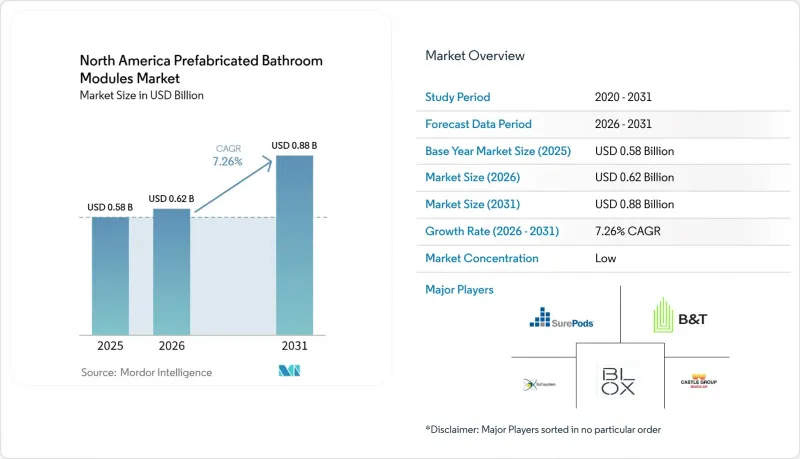
This report is Segmented by Product Type (Steel Framed Modules, Concrete Modules, Hybrid Modules, and More), Installation Type (New Build, and More), End User (Hospitality, Healthcare, Residential, Commercial Offices, and Others), and Country (United States, Canada, and Mexico). The Report Provides Market Forecasts in Terms of Value (USD).
North America Prefabricated Bathroom Modules Market Trends and Insights
Rising Demand for Faster Project Delivery
The North America prefabricated bathroom modules market is also benefiting from the growing value owners place on schedule certainty. Bathroom pods are built in parallel with structural work and site preparation, which removes a major sequencing bottleneck from the interior delivery program. SurePods reported that pod-based delivery at Sierra College's 354-bed student housing project reduced on-site bathroom construction by nearly 3 weeks per floor. That time saving matters beyond the bathroom itself because earlier bathroom completion allows furniture installation, commissioning, and closeout work to begin sooner. The schedule case is strongest on large hotel, healthcare, and student housing projects where room turnover dates carry direct financial consequences.
Labor Shortages in MEP and Finishing Trades
The North America prefabricated bathroom modules market is being driven by a labor problem that now appears structural rather than temporary. The AGC and NCCER 2025 workforce survey found that 92% of construction firms had difficulty filling open roles, and 45% said worker shortages were the main cause of project delays. That pressure is especially important in bathroom construction because plumbing, electrical, tiling, and finishing work usually depend on several trade crews arriving in the right order. Pod procurement reduces that dependency by moving those scopes into a factory setting, where staffing is easier to organize and output is easier to monitor. This is also opening the North America prefabricated bathroom modules market to smaller regional contractors and mid-market developers that previously relied on conventional field labor for hospitality and multifamily work.
High Upfront Factory Investment
High factory setup costs remain a clear restraint on the North America prefabricated bathroom modules market, as only well-capitalized manufacturers can build and scale certified production lines. Bathroom pod plants require precision-fabrication equipment, climate-controlled space, testing and inspection systems, and experienced MEP labor before a supplier can deliver to a consistent standard. This narrows the supplier base and reduces pricing pressure in cost-sensitive construction programs such as affordable housing or lower-budget regional developments. HBI estimated that longer construction timelines linked to labor shortages created USD 2.7 billion in carrying costs for the United States residential sector in 2025, which helps explain why some owners accept pod premiums when lifecycle delivery benefits are clear. Even so, many buyers still evaluate pods against upfront unit cost rather than total delivery cost over the project cycle. The North America prefabricated bathroom modules market will continue to face adoption friction where procurement teams are not set up to value reduced delay risk, lower rework, and long-term maintenance consistency.
Other drivers and restraints analyzed in the detailed report include:
- Standardized Wet Room Solutions Improve Consistency
- Reduced Rework and Defect Risks
- Site-Specific Design Constraints in Retrofit Work
For complete list of drivers and restraints, kindly check the Table Of Contents.
Segment Analysis
Hybrid modules are the fastest-growing product type in the North America prefabricated bathroom modules market, with an 8.60% CAGR projected for 2026 to 2031. Developers are using these systems to balance lower weight with the acoustic performance, fire ratings, and finish quality expected in premium hospitality and healthcare buildings. A hybrid pod usually combines a structural steel chassis with composite, GRP, or tiled wall systems and a coordinated floor assembly, giving project teams greater flexibility in performance specifications. BLOX stated that its Design Manufacture Construct process for healthcare bathrooms can support manufacturing output of 10 units per day and installation output of 10 units per day with a 4-person crew. That production logic makes hybrid configurations appealing where owners want speed without giving up finish control or compliance documentation.
Steel framed modules captured 39.20% of the North America prefabricated bathroom modules market share in 2025. Their lead reflects the need for rigid stacking tolerances and dependable MEP routing in mid-rise and high-rise projects where bathroom modules must align precisely floor after floor. Steel frames also make it easier to meet ADA grab bar loading requirements without additional wall reinforcement, helping reduce field modification work after installation. GRP modules are gaining interest in healthcare settings because their surfaces are durable, moisture-resistant, and easier to maintain. At the same time, concrete and timber-based formats remain more selective options tied to specific durability or low-carbon project priorities.
Complete Report Scope:
- By Product Type
- Steel Framed Modules
- Concrete Modules
- Hybrid Modules
- Glass Reinforced Plastic Modules
- Timber-Based Modules
- By Installation Type
- New Build
- Retrofit and Renovation
- Temporary and Relocatable Units
- By End User
- Hospitality
- Healthcare
- Residential
- Commercial Offices
- Others
- By Country
- United States
- Canada
- Mexico
List of Companies Covered in this Report:
- Oldcastle SurePods
- Bathsystem USA
- BLOX, LLC
- Castle Modular
- B&T Manufacturing
- Guerdon Modular Buildings
- Volumetric Building Companies (VBC)
- NRB Modular Solutions
- Z Modular
- Ramtech Building Systems
- Champion Modular
- VESTA Modular
- Modular Genius
- Silver Creek Industries
- Triumph Modular
- MODLOGIQ
- SurePods Canada
- Oldcastle Infrastructure
- EcoReadyBath
- Guerdon Modular Systems
Additional Benefits:
- The market estimate (ME) sheet in Excel format
- 3 months of analyst support
TABLE OF CONTENTS
1 Introduction
- 1.1 Study Assumptions and Market Definition
- 1.2 Scope of the Study
2 Research Methodology
3 Executive Summary
4 Market Landscape
- 4.1 Market Overview
- 4.2 Market Drivers
- 4.2.1 Rising Demand for Faster Project Delivery
- 4.2.2 Labor Shortages in MEP and Finishing Trades
- 4.2.3 Standardized Wet Room Solutions Improve Consistency
- 4.2.4 Reduced Rework and Defect Risks
- 4.2.5 Building Code Compliance Supports Factory Tested Modules
- 4.2.6 Early BIM Integration Improves Design Coordination
- 4.3 Market Restraints
- 4.3.1 High Upfront Factory Investment
- 4.3.2 Site-Specific Design Constraints in Retrofit Work
- 4.3.3 Freight Damage and Complex Last-Mile Delivery
- 4.3.4 Limited Contractor Familiarity in Secondary Markets
- 4.4 Value / Supply-Chain Analysis
- 4.4.1 Overview of the Supply Chain and Ecosystem
- 4.4.2 List of Key Raw Materials, Resources & Suppliers
- 4.4.3 List of Major Distributors and Channel Partners
- 4.4.4 List of Major End Users
- 4.5 Regulatory Landscape
- 4.6 Technological Outlook
- 4.7 Porter's Five Forces Analysis
- 4.7.1 Bargaining Power of Suppliers
- 4.7.2 Bargaining Power of Consumers
- 4.7.3 Threat of New Entrants
- 4.7.4 Threat of Substitutes
- 4.7.5 Intensity of Competitive Rivalry
5 Market Size & Growth Forecasts (Value, USD)
- 5.1 By Product Type
- 5.1.1 Steel Framed Modules
- 5.1.2 Concrete Modules
- 5.1.3 Hybrid Modules
- 5.1.4 Glass Reinforced Plastic Modules
- 5.1.5 Timber-Based Modules
- 5.2 By Installation Type
- 5.2.1 New Build
- 5.2.2 Retrofit and Renovation
- 5.2.3 Temporary and Relocatable Units
- 5.3 By End User
- 5.3.1 Hospitality
- 5.3.2 Healthcare
- 5.3.3 Residential
- 5.3.4 Commercial Offices
- 5.3.5 Others
- 5.4 By Country
- 5.4.1 United States
- 5.4.2 Canada
- 5.4.3 Mexico
6 Competitive Landscape
- 6.1 Market Concentration
- 6.2 Strategic Moves
- 6.3 Market Share Analysis
- 6.4 Company Profiles (Includes Global Level Overview, Market Level Overview, Core Segments, Financials as Available, Strategic Information, Products and Services, Recent Developments)
- 6.4.1 Oldcastle SurePods
- 6.4.2 Bathsystem USA
- 6.4.3 BLOX, LLC
- 6.4.4 Castle Modular
- 6.4.5 B&T Manufacturing
- 6.4.6 Guerdon Modular Buildings
- 6.4.7 Volumetric Building Companies (VBC)
- 6.4.8 NRB Modular Solutions
- 6.4.9 Z Modular
- 6.4.10 Ramtech Building Systems
- 6.4.11 Champion Modular
- 6.4.12 VESTA Modular
- 6.4.13 Modular Genius
- 6.4.14 Silver Creek Industries
- 6.4.15 Triumph Modular
- 6.4.16 MODLOGIQ
- 6.4.17 SurePods Canada
- 6.4.18 Oldcastle Infrastructure
- 6.4.19 EcoReadyBath
- 6.4.20 Guerdon Modular Systems
7 Market Opportunities & Future Outlook
- 7.1 White-Space and Unmet-Need Assessment

