PUBLISHER: Mordor Intelligence | PRODUCT CODE: 2118265

PUBLISHER: Mordor Intelligence | PRODUCT CODE: 2118265
Middle East and Africa Prefabricated Bathroom Modules - Market Share Analysis, Industry Trends & Statistics, Growth Forecasts (2026 - 2031)
According to Mordor Intelligence, the Middle East and Africa prefabricated bathroom modules market size is expected to grow from USD 0.11 billion in 2025 to USD 0.12 billion in 2026 and is forecast to reach USD 0.18 billion by 2031 at 8.45% CAGR over 2026-2031.
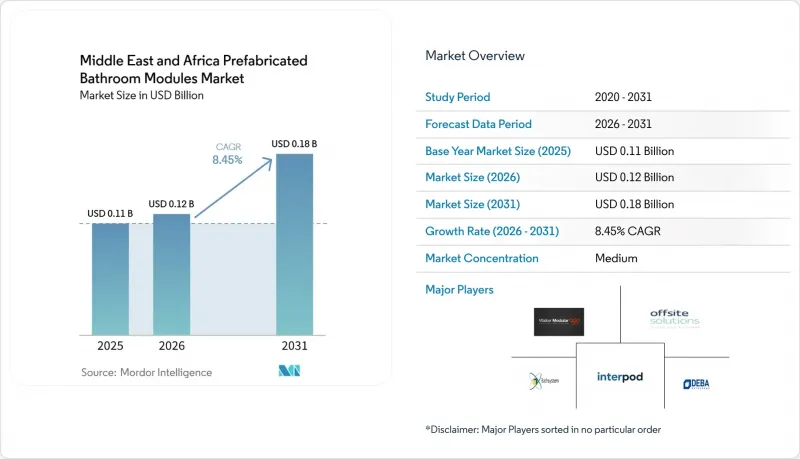
This report is Segmented by Product Type (Steel Framed Modules, Concrete Modules, Hybrid Modules, and More), Installation Type (New Build, and More), End User (Hospitality, Healthcare, Residential, Commercial Offices, and Others), and Geography (United Arab Emirates, Saudi Arabia, South Africa, Egypt, and More). The Market Forecasts are Provided in Terms of Value (USD).
Middle East and Africa Prefabricated Bathroom Modules Market Trends and Insights
Mega Projects Accelerate Bathroom Module Demand
Projects in Saudi Arabia and the United Arab Emirates have driven the Middle East and Africa prefabricated bathroom modules market toward wider use in hospitality, housing, healthcare, and worker accommodation, as their standardized room formats can be specified and tested before site delivery. Large developments need repeated room layouts and fixed completion schedules, which favor factory-made units over sequential site work. New Murabba Development Company issued a January 2026 request for information on bathroom, kitchen, and dressing room modules for the 375-meter Mukaab towers in Riyadh. DuPod began supplying 5,642 bathroom pods for 6 mid-rise towers at Al Marjan Island in 2026, showing the order volumes now associated with resort-led development in the United Arab Emirates. These programs allow capable suppliers to plan capacity across several projects rather than pursue isolated contracts. They also increase the value of local fabrication, logistics planning, and product files that meet Gulf Cooperation Council (GCC) requirements.
Skilled Wet-Trade Labor Shortages Redirect Construction Procurement Toward Offsite
The availability of certified tilers, plumbers, and waterproofing specialists remains important to the Middle East and Africa prefabricated bathroom modules market, particularly when developers must finish many hotel rooms or clinical spaces to one documented standard. Bathroom fit-out brings several trades into a small area, so delays in any one activity can affect the project handover date. Offsite production removes much of the tiling, waterproofing, and pipe fitting work from the site sequence. This can make labor planning more predictable for developers managing multiple buildings. The benefit is strongest where high volumes of similar rooms allow manufacturers to repeat the same design and inspection process. It also makes early coordination between the developer, designer, structural contractor, and pod supplier more important.
Transport and Crane Access Constraints Increase Complexity
Bathroom modules require careful handling from the factory through final installation, which can limit the schedule benefit of off-site delivery. Units usually occupy 3-6 cubic meters when packing frames are included, so dense city sites need planned unloading areas and lifting windows. Central Riyadh and Downtown Dubai can impose crane access restrictions, traffic plans, and permit lead times. Remote projects need coordinated land or marine transport, temporary crane pads, and controlled delivery routes. Heavy concrete units are more affected by these requirements than lighter steel-framed and GRP alternatives. The result is a practical advantage for products that balance structural performance with lower transport and installation complexity.
Other drivers and restraints analyzed in the detailed report include:
- Factory-Verified Quality Supports Module Adoption
- Hygiene Compliance Increases Healthcare and Hospitality Demand
- Fragmented Approval and Fire Safety Requirements Delay Delivery
For complete list of drivers and restraints, kindly check the Table Of Contents.
Segment Analysis
Steel framed modules held 37.80% of regional revenue in 2025. Steel frames suit high-rise residential and hospitality projects because they can be lifted into place without requiring substantial changes to the building design. Their use is relevant to the tall hotel and apartment developments that remain common in Dubai and Riyadh. Hybrid modules are expected to grow at a 10.30% CAGR through 2031. They combine a structural steel frame with GRP or composite interior finishes, which support both lifting performance and smooth internal surfaces. Product selection in the Middle East and Africa prefabricated bathroom modules market is therefore tied to building height, lifting methods, transport access, surface requirements, and the degree of design repetition achievable in a project.
Concrete modules remain relevant in volume housing and worker accommodation programs where permanent structural performance and thermal mass are valued. Group AMANA used concrete modular units for the AMAALA Staff Village, demonstrating the role of this approach in large Saudi projects. Their weight can limit use at high-rise sites or remote locations, leaving space for steel and hybrid systems. GRP units are useful for corrosion resistance and lighter crane handling at coastal developments. Timber-based systems remain limited, with use focused on projects that prioritize low-carbon embodied materials. The prefabricated bathroom modules industry is likely to see hybrid designs gain attention, as developers seek structural strength and a premium internal finish from a single unit. Digital production systems can also improve repeatability when the same module is supplied across many rooms.
Complete Report Scope:
- By Product Type
- Steel Framed Modules
- Concrete Modules
- Hybrid Modules
- Glass Reinforced Plastic Modules
- Timber-Based Modules
- By Installation Type
- New Build
- Retrofit and Renovation
- Temporary and Relocatable Units
- By End User
- Hospitality
- Healthcare
- Residential
- Commercial Offices
- Others
- By Country
- United Arab Emirates
- Saudi Arabia
- South Africa
- Egypt
- Rest of Middle East and Africa
List of Companies Covered in this Report:
- Walker Modular
- Offsite Solutions
- Bathsystem S.p.A.
- Interpod
- DEBA Badsysteme GmbH
- BAUDET
- Parmarine Ltd
- Hellweg Badsysteme GmbH
- Varis Fertigbader
- StercheleGroup
- Schworer Fertigbad-Systeme
- Eurocomponents
- Sanika
- Suzhou COZY House Equipment
- Guangzhou Seagull Housing Industry
- Hunan Xinling Housing Equipment Co., Ltd.
- Changsha Broad Homes Industrial Group
- Al Bandar Pre Fabricated Houses Trd. LLC
- Al Arab Prefab Houses
- Erawet Sdn. Bhd.
Additional Benefits:
- The market estimate (ME) sheet in Excel format
- 3 months of analyst support
TABLE OF CONTENTS
1 Introduction
- 1.1 Study Assumptions and Market Definition
- 1.2 Scope of the Study
2 Research Methodology
3 Executive Summary
4 Market Landscape
- 4.1 Market Overview
- 4.2 Market Drivers
- 4.2.1 Mega Projects Accelerate Bathroom Module Demand
- 4.2.2 Skilled Wet-Trade Labor Shortages Drive Offsite Construction
- 4.2.3 Factory-Verified Quality Supports Module Adoption
- 4.2.4 Hygiene Compliance Increases Healthcare and Hospitality Demand
- 4.2.5 Digital Design Coordination Improves Module Integration
- 4.2.6 Industrialized Construction Adoption Supports Demand
- 4.3 Market Restraints
- 4.3.1 Transport and Crane Access Constraints Increase Complexity
- 4.3.2 Fragmented Approval and Fire Safety Requirements Delay Delivery
- 4.3.3 Limited Local Specialized Materials Restrict Production
- 4.3.4 Imported Component Dependence Increases Costs
- 4.4 Value / Supply-Chain Analysis
- 4.4.1 Overview of the Supply Chain and Ecosystem
- 4.4.2 List of Key Raw Materials, Resources & Suppliers
- 4.4.3 List of Major Distributors and Channel Partners
- 4.4.4 List of Major End Users
- 4.5 Regulatory Landscape
- 4.6 Technological Outlook
- 4.7 Porter's Five Forces Analysis
- 4.7.1 Bargaining Power of Suppliers
- 4.7.2 Bargaining Power of Consumers
- 4.7.3 Threat of New Entrants
- 4.7.4 Threat of Substitutes
- 4.7.5 Intensity of Competitive Rivalry
5 Market Size & Growth Forecasts (Value, USD)
- 5.1 By Product Type
- 5.1.1 Steel Framed Modules
- 5.1.2 Concrete Modules
- 5.1.3 Hybrid Modules
- 5.1.4 Glass Reinforced Plastic Modules
- 5.1.5 Timber-Based Modules
- 5.2 By Installation Type
- 5.2.1 New Build
- 5.2.2 Retrofit and Renovation
- 5.2.3 Temporary and Relocatable Units
- 5.3 By End User
- 5.3.1 Hospitality
- 5.3.2 Healthcare
- 5.3.3 Residential
- 5.3.4 Commercial Offices
- 5.3.5 Others
- 5.4 By Country
- 5.4.1 United Arab Emirates
- 5.4.2 Saudi Arabia
- 5.4.3 South Africa
- 5.4.4 Egypt
- 5.4.5 Rest of Middle East and Africa
6 Competitive Landscape
- 6.1 Market Concentration
- 6.2 Strategic Moves
- 6.3 Market Share Analysis
- 6.4 Company Profiles (Includes Global Level Overview, Market Level Overview, Core Segments, Financials as Available, Strategic Information, Products and Services, Recent Developments)
- 6.4.1 Walker Modular
- 6.4.2 Offsite Solutions
- 6.4.3 Bathsystem S.p.A.
- 6.4.4 Interpod
- 6.4.5 DEBA Badsysteme GmbH
- 6.4.6 BAUDET
- 6.4.7 Parmarine Ltd
- 6.4.8 Hellweg Badsysteme GmbH
- 6.4.9 Varis Fertigbader
- 6.4.10 StercheleGroup
- 6.4.11 Schworer Fertigbad-Systeme
- 6.4.12 Eurocomponents
- 6.4.13 Sanika
- 6.4.14 Suzhou COZY House Equipment
- 6.4.15 Guangzhou Seagull Housing Industry
- 6.4.16 Hunan Xinling Housing Equipment Co., Ltd.
- 6.4.17 Changsha Broad Homes Industrial Group
- 6.4.18 Al Bandar Pre Fabricated Houses Trd. LLC
- 6.4.19 Al Arab Prefab Houses
- 6.4.20 Erawet Sdn. Bhd.
7 Market Opportunities & Future Outlook
- 7.1 White-Space and Unmet-Need Assessment

