PUBLISHER: Mordor Intelligence | PRODUCT CODE: 2119158

PUBLISHER: Mordor Intelligence | PRODUCT CODE: 2119158
South America Prefabricated Bathroom Modules - Market Share Analysis, Industry Trends & Statistics, Growth Forecasts (2026 - 2031)
According to Mordor Intelligence, the South America prefabricated bathroom modules market size is expected to grow from USD 0.13 billion in 2025 to USD 0.14 billion in 2026 and is forecast to reach USD 0.21 billion by 2031 at 8.45% CAGR over 2026-2031.
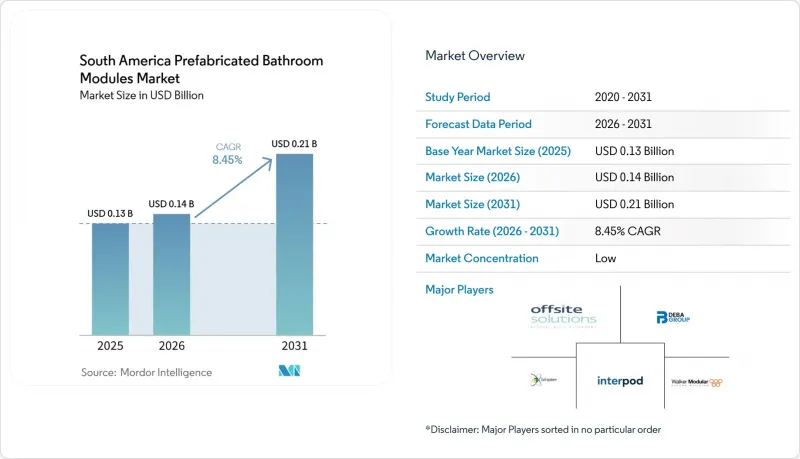
This report is Segmented by Product Type (Steel Framed Modules, Concrete Modules, Hybrid Modules, and More), Installation Type (New Build, and More), End User (Hospitality, Healthcare, Residential, Commercial Offices, and Others), and Geography (Brazil, Argentina, Colombia, Chile, and Rest of South America). The Market Forecasts are Provided in Terms of Value (USD).
South America Prefabricated Bathroom Modules Market Trends and Insights
Hotel and Mixed-Use Development
Latin America had 759 active hotel projects with 111,340 rooms in the second quarter of 2026. Brazil accounted for 140 of those projects and 20,181 rooms. This volume supports the South America prefabricated bathroom modules market because hotels often use repeated room layouts, allowing developers to specify the same bathroom configuration across many guestrooms without redesigning it for every floor. Brazil's hotel investment pipeline reached BRL 13.6 billion (USD 2.3 billion) across 178 new projects in 2026. The pipeline increased 28.3% from 2025 and was concentrated in midscale and upscale formats. Repeated bathroom installations allow developers to coordinate services and finishes before work begins on site, making the handover between structural work and final room completion easier to plan.
Construction Labor Constraints
Construction labor shortages are increasing interest in controlled offsite work in Brazil. Fundacao Getulio Vargas reported that 82% of construction firms faced recruitment difficulties, while 21% had delayed projects and 18% had revised pricing. Bathroom completion requires work from plumbing, electrical, tiling, and sealing teams. A prefabricated unit brings those activities into one coordinated manufacturing sequence. The South America prefabricated bathroom modules market, therefore, addresses both a practical scheduling issue and a product requirement, since the bathroom is one of the final spaces to be completed before a room can be handed over. A smaller site team can focus on connections and checks after delivery, rather than managing each individual finishing activity in an occupied or crowded construction area. This approach is especially relevant where project schedules are tight and skilled finishing crews are difficult to secure in the South America prefabricated bathroom modules market.
Limited Regional Manufacturing Capacity
Regional manufacturing capacity remains limited for the South America prefabricated bathroom modules market. A peer-reviewed study in Ambiente Construido reported few active Brazilian producers and low production volumes for prefabricated bathrooms. Imported modules can incur shipping costs, currency exposure, and longer delivery coordination times, which can complicate final pricing even when a supplier has a well-established product and technical reference base. The Vicuna copper project in Argentina sourced a modular mining settlement through a Chinese consortium for delivery to the Andes. That sourcing pattern shows why location and transport planning matter for remote projects in the South America prefabricated bathroom modules market. Local plants could shorten delivery routes, but investment decisions are affected by Brazil's financing conditions and Argentina's macroeconomic volatility, so new capacity may take time to match the demand indicated by larger housing, hotel, and mining projects.
Other drivers and restraints analyzed in the detailed report include:
- Standardized Social Housing Design
- Quality and Performance Standards
- Diverse Building and Plumbing Requirements
For complete list of drivers and restraints, kindly check the Table Of Contents.
Segment Analysis
Steel-framed modules held 38.40% of the South America prefabricated bathroom modules market share in 2025. Their galvanized cold-formed steel chassis fits reinforced concrete frames and light steel structures used in hotel and residential construction, allowing design teams to use a familiar load-bearing interface while keeping the bathroom package separate from several on-site finishing activities. Steel also supports recycling considerations in projects pursuing building certification, although this benefit must be assessed alongside transport, lifting, and project-specific material requirements. The material provides manufacturers with a familiar structural base for repeated bathroom layouts and helps maintain a standard production approach across hotel rooms and similar apartment plans. Concrete modules continue to play a role in institutional and correctional settings, where durability and a more robust construction approach can take priority over lighter transport requirements. Their weight can make transport and placement more difficult at high-altitude Andean sites, where road access, crane capacity, and delivery timing must be planned carefully.
Hybrid modules are projected to grow at a 9.40% CAGR from 2026 to 2031. The South America prefabricated bathroom modules market size for hybrid configurations is driven by developers who need a steel chassis with composite, fiber-cement, or tiled wall finishes, particularly when the required finish is more detailed than that of a standard molded unit. These units can combine structural support, acoustic separation, and finished interiors, allowing teams to select materials that suit the expected use of a hotel room, hospital room, or apartment. Glass reinforced plastic (GRP) modules remain relevant for healthcare and student accommodation because they resist moisture and are easier to clean, two characteristics that are important in settings where cleaning routines and visible surface conditions receive close attention. Brasil ao Cubo, backed by Gerdau and Dexco, is developing off-site, multistory modular buildings and targets 4,032 units per year by 2028. Its work shows where hybrid specifications may become more common in larger building programs, especially when a developer seeks factory coordination without giving up a more tailored interior finish.
Complete Report Scope:
- By Product Type
- Steel Framed Modules
- Concrete Modules
- Hybrid Modules
- Glass Reinforced Plastic Modules
- Timber-Based Modules
- By Installation Type
- New Build
- Retrofit and Renovation
- Temporary and Relocatable Units
- By End User
- Hospitality
- Healthcare
- Residential
- Commercial Offices
- Others
- By Country
- Brazil
- Argentina
- Colombia
- Chile
- Rest of South America
List of Companies Covered in this Report:
- Walker Modular Limited
- Offsite Solutions Limited
- Bathsystem Group
- Interpod Australia Pty Ltd
- Deba Group
- Sanika GmbH
- Eurocomponents Italia S.p.A.
- WetModule AB
- Baudet UK
- Buildom
- StercheleGroup S.A.
- Hydrodiseno Global S.L.
- Suzhou Cozy House Equipment Co. Ltd.
- Pivotek Limited
- Oldcastle SurePods
- AEC Modular
- Guangzhou Seagull Housing Industry
- Erawat Modular
- Modul Panel
- M Modul System
Additional Benefits:
- The market estimate (ME) sheet in Excel format
- 3 months of analyst support
TABLE OF CONTENTS
1 Introduction
- 1.1 Study Assumptions and Market Definition
- 1.2 Scope of the Study
2 Research Methodology
3 Executive Summary
4 Market Landscape
- 4.1 Market Overview
- 4.2 Market Drivers
- 4.2.1 Hotel and Mixed-Use Development
- 4.2.2 Construction Labor Constraints
- 4.2.3 Standardized Social Housing Design
- 4.2.4 Quality and Performance Standards
- 4.2.5 Factory-Controlled Waterproofing
- 4.2.6 Reusable Workforce and Event Units
- 4.3 Market Restraints
- 4.3.1 Limited Regional Manufacturing Capacity
- 4.3.2 Diverse Building and Plumbing Requirements
- 4.3.3 High Upfront Manufacturing Investment
- 4.3.4 Preference for Traditional Trade Packages
- 4.4 Value / Supply-Chain Analysis
- 4.4.1 Overview of the Supply Chain and Ecosystem
- 4.4.2 List of Key Raw Materials, Resources & Suppliers
- 4.4.3 List of Major Distributors and Channel Partners
- 4.4.4 List of Major End Users
- 4.5 Regulatory Landscape
- 4.6 Technological Outlook
- 4.7 Porter's Five Forces Analysis
- 4.7.1 Bargaining Power of Suppliers
- 4.7.2 Bargaining Power of Consumers
- 4.7.3 Threat of New Entrants
- 4.7.4 Threat of Substitutes
- 4.7.5 Intensity of Competitive Rivalry
5 MARKET SIZE AND GROWTH FORECASTS (VALUE, USD)
- 5.1 By Product Type
- 5.1.1 Steel Framed Modules
- 5.1.2 Concrete Modules
- 5.1.3 Hybrid Modules
- 5.1.4 Glass Reinforced Plastic Modules
- 5.1.5 Timber-Based Modules
- 5.2 By Installation Type
- 5.2.1 New Build
- 5.2.2 Retrofit and Renovation
- 5.2.3 Temporary and Relocatable Units
- 5.3 By End User
- 5.3.1 Hospitality
- 5.3.2 Healthcare
- 5.3.3 Residential
- 5.3.4 Commercial Offices
- 5.3.5 Others
- 5.4 By Country
- 5.4.1 Brazil
- 5.4.2 Argentina
- 5.4.3 Colombia
- 5.4.4 Chile
- 5.4.5 Rest of South America
6 Competitive Landscape
- 6.1 Market Concentration
- 6.2 Strategic Moves
- 6.3 Market Share Analysis
- 6.4 Company Profiles (includes Global Level Overview, Market Level Overview, Core Segments, Financials as Available, Strategic Information, Market Rank/Share, Products and Services, Recent Developments)
- 6.4.1 Walker Modular Limited
- 6.4.2 Offsite Solutions Limited
- 6.4.3 Bathsystem Group
- 6.4.4 Interpod Australia Pty Ltd
- 6.4.5 Deba Group
- 6.4.6 Sanika GmbH
- 6.4.7 Eurocomponents Italia S.p.A.
- 6.4.8 WetModule AB
- 6.4.9 Baudet UK
- 6.4.10 Buildom
- 6.4.11 StercheleGroup S.A.
- 6.4.12 Hydrodiseno Global S.L.
- 6.4.13 Suzhou Cozy House Equipment Co. Ltd.
- 6.4.14 Pivotek Limited
- 6.4.15 Oldcastle SurePods
- 6.4.16 AEC Modular
- 6.4.17 Guangzhou Seagull Housing Industry
- 6.4.18 Erawat Modular
- 6.4.19 Modul Panel
- 6.4.20 M Modul System
7 Market Opportunities & Future Outlook
- 7.1 White-Space and Unmet-Need Assessment

