PUBLISHER: Mordor Intelligence | PRODUCT CODE: 2119009

PUBLISHER: Mordor Intelligence | PRODUCT CODE: 2119009
Alternate Fuel and Raw Materials (AFR) For New Energy Generation Industry - Market Share Analysis, Industry Trends & Statistics, Growth Forecasts (2026 - 2031)
According to Mordor Intelligence, the alternate fuel and Raw Materials Market for New Energy Generation Industry size is projected to expand from USD 0.84 billion in 2025 and USD 0.96 billion in 2026 to USD 1.52 billion by 2031, registering a CAGR of 9.63% between 2026 and 2031.
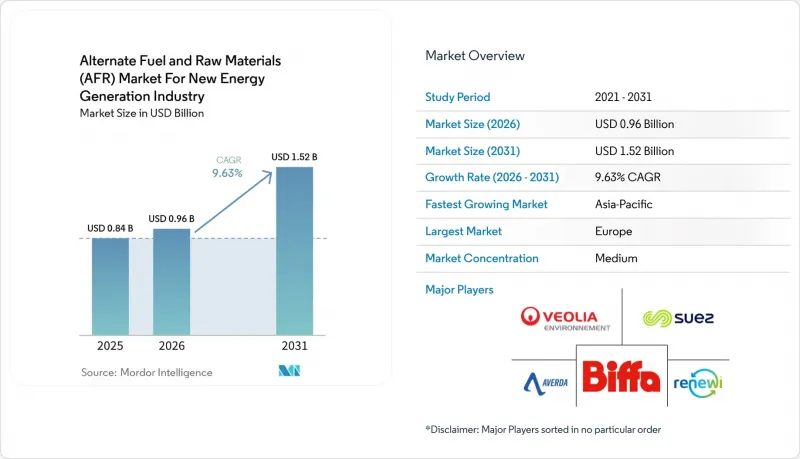
This report is Segmented by Fuel Type (RDF, SRF, Biomass, Waste Plastics, and Others), Raw Material Type (Fly Ash, Blast Furnace Slag, and Others), Application (WtE Power Plants, Biomass and Bioenergy Plants, and Others), and Geography (North America, Europe, Asia-Pacific, South America, and Middle East and Africa). The Market Forecasts are Provided in Terms of Value (USD).
Insights and Trends of Alternate Fuel and Raw Materials (AFR) Market For New Energy Generation Industry
Carbon Pricing and Industrial Decarbonization
The alternate fuel and raw materials market gains support from the cost of carbon-intensive fuel use in cement and other heavy industries. Carbon pricing and related import requirements have increased attention to the emissions cost of cement, steel, and aluminum production. The Global Cement and Concrete Association reported that waste supplied less than 10% of cement kiln energy worldwide in 2025, leaving room for broader substitution where operational conditions allow . A peer-reviewed 2026 review found that RDF substitution can reduce the global warming potential of clinker production, with the outcome depending on the substitution rate and avoided landfill effects. The planned phase-out of free emissions allowances for cement increases the operating relevance of reduced fossil fuel use. This setting supports longer fuel supply agreements for certified recovered fuels, especially where buyers must document emissions reductions across their operations.
Landfill Diversion and Circular-Economy Mandates
Landfill diversion requirements support the alternate fuel and raw materials market by directing residual waste away from disposal. The revised EU Waste Framework Directive strengthened requirements related to separate collection and food waste reduction in 2025. EU waste policy links higher recycling expectations with lower landfill use by 2035. Material that remains after appropriate sorting can become feedstock for RDF and SRF processing, although processors must maintain quality controls before the material reaches industrial users. The Clean Industrial Deal presented in February 2025 places industrial decarbonization and circularity within the EU competitiveness agenda. Better source separation can increase the supply of suitable residual material without requiring higher total waste volumes, while maintaining the priority given to recycling under waste policy.
Feedstock Quality Variability and Contamination
Feedstock variability remains a restraint on the alternate fuel and raw materials market because industrial users need predictable material properties. A 2026 study found that RDF quality results cannot be applied across feedstocks without testing each material composition. Chlorine is particularly important because higher concentrations can increase the risk of undesirable emissions during cement kiln co-processing. Storage also requires controls for fire prevention, moisture, and contamination. These requirements increase operating costs for smaller processors in the alternate fuel and raw materials market. Stronger chemical controls in Europe and the UK can further raise the specification burden for suppliers.
Other drivers and restraints analyzed in the detailed report include:
- Cement-Kiln Fuel Substitution Economics
- Expansion of Waste Sorting and Pre-Processing Infrastructure
- High Retrofit, Storage, and Permitting Costs
For complete list of drivers and restraints, kindly check the Table Of Contents.
Segment Analysis
RDF held 34.8% of the alternate fuel and raw materials market share in 2025, supported by co-processing agreements with cement manufacturers in Germany, Italy, and Poland. SRF is forecast to grow at a 10.9% CAGR through 2031, the highest rate among fuel types. Its EN ISO 21644 biomass-content certification can support procurement decisions that require auditable renewable content. The alternate fuel and raw materials market rewards SRF suppliers that can provide stable specifications and traceable material, because industrial buyers need clear evidence of fuel composition and renewable content. Higher biogenic content can help cement producers separate renewable and fossil carbon in emissions reporting.
Within the alternate fuel and raw materials market, waste plastics provide high calorific value in co-firing blends, but recycling policy can restrict their use for energy recovery. Tire-derived fuel remains important in parts of South America. Brazil used tire-derived fuel in cement kilns under Ibama monitoring in 2024. Tire-derived fuel also remains relevant to the cement sector in Mexico. Process-derived fuels and agricultural residues retain smaller roles where segregated waste collection is less developed.
Complete Report Scope:
- By Fuel Type
- Refuse-Derived Fuel (RDF)
- Solid Recovered Fuel (SRF)
- Biomass
- Waste Plastics
- Other Fuel Types
- By Raw Material Type
- Fly Ash
- Blast Furnace Slag
- Foundry Sand
- Steel Slag
- Other Raw Material Types
- By Application
- Waste-to-Energy (WtE) Power Plants
- Biomass and Bioenergy Plants
- Other Applications
- By Geography
- North America
- United States
- Canada
- Mexico
- Europe
- Germany
- France
- Italy
- Spain
- United Kingdom
- Poland
- Russia
- Rest of Europe
- Asia-Pacific
- China
- India
- Japan
- South Korea
- Australia
- Indonesia
- Vietnam
- Thailand
- Rest of Asia-Pacific
- South America
- Brazil
- Argentina
- Chile
- Rest of South America
- Middle East and Africa
- Saudi Arabia
- United Arab Emirates
- Egypt
- South Africa
- Morocco
- Rest of Middle East and Africa
- North America
Geography Analysis
The alternate fuel and raw materials market in Europe held 39.6% of the alternate fuel and raw materials market share in 2025, supported by mature sorting systems, landfill rules, and cement kiln co-processing capacity. Germany, Italy, Poland, France, and the United Kingdom accounted for much of the region's SRF and RDF demand. Poland and Germany have substantial SRF co-firing capacity as cement producers replace coal. Indaver opened the Rivenhall Integrated Waste Management Facility in Essex in June 2026, a GBP 589 million project that processes up to 595,000 tonnes of residual waste each year and produces 55 MW of electricity . EU waste and industrial policy continue to support demand for recovered fuels and materials in the region, while harmonized classifications and emissions thresholds influence how operators structure processing investments.
Asia-Pacific is forecast to grow at an 11.1% CAGR through 2031, the fastest geographic rate in the alternate fuel and raw materials market. India and China have lower cement kiln thermal substitution rates than leading European facilities. Indonesia, India, Vietnam, and Thailand are developing processing and waste-to-energy capacity. Indonesia launched more than USD 600 million in waste-to-energy investment during 2026. India has a substantial agricultural biomass resource that can support biomass-origin recovered fuels. Japan and South Korea, with 50-65% thermal substitution rates in cement kilns, provide regional reference points as policy frameworks develop and neighboring markets work to improve waste access and fuel preparation.
North America, South America, and the Middle East and Africa have different demand patterns. In North America, landfill gas conversion to renewable natural gas is an important energy-recovery route. Republic Services and Archaea Energy opened their first joint renewable natural gas facility in Fort Wayne, Indiana, in June 2026. South America continues to use tire-derived fuel within cement co-processing. South Africa, Morocco, and Saudi Arabia are emerging locations for specification-controlled alternative fuel activity.
- Averda International Limited
- Biffa Limited
- Enva Group Limited
- FCC Servicios Medio Ambiente Holding, S.A.U.
- Fomento de Construcciones y Contratas, S.A.
- Indaver NV
- PreZero International GmbH
- Ragn-Sells AB
- REMONDIS SE & Co. KG
- Renewi plc
- Republic Services, Inc.
- SARIA SE & Co. KG
- Sembcorp Industries Ltd.
- SUEZ S.A.
- Tradebe Environmental Services, LLC
- Veolia Environnement S.A.
- Viridor Limited
- Waste Management, Inc.
Additional Benefits:
- The market estimate (ME) sheet in Excel format
- 3 months of analyst support
TABLE OF CONTENTS
1 INTRODUCTION
- 1.1 Study Assumptions and Market Definition
- 1.2 Scope of the Study
2 RESEARCH METHODOLOGY
3 EXECUTIVE SUMMARY
4 MARKET LANDSCAPE
- 4.1 Market Overview
- 4.2 Market Drivers
- 4.2.1 Carbon Pricing and Industrial Decarbonization
- 4.2.2 Landfill Diversion and Circular-Economy Mandates
- 4.2.3 Cement-Kiln Fuel Substitution Economics
- 4.2.4 Expansion of Waste Sorting and Pre-Processing Infrastructure
- 4.2.5 Localized Industrial Symbiosis and Waste-to-Resource Platforms
- 4.2.6 Digital Fuel-Quality Certification and Traceability
- 4.3 Market Restraints
- 4.3.1 Feedstock Quality Variability and Contamination
- 4.3.2 High Retrofit, Storage, and Permitting Costs
- 4.3.3 Competition for Premium Waste Streams
- 4.3.4 Declining Availability of Traditional Secondary Raw Materials
- 4.4 Value Chain Analysis
- 4.5 Regulatory Landscape
- 4.6 Technological Outlook
- 4.7 Porter's Five Forces Analysis
- 4.7.1 Bargaining Power of Suppliers
- 4.7.2 Bargaining Power of Buyers
- 4.7.3 Threat of New Entrants
- 4.7.4 Threat of Substitutes
- 4.7.5 Competitive Rivalry
5 MARKET SIZE AND GROWTH FORECASTS
- 5.1 By Fuel Type
- 5.1.1 Refuse-Derived Fuel (RDF)
- 5.1.2 Solid Recovered Fuel (SRF)
- 5.1.3 Biomass
- 5.1.4 Waste Plastics
- 5.1.5 Other Fuel Types
- 5.2 By Raw Material Type
- 5.2.1 Fly Ash
- 5.2.2 Blast Furnace Slag
- 5.2.3 Foundry Sand
- 5.2.4 Steel Slag
- 5.2.5 Other Raw Material Types
- 5.3 By Application
- 5.3.1 Waste-to-Energy (WtE) Power Plants
- 5.3.2 Biomass and Bioenergy Plants
- 5.3.3 Other Applications
- 5.4 By Geography
- 5.4.1 North America
- 5.4.1.1 United States
- 5.4.1.2 Canada
- 5.4.1.3 Mexico
- 5.4.2 Europe
- 5.4.2.1 Germany
- 5.4.2.2 France
- 5.4.2.3 Italy
- 5.4.2.4 Spain
- 5.4.2.5 United Kingdom
- 5.4.2.6 Poland
- 5.4.2.7 Russia
- 5.4.2.8 Rest of Europe
- 5.4.3 Asia-Pacific
- 5.4.3.1 China
- 5.4.3.2 India
- 5.4.3.3 Japan
- 5.4.3.4 South Korea
- 5.4.3.5 Australia
- 5.4.3.6 Indonesia
- 5.4.3.7 Vietnam
- 5.4.3.8 Thailand
- 5.4.3.9 Rest of Asia-Pacific
- 5.4.4 South America
- 5.4.4.1 Brazil
- 5.4.4.2 Argentina
- 5.4.4.3 Chile
- 5.4.4.4 Rest of South America
- 5.4.5 Middle East and Africa
- 5.4.5.1 Saudi Arabia
- 5.4.5.2 United Arab Emirates
- 5.4.5.3 Egypt
- 5.4.5.4 South Africa
- 5.4.5.5 Morocco
- 5.4.5.6 Rest of Middle East and Africa
- 5.4.1 North America
6 COMPETITIVE LANDSCAPE
- 6.1 Market Concentration
- 6.2 Strategic Moves
- 6.3 Market Share Analysis
- 6.4 Company Profiles (includes Global Level Overview, Market Level Overview, Core Segments, Financials as available, Strategic Information, Market Rank/Share, Products and Services, Recent Developments)
- 6.4.1 Averda International Limited
- 6.4.2 Biffa Limited
- 6.4.3 Enva Group Limited
- 6.4.4 FCC Servicios Medio Ambiente Holding, S.A.U.
- 6.4.5 Fomento de Construcciones y Contratas, S.A.
- 6.4.6 Indaver NV
- 6.4.7 PreZero International GmbH
- 6.4.8 Ragn-Sells AB
- 6.4.9 REMONDIS SE & Co. KG
- 6.4.10 Renewi plc
- 6.4.11 Republic Services, Inc.
- 6.4.12 SARIA SE & Co. KG
- 6.4.13 Sembcorp Industries Ltd.
- 6.4.14 SUEZ S.A.
- 6.4.15 Tradebe Environmental Services, LLC
- 6.4.16 Veolia Environnement S.A.
- 6.4.17 Viridor Limited
- 6.4.18 Waste Management, Inc.
7 MARKET OPPORTUNITIES AND FUTURE OUTLOOK
- 7.1 White-Space and Unmet-Need Assessment

